Is it safe to use exercise stress testing as a single screening strategy for coronary artery disease in masters athletes?
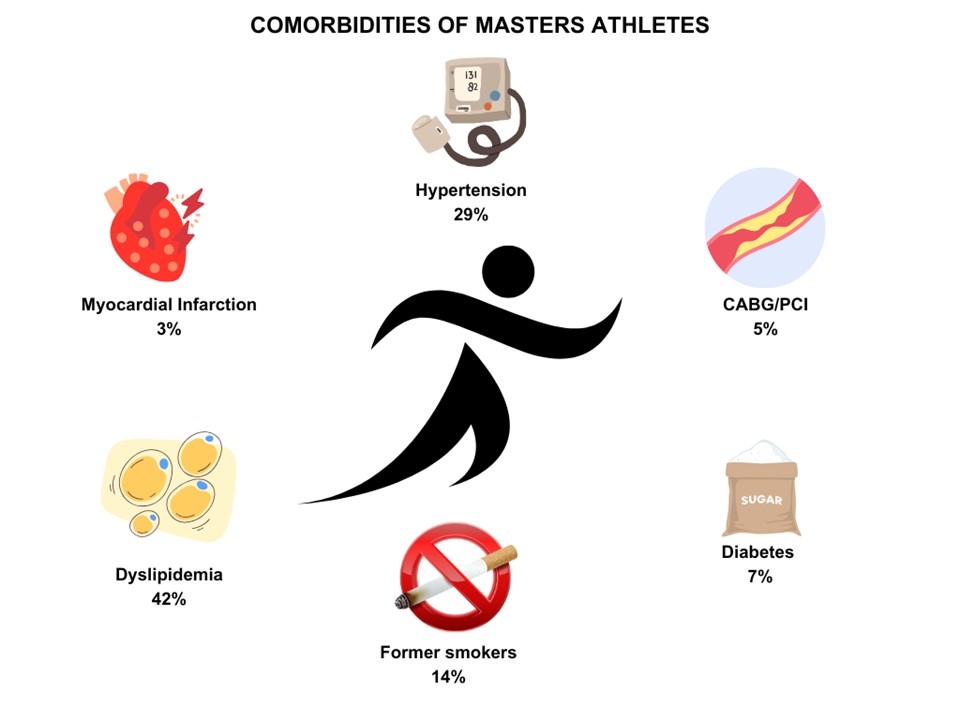
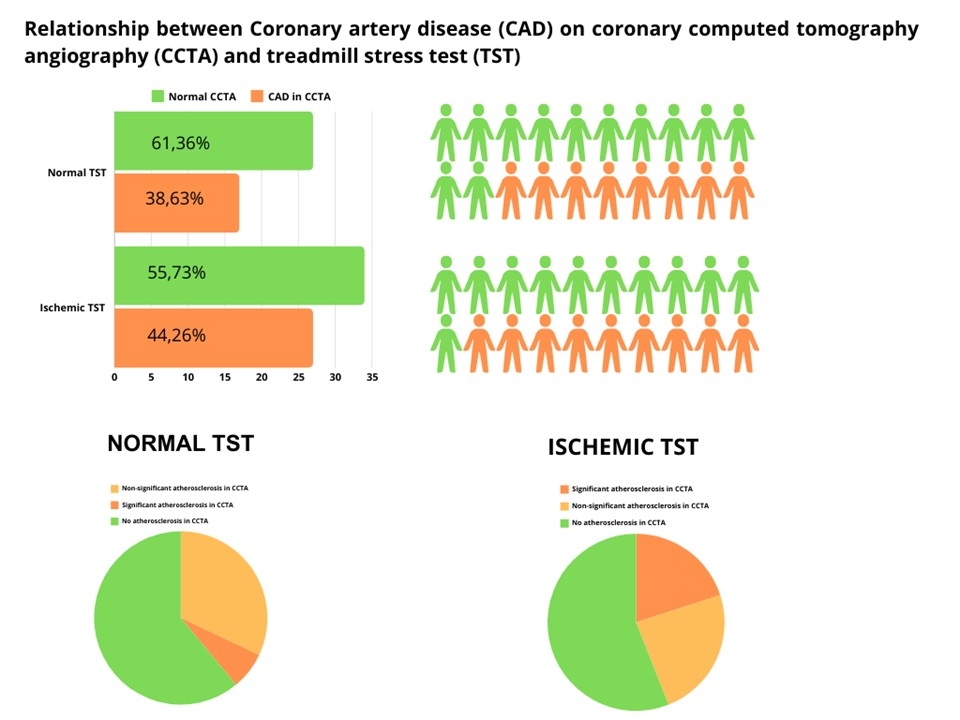
Abstract Body (Do not enter title and authors here): Background: Coronary artery disease (CAD) is responsible for approximately 610,000 deaths annually. In 2022, an estimated 315 million individuals globally had prevalent CAD (95% UI: 273–362 million). It remains the leading cause of sudden cardiac death (SCD) in athletes over 35 years of age, with symptoms preceding the event in only 12%–36% of cases. The treadmill stress test (TST) is a commonly used screening tool to detect myocardial ischemia in athletes; however, its predictive accuracy is limited. In individuals with a positive TST, only 30% present with CAD >50%. Coronary computed tomography angiography (CCTA) offers sensitivity and specificity >90% for detecting significant coronary stenoses. We present a clinical series of master athletes, comparing findings between TST and CCTA for CAD detection. Methods: This retrospective registry included 105 master athletes followed in a sports cardiology outpatient clinic at a tertiary cardiology hospital in Brazil. All participants underwent both TST and CCTA. CCTA was indicated due to: abnormal TST, Framingham risk score >10%, family history of CAD, or atypical chest pain. The predominant sports were marathon and trail running (>50%). The most prevalent cardiovascular risk factors were dyslipidemia, smoking, and hypertension. Results:Of the 105 athletes, 44 (41.9%) had normal TST and 61 (58.1%) had abnormal TST suggestive of ischemia. Among those with normal TST, 17 (38.6%) had evidence of atherosclerosis on CCTA, and 3 (7%) had significant stenosis (>50%). Among those with abnormal TST, 27 (44%) had atherosclerosis on CCTA, and 12 (20%) had significant lesions. Overall, the correlation between TST and CCTA findings was modest, with a substantial number of athletes with normal TST showing coronary plaques, and some with abnormal TST lacking significant disease on CCTA. Conclusion:This study raises concern regarding the reliability of the stress test as the sole screening method for CAD in master athletes. Consistent with prior studies, risk factors and positive TST findings showed limited discriminatory power in identifying individuals with higher atherosclerotic burden. CCTA has emerged as a valuable non-invasive tool, offering high sensitivity and specificity for CAD detection. Further research is needed to assess the prognostic implications of atherosclerotic burden observed on CCTA in this population. The Framingham score remains a useful adjunct for guiding diagnostic strategies in risk stratification.
Almeida, Kaliana
(
DANTE PAZZANESE INSTITUTE OF CARDIO
, Sao Paulo , Brazil )
Crusoe, Julia
(
Instituto Dante Pazzanese de Cardio
, Sao Paulo , Brazil )
Smaniotto, Marcos
(
DANTE PAZZANESE INSTITUTE OF CARDIO
, Sao Paulo , Brazil )
Pacheco, Gabriel
(
DANTE PAZZANESE INSTITUTE OF CARDIO
, Sao Paulo , Brazil )
Garcez, Marcelo
(
DANTE PAZZANESE INSTITUTE OF CARDIO
, Sao Paulo , Brazil )
Cavini, Yolanda
(
DANTE PAZZANESE INSTITUTE OF CARDIO
, Sao Paulo , Brazil )
Buso, Rafaela
(
DANTE PAZZANESE INSTITUTE OF CARDIO
, Sao Paulo , Brazil )
Bougleux Alo, Rodrigo
(
DANTE PAZZANESE INSTITUTE OF CARDIO
, Sao Paulo , Brazil )
Author Disclosures:
Kaliana Almeida:DO NOT have relevant financial relationships
| Julia Crusoe:DO NOT have relevant financial relationships
| MARCOS SMANIOTTO:DO NOT have relevant financial relationships
| Gabriel Pacheco:No Answer
| Marcelo Garcez:No Answer
| Yolanda Cavini:No Answer
| Rafaela Buso:DO NOT have relevant financial relationships
| Rodrigo Bougleux Alo:DO NOT have relevant financial relationships
De Alencar Jose, Almeida Kaliana, Bortoletto Mussolini Maria Carolina, Mota Diandro, Fuziy Nogueira De Marchi Mariana, Ferreira Italo Menezes, Ribeiro Ramadan Hugo
4359535_File000000.jpg
4359535_File000001.jpg
You have to be authorized to contact abstract author. Please, Login