Galectin-3 and sST2 for Early Risk Prediction in Pediatric Cardiac Failure Requiring Venoarterial Extracorporeal Membrane Oxygenation
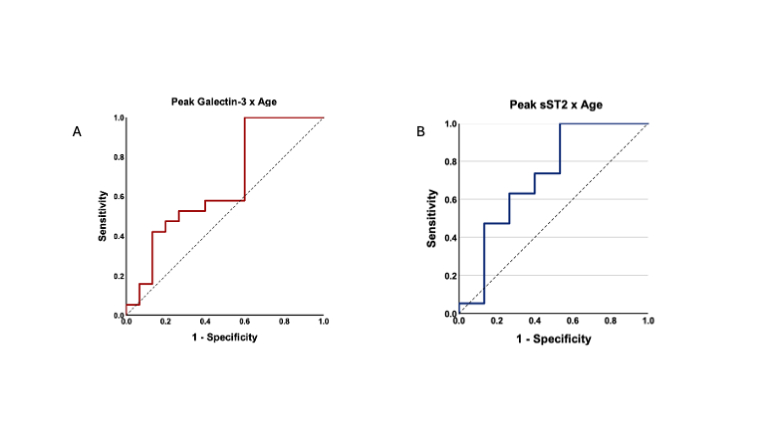
Abstract Body (Do not enter title and authors here): Background Galectin-3 and soluble suppression of tumorigenicity-2 (sST2) are biomarkers of fibrosis and inflammation, with prognostic value in adult cardiac failure both with and without mechanical circulatory support. Their utility in pediatric venoarterial extracorporeal membrane oxygenation (VA-ECMO), especially across different age, remains unclear. Research Question Can early Galectin-3 and sST2 levels, with or without age context, predict mortality in pediatric patients with cardiac failure requiring VA-ECMO? Methods We prospectively enrolled 34 pediatric patients on VA-ECMO. Plasma Galectin-3 and sST2 were measured from serial blood samples collected pre-cannulation, at 2-, 4-, and 6-hours post-cannulation, daily up to day 8, and at decannulation and the following day. Levels were quantified using ELISA. Biomarker trends were analyzed, using peak values from the first 3 days to compare outcomes between survivors (discharged) and non-survivors. Logistic regression models assessed the predictive performance of Galectin-3 and sST2 individually and in combination with age. Discrimination was evaluated using ROC curves and Youden’s Index. Results The cohort included 11 neonates (32%), 16 infants (47%), 5 children (15%), and 2 adolescents (6%). Thirteen patients (38%) were male. Diagnoses included extracorporeal cardiopulmonary resuscitation (38%), failure to wean from cardiopulmonary bypass (26%), cardiomyopathy/myocarditis (24%), and cardiac failure not otherwise specified (15%). Fifteen patients survived to discharge. The median duration of VA-ECMO support was longer in non-survivors (8 days [IQR 5–10]) compared to survivors (5 days [IQR 4–6.5]). Mean Galectin-3 levels were elevated early and declined over time but remained persistently higher in non-survivors. Mean sST2 peaked within 48 hours and declined in both groups, with a longer elevation in non-survivors. Individually, neither biomarker was predictive (AUC = 0.55 each). However, combining both with age improved discrimination (AUC = 0.73, p = 0.02). Optimal thresholds were identified: Galectin-3 ≥ 21.1 ng/mL and sST2 ≥ 1820.6 ng/mL. Conclusion Early serial sampling of Galectin-3 and sST2 revealed outcome-related temporal patterns. While neither marker alone was predictive, their combination with patient age improved prognostic model in younger patients. These findings support age-adjusted biomarker use for risk stratification in pediatric ECMO. Validation in larger cohorts is warranted.
Bi, Jianli
(
Nationwide Children's Hospital
, Columbus , Ohio , United States )
Belmont, Kevin
(
Nationwide Childrens Hospital
, Columbus , Ohio , United States )
Bigelow, Amee
(
Nationwide Childrens Hospital
, Columbus , Ohio , United States )
Carl, Jolynne
(
Nationwide Childrens Hospital
, Columbus , Ohio , United States )
Deitemyer, Matt
(
Nationwide Childrens Hospital
, Columbus , Ohio , United States )
Duffy, Vicky
(
Nationwide Childrens Hospital
, Columbus , Ohio , United States )
Nandi, Deipanjan
(
Nationwide Children's Hospital
, Columbus , Ohio , United States )
Wright, Lydia
(
Nationwide Children's Hospital
, Columbus , Ohio , United States )
Garg, Vidu
(
Nationwide Childrens Hospital
, Columbus , Ohio , United States )
Yates, Andrew
(
Nationwide Childrens Hospital
, Columbus , Ohio , United States )
Author Disclosures:
Jianli Bi:DO NOT have relevant financial relationships
| Andrew Yates:DO NOT have relevant financial relationships
| Kevin Belmont:DO NOT have relevant financial relationships
| Amee Bigelow:No Answer
| Jolynne Carl:DO NOT have relevant financial relationships
| Matt Deitemyer:DO NOT have relevant financial relationships
| Vicky Duffy:DO NOT have relevant financial relationships
| Deipanjan Nandi:DO have relevant financial relationships
;
Consultant:Lumanity:Past (completed)
; Consultant:DSMB, Capricor:Active (exists now)
| Lydia Wright:DO NOT have relevant financial relationships
| Vidu Garg:DO NOT have relevant financial relationships