Logo

American Heart Association

  112
  0


Final ID: Mo2004

Stethoscopes to Sequencers: How Next Generation Sequencing Aids Pediatric Cardiac Intensive Care Diagnosis

Abstract Body (Do not enter title and authors here): Background: Despite a high burden of rare genetic diseases among children admitted to cardiac intensive care units (CICUs), comprehensive guidelines for genetic testing in children with heart disease, particularly those that are critically ill, are lacking. Traditional testing methods, such as karyotype, chromosomal microarray (CMA) and candidate gene panels, are often employed based on suspected diagnoses. Rapid advancements in next-generation sequencing (NGS) technologies allow for more comprehensive genetic evaluation which is already recommended for patients with ventricular dysfunction, primary arrhythmias, and pulmonary hypertension (PH). Broad application of NGS in intensive care settings for pediatric heart disease has not been extensively investigated.

Aims: Evaluate diagnostic efficacy of NGS in critically ill pediatric patients with cardiac disease.

Methods: Retrospective cohort of patients who underwent exome or genome sequencing in a pediatric CICU between January 2020 and August 2023.

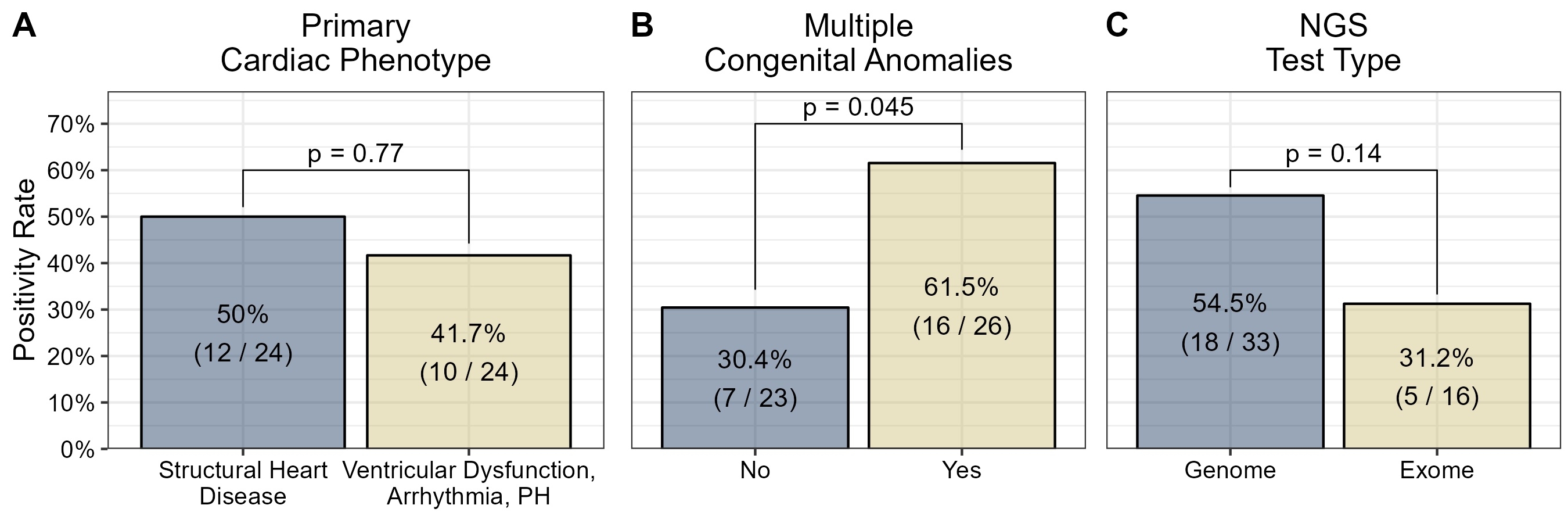
Results: Exome or genome sequencing was performed on 49 patients with median testing age of 46 days (IQR 7-609). Primary cardiac phenotypes included congenital heart disease, ventricular dysfunction, arrhythmia, and PH. Forty-two pathogenic or likely pathogenic variants were identified and 23 (46.9%) resulted in a genetic diagnosis, of those, 16 (69.6%) were associated with a cardiac phenotype. Positivity rate did not differ between primary cardiac phenotypes but was significantly higher when the patient had associated multiple congenital anomalies (Fig. 1). Genome sequencing trended towards a higher positivity rate (54.5%) than exome (31.3%), though did not meet statistical significance (Fig. 1). Notably, 84.6% and 38.5% of the identified pathogenic variants would have remained undetectable by CMA and many commercially available gene panels, respectively.

Conclusion: Exome and genome sequencing demonstrate high diagnostic yield across isolated and non-isolated cardiac disease and various cardiac phenotypes with diagnostic efficacy surpassing CMA and many commercial gene panels. As NGS technologies evolve, they promise to streamline diagnoses and enhance therapeutic decision-making for this patient population.
  • Onorato, Angela  ( Nationwide Children's Hospital , Columbus , Ohio , United States )
  • Gosselin, Rachel  ( Nationwide Children's Hospital , Columbus , Ohio , United States )
  • Chaudhari, Bimal  ( Nationwide Children's Hospital , Columbus , Ohio , United States )
  • Alvarado, Chance  ( The Ohio State University , Columbus , Ohio , United States )
  • Garg, Vidu  ( Nationwide Children's Hospital , Columbus , Ohio , United States )
  • Bigelow, Amee  ( Nationwide Children's Hospital , Columbus , Ohio , United States )
  • Author Disclosures:
    Angela Onorato: DO NOT have relevant financial relationships | Rachel Gosselin: DO NOT have relevant financial relationships | BIMAL CHAUDHARI: DO have relevant financial relationships ; Research Funding (PI or named investigator):Inozyme:Active (exists now) | Chance Alvarado: DO NOT have relevant financial relationships | Vidu Garg: DO NOT have relevant financial relationships | Amee Bigelow: No Answer
Meeting Info:

Scientific Sessions 2024

2024

Chicago, Illinois

Session Info:

Congenital Heart Disease and Adult Congenital Care

Monday, 11/18/2024 , 10:30AM - 11:30AM

Abstract Poster Session

More abstracts on this topic:
Abnormal Oxygen Pulse Trajectory Differentiates Anatomic Complexity and Functional Classification in Adults with Congenital Heart Disease

Campbell Matthew, Lefebvre Margaret, Li Pengyang, Padgett Hannah, Tchoukina Inna, Canada Justin, Shah Sangeeta, Rouse Sierra, Reyes Oscar, Shin Yongdeok, Bakken Brad, Coe Alexa, Hallam Jessica, Kapa Meghana

Atrial Fibrillation in Genotyped Dilated Cardiomyopathy: Epidemiology and Associated Risk Factors - Insights from the SHaRe Consortium

Heymans Astrid, Reza Nosheen, Helms Adam, Shore Supriya, Prasad Sanjay, Tayal Upasana, Wheeler Matthew, Fornaro Alessandra, Olivotto Iacopo, Mestroni Luisa, Wilsbacher Lisa, Balakrishnan Iswaree, Khan Sadiya, Sinagra Gianfranco, Merlo Marco, Rossano Joseph, Lin Kimberly, Ho Carolyn, Heymans Stephane, Parikh Victoria, Verdonschot Job, Lakdawala Neal, Claggett Brian, Stroeks Sophie, Stewart Garrick, Seidman Christine, Beelen Nina, Owens Anjali, Day Sharlene

More abstracts from these authors:
Galectin-3 and sST2 for Early Risk Prediction in Pediatric Cardiac Failure Requiring Venoarterial Extracorporeal Membrane Oxygenation

Bi Jianli, Yates Andrew, Belmont Kevin, Bigelow Amee, Carl Jolynne, Deitemyer Matt, Duffy Vicky, Nandi Deipanjan, Wright Lydia, Garg Vidu

Patient Perspectives of Genetic Testing in Adult Congenital Heart Disease

Onorato Angela, Vannatta Kathryn, Texter Karen, Spayde Katherine, Gosselin Rachel, Chaudhari Bimal, Kistler Isaac, Garg Vidu, Mah May Ling

You have to be authorized to contact abstract author. Please, Login
Not Available