Logo

American Heart Association

  17
  0


Final ID: MP1304

Associations Between Food Insecurity and Life’s Essential 8 Metrics Among Women of Reproductive Age in the SAFE HEART Study

Abstract Body (Do not enter title and authors here): Introduction:
Food insecurity, a critical social determinant of health, that affects many women of reproductive age, particularly those living in communities at high risk for cardiovascular disease and adverse pregnancy outcomes. While food insecurity is linked to poor cardiometabolic health, few studies have examined its impact among a diverse population of reproductive-age women using cardiovascular health metrics like Life’s Essential 8 (LE8).
Methods:
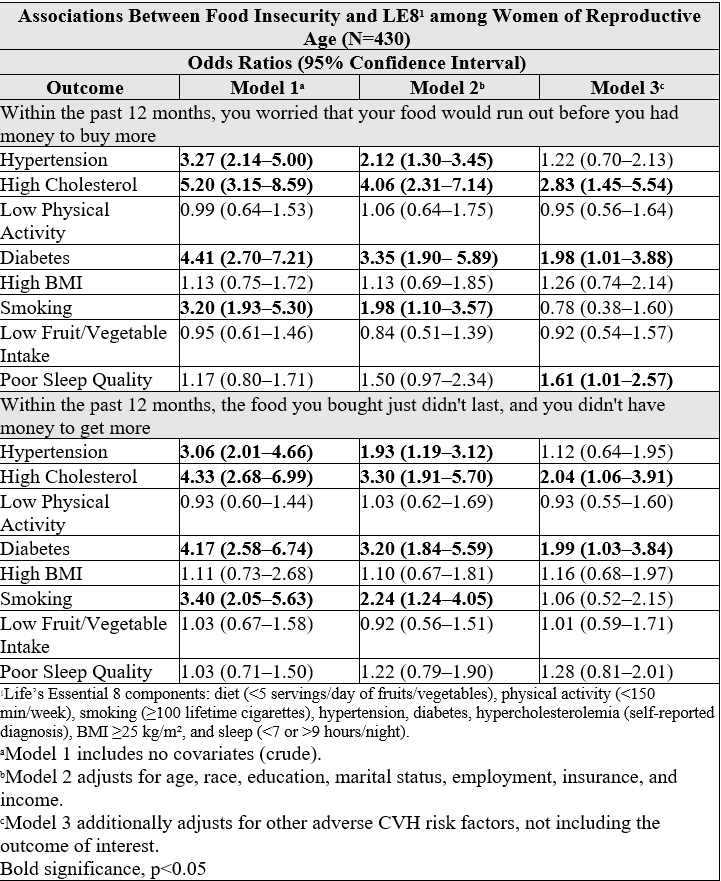
We conducted a cross-sectional analysis of women aged 18–50 enrolled in the SAFE HEART Study, which includes participants recruited through community outreach and the American Heart Association’s Research Goes Red registry. Food insecurity was assessed using a validated two-item screener. Key Cardiovascular health measures including sleep, BMI, cholesterol, blood glucose, and blood pressure. Multivariable logistic regressions estimated odds ratios (ORs) and 95% confidence intervals (CIs) for adverse LE8 outcomes associated with food insecurity across three models: unadjusted, sociodemographic-adjusted, and fully adjusted for cardiovascular risk factors.
Results:
Among 430 participants (mean age: 30.7 ± 6.8), 44.7% were Non-Hispanic Black, 28.1% Hispanic/Other, and 23.0% Non-Hispanic White. Food insecurity was significantly associated with adverse LE8 risk factors. In fully adjusted models, women who reported being worried food would run out (Question 1) had higher odds of high cholesterol (OR = 2.83; 95% CI: 1.45–5.54), diabetes (OR = 1.98; 95% CI: 1.01–3.88), and poor sleep (OR = 1.61; 95% CI: 1.01–2.57). Women who reported food did not last (Question 2) also had increased odds of high cholesterol (OR = 2.04; 95% CI: 1.06–3.91) and diabetes (OR = 1.99; 95% CI: 1.03–3.84). Other LE8 risk factors were not significantly associated with food insecurity in fully adjusted models.
Conclusion:
Food insecurity was independently associated with adverse LE8 cardiovascular health risk factors, specifically high cholesterol, diabetes, and poor sleep, among women of reproductive age. These findings highlight food insecurity as a modifiable risk factor and reinforce the importance of integrating social risk screening and intervention into CVD prevention efforts targeting diverse populations.
  • Baez Mateo, Ana  ( Johns Hopkins School of Nursing , Baltimore , Maryland , United States )
  • Hladek, Melissa  ( Johns Hopkins School of Nursing , Baltimore , Maryland , United States )
  • Sharma, Garima  ( Inova Fairfax Medical Campus , Falls Church , Virginia , United States )
  • Commodore-mensah, Yvonne  ( Johns Hopkins School of Nursing , Baltimore , Maryland , United States )
  • Metlock, Faith  ( Johns Hopkins School of Nursing , Baltimore , Maryland , United States )
  • Hernandez, Lilian  ( Johns Hopkins School of Nursing , Baltimore , Maryland , United States )
  • Ateh Stanislas, Ketum  ( Johns Hopkins School of Nursing , Baltimore , Maryland , United States )
  • Rayani, Asma  ( Johns Hopkins School of Nursing , Baltimore , Maryland , United States )
  • Dankwa, Kwabena  ( Johns Hopkins University , Baltimore , Maryland , United States )
  • Etelier, Feodora  ( Johns Hopkins University , Baltimore , Maryland , United States )
  • Ezuma, Chioma  ( Howard University , Burtonsville , Maryland , United States )
  • Vaidya, Dhananjay  ( Johns Hopkins School of Nursing , Baltimore , Maryland , United States )
  • Ouyang, Pamela  ( Johns Hopkins School of Nursing , Baltimore , Maryland , United States )
  • Author Disclosures:
    Ana Baez Mateo: DO NOT have relevant financial relationships | Melissa Hladek: DO have relevant financial relationships ; Consultant:Fresenius Medical Care:Past (completed) | Garima Sharma: DO NOT have relevant financial relationships | Yvonne Commodore-Mensah: DO NOT have relevant financial relationships | Faith Metlock: DO NOT have relevant financial relationships | Lilian Hernandez: No Answer | Ketum Ateh Stanislas: DO NOT have relevant financial relationships | Asma Rayani: DO NOT have relevant financial relationships | Kwabena Dankwa: DO NOT have relevant financial relationships | Feodora Etelier: No Answer | Chioma Ezuma: DO NOT have relevant financial relationships | Dhananjay Vaidya: DO NOT have relevant financial relationships | Pamela Ouyang: DO NOT have relevant financial relationships
Meeting Info:

Scientific Sessions 2025

2025

New Orleans, Louisiana

Session Info:
More abstracts from these authors:
Racial/Ethnic Disparities in Life’s Essential 8 Outcomes Among Women of Reproductive Age in Baltimore and Washington D.C.

Etelier Feodora, Hladek Melissa, Sharma Garima, Commodore-mensah Yvonne, Metlock Faith, Ateh Stanislas Ketum, Rayani Asma, Baez Mateo Ana, Hernandez Lilian, Dankwa Kwabena, Ezuma Chioma, Vaidya Dhananjay, Ouyang Pamela

Joint Associations Between Polysocial and Psychological Risks and Hypertension in Women of Reproductive Age: Findings from the SAFE HEART Study

Metlock Faith, Ouyang Pamela, Hladek Melissa, Sharma Garima, Commodore-mensah Yvonne, Ateh Stanislas Ketum, Rayani Asma, Baez Mateo Ana, Hernandez Lilian, Dankwa Kwabena, Etelier Feodora, Ezuma Chioma, Vaidya Dhananjay

You have to be authorized to contact abstract author. Please, Login
Not Available