Repeated Exposure to Tobacco Smoke/Aerosol Reduces Myocardial Tissue Preservation after Subsequent Acute Myocardial Infarction in Rats
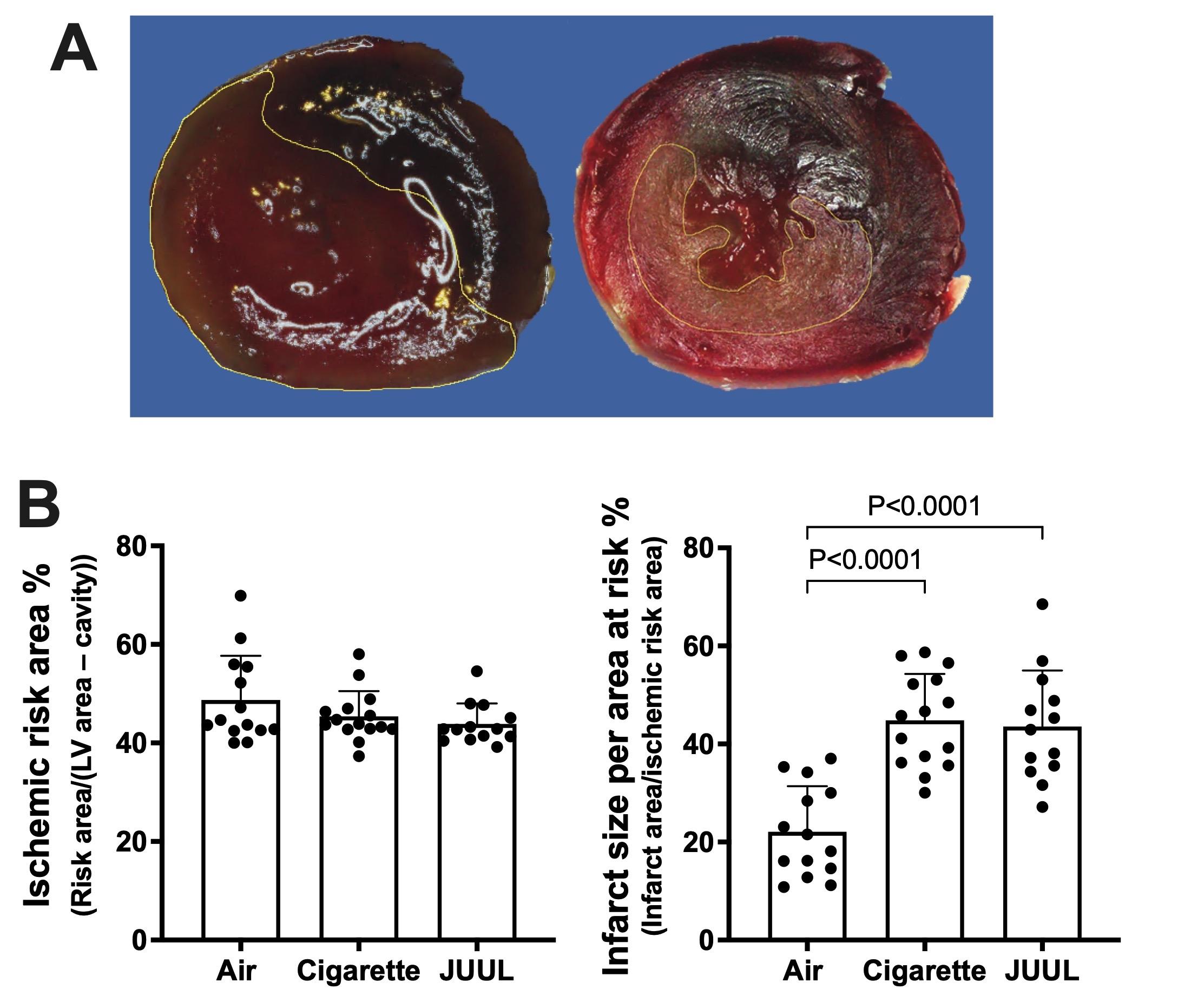
Abstract Body (Do not enter title and authors here): Background: Tobacco products, including combustible cigarettes and e-cigarettes (e-cigs), cause a range of adverse cardiovascular effects, involving an increased incidence of myocardial infarction (MI). Smoking induces chronic inflammation that weakens the arterial wall, making arteries more prone to form plaque and reduce blood flow/oxygen supply to the heart. It remains unknown whether cigarette smoke or e-cig aerosol can exacerbate myocardial damage after subsequent acute MI. We hypothesized that repeated exposure to tobacco smoke/aerosol reduces post-MI myocardial tissue survival in rats. Methods: We exposed conscious Sprague-Dawley rats (n=16/group, 8M+8F, age 10-11 weeks) once daily for 28 days to smoke from Marlboro Red cigarettes or aerosol from Virginia Tobacco flavor JUUL e-cigs or clean air, using a Gram Universal Vaping Machine. Exposure was pulsatile (10 cycles each consisting of 5 sec exposure + 25 sec air, 2x/min for 5 min via nosecone), similar to the exposure conditions in our previous studies in rodent smoking and vaping models. One day after the last exposure, rats were anesthetized and subjected to surgical MI consisting of temporary occlusion (25 min) of the left anterior descending coronary artery (LAD), followed by reperfusion (40 min). After reperfusion, the LAD was reoccluded and Evans blue was injected into left ventricular (LV) cavity via the apex and allowed to perfuse the nonischemic region of the heart. The heart was excised, and LV tissue was frozen, sliced, and photographed. The tissue slices were stained with 2,3,5-triphenyltetrazolium chloride (TTC) and fixed in formalin for imaging. The ischemic area was defined as regions unstained by Evans blue dye and infarct area was defined as regions unstained by TTC (pale area); see Figure A. Group means were analyzed by one-way ANOVA with Tukey’s post-hoc test; p≤.05 was considered significant. Results: There were no significant differences in the ischemic risk area among groups, as expected because the ischemic risk area was determined by the surgery (48.7±9% for air, 45.4±5% for cigarette, and 43.9±4% for JUUL). However, the infarct per area at risk was significantly larger in the cigarette and JUUL groups than in the clean air group (22.1±9% for air, 44.8±9% for cigarette, and 43.6±11% for JUUL) (Figure B). Conclusion: One month of daily single sessions of exposure to cigarette smoke or e-cig aerosol reduces subsequent post-MI myocardial tissue preservation.
Punnati, Chaitanya
(
UCSF
, San Francisco , California , United States )
Wang, Xiaoyin
(
UCSF
, San Francisco , California , United States )
Goyal, Natasha
(
UCSF
, San Francisco , California , United States )
Parangan, Alyssa
(
UCSF
, San Francisco , California , United States )
Mukunda, Jayita
(
UCSF
, San Francisco , California , United States )
Tabibiazar, Parmis
(
UCSF
, San Francisco , California , United States )
Tran, Lam
(
UCSF
, San Francisco , California , United States )
Derakhshandeh, Ronak
(
UCSF
, San Francisco , California , United States )
Springer, Matthew
(
UCSF
, San Francisco , California , United States )
Author Disclosures:
Chaitanya Punnati:DO NOT have relevant financial relationships
| Xiaoyin Wang:DO NOT have relevant financial relationships
| Natasha Goyal:No Answer
| Alyssa Parangan:No Answer
| Jayita Mukunda:DO NOT have relevant financial relationships
| Parmis Tabibiazar:No Answer
| Lam Tran:No Answer
| Ronak Derakhshandeh:No Answer
| Matthew Springer:No Answer