Trends in Mortality Due to Heart Failure and Gastrointestinal Hemorrhage in the United States: A Retrospective Analysis of CDC WONDER Database
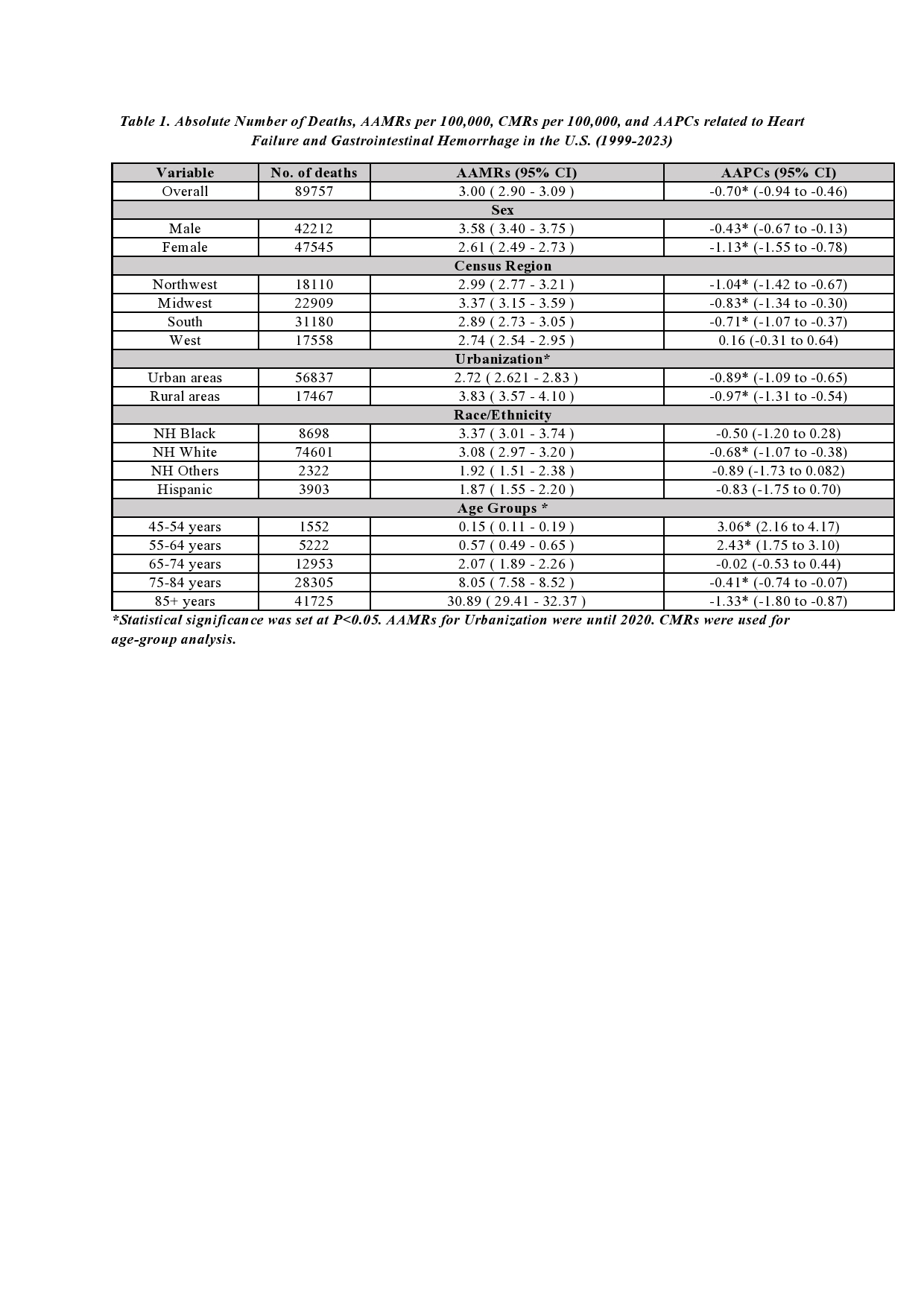
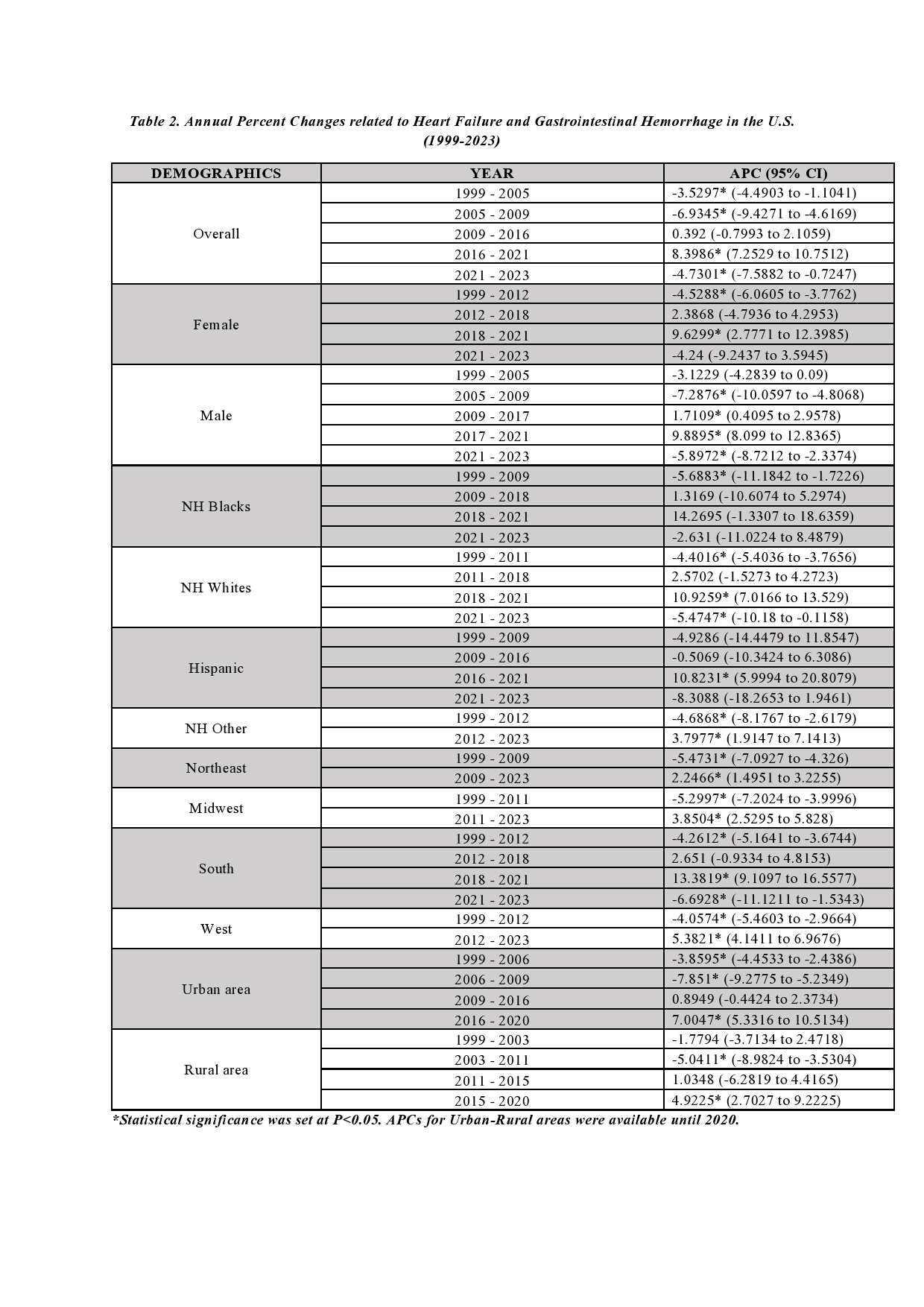
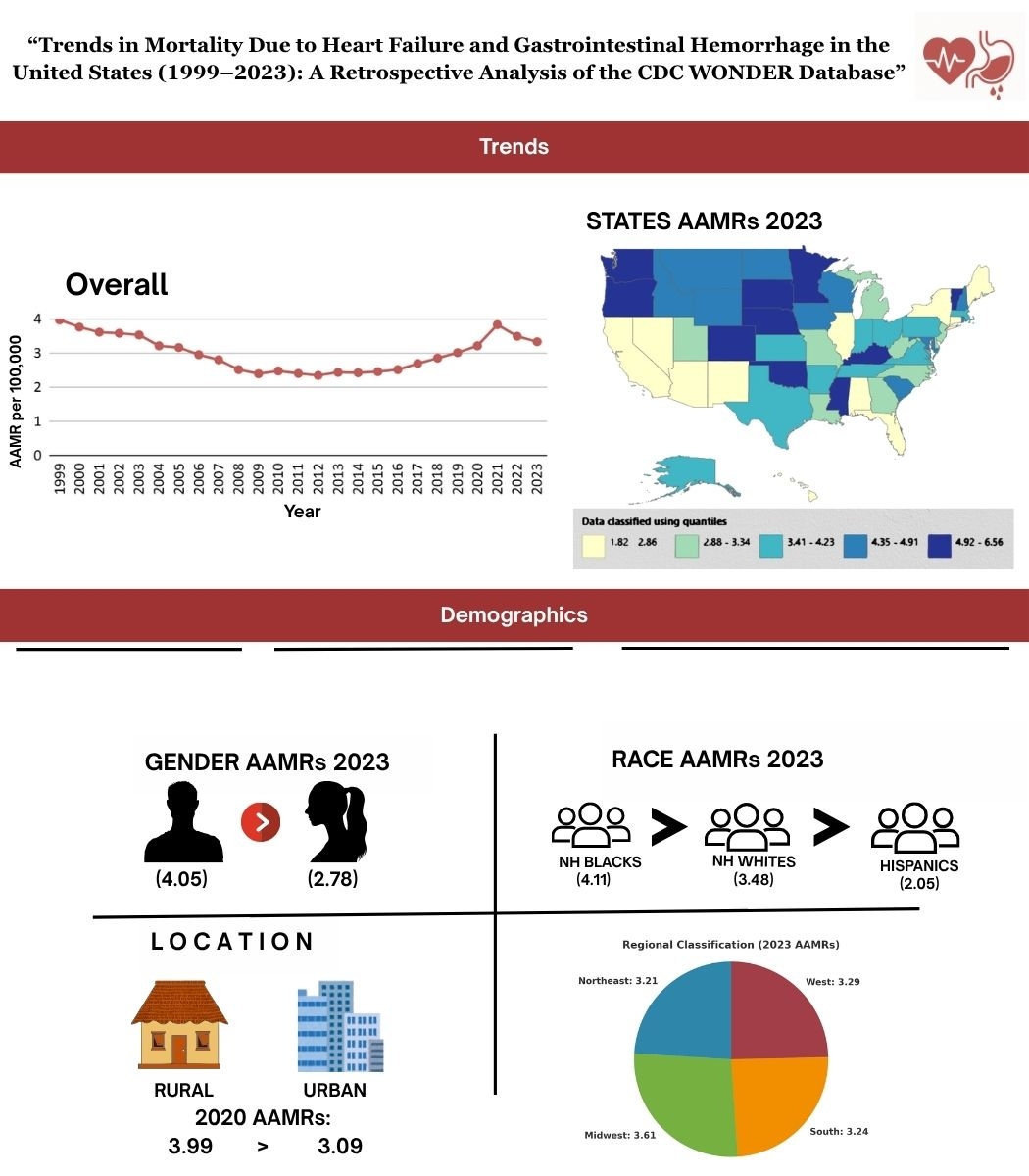
Abstract Body (Do not enter title and authors here): Introduction: Weakening of cardiac function in Heart Failure is clinically associated with Gastrointestinal Hemorrhage. This study investigates mortality trends to identify disparities and identify targeted interventions. Methods: Using CDC WONDER death certificate data (1999–2023) for adults aged ≥45 years with Heart Failure (ICD-10: I-50) and Gastrointestinal Hemorrhage (K92.2), we calculated Age-adjusted mortality rates (AAMRs) and Crude Mortality Rates (CMRs) per 100,000 population, stratified by age, sex, race, region, urban-rural classification, state, and place of death. Annual percent changes (APCs) were estimated via Joinpoint regression, with 95% confidence intervals (CIs); statistical significance (*) was set at P<0.05. Results: From 1999 to 2023, 89,757 deaths were attributed to HF with GIH, with 52,698 occurring at the medical facilities. AAMRs declined from 1999–2012, notably for men (2005–2009: APC -7.29* [95% CIs: -10.06, -4.81]), NH Black population (1999–2009: -5.69* [-11.18, -1.72]), the Northeast region (1999–2009: -5.47* [-7.09, -4.33]), and Urban areas (2006–2009: -7.85* [-9.28, -5.23]). Increases in AAMRs occurred from 2016-2021, particularly for men (2017–2021: 9.89* [8.10, 12.84]), NH White population (2018–2021: 10.93* [7.02, 13.53]), the South region (2018–2021: 13.38* [9.11, 16.56]), and Urban areas (2016–2020: 7.00* [5.33, 10.51]). Individuals aged ≥85 experienced the highest CMRs in 2023 (30.75; 29.37-32.13). Conclusion: HF and GIH mortality decreased until 2012 but increased through 2021, with Men, NH blacks, and the Northeast Region facing significantly higher mortalities, which highlights the need for enhanced screening and treatment access. Future research should explore the risk factors of increased mortality to address these disparities effectively.
Danishwar, Mahmood
(
Reading Hospital
, Reading , Pennsylvania , United States )
Noor, Huzaifa
(
Nishtar Medical University
, Multan , Punjab , Pakistan )
Asghar, Tehreem
(
Akhtar Saeed Medical College
, Lahore , Punjab , Pakistan )
Mubarika, Moosa
(
Nishtar Medical University
, Multan , Punjab , Pakistan )
Kumar, Dinesh
(
Dow University of Health Sciences
, Karachi , Sindh , Pakistan )
Zulfiqar, Eeshal
(
Dow University of Health Sciences
, Karachi , Sindh , Pakistan )
Rizvi, Syeda
(
Dow University of Health Sciences
, Karachi , Sindh , Pakistan )
Author Disclosures:
Mahmood Danishwar:DO NOT have relevant financial relationships
| Huzaifa Noor:DO NOT have relevant financial relationships
| Tehreem Asghar:DO NOT have relevant financial relationships
| Moosa Mubarika:DO NOT have relevant financial relationships
| Dinesh Kumar:DO NOT have relevant financial relationships
| Eeshal Zulfiqar:DO NOT have relevant financial relationships
| Syeda Rizvi:DO NOT have relevant financial relationships
Ali Manzer, Umar Haddaya, Nazir Tahira, Nizam Muhammad, Steafo Lark, Sharif Ayesha, Jehangir Hanzala, Arham Muhammad, Hamza Anfal, Hassan Arbaz, Amjad Ans, Ali Iman, Zuha Zuha
Mubarika Moosa, Aamir Muhammad, Noor Huzaifa, Zia Ul Haq Muhammad, Raza Muhammad Hassan, Safdar Ali Haseeb, Khawar Muneeb, Asghar Kanwal, Komel Aqsa, Asim Rabia
4359184_File000000.jpg
4359184_File000001.jpg
4359184_File000002.jpg
You have to be authorized to contact abstract author. Please, Login