
Cancer Patients With Incidental Coronary Artery Calcification Receive Less Preventive Cardiovascular Care: A Propensity-Matched Cohort Study
Abstract Body (Do not enter title and authors here): Introduction Incidental coronary artery calcification (CAC) frequently appears on routine chest CT scans and indicates high risk for future atherosclerotic cardiovascular events, presenting an opportunity for prevention. In patients with active or recent cancer diagnosis, such incidental findings may be overlooked or inadequately managed. Evaluating how the incidental CAC finding influences clinical management could provide critical insight into integrative cardiovascular care in oncology populations. We aimed to evaluate whether cancer patients with incidental CAC receive comparable cardiovascular preventive interventions as non-cancer counterparts.
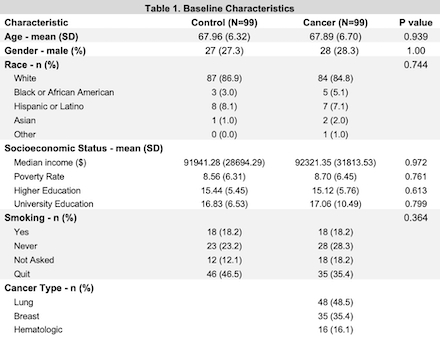
Methods We conducted a retrospective cohort study of patients aged 18-75 years at UCONN Health who had incidental CAC identified on routine non-gated chest CT between January 1, 2020, and December 31, 2023. Patients were stratified into two groups: those with an active or recent cancer diagnosis (n=99) and those without cancer (n=698). After 1:1 propensity score matching on demographic and baseline comorbidities, 99 matched pairs were analyzed. Patients with known pre-existing cardiovascular disease or prior coronary interventions were excluded. Socioeconomic factors were estimated based on ZIP code. Primary outcomes included initiation of statin or aspirin therapy, cardiology referral, stress testing within one year, and all-cause mortality. Group differences were assessed using chi-square tests.
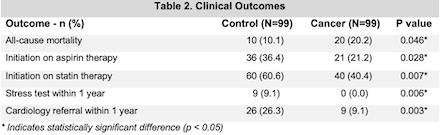
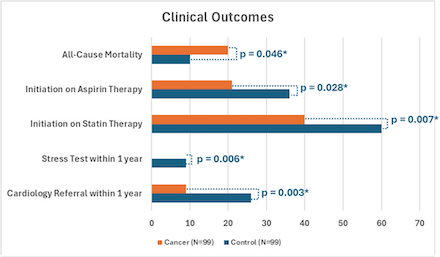
Results After matching, cancer patients had significantly higher all-cause mortality compared to non-cancer controls (20.2% vs. 10.1%, p=0.046). Cardiovascular preventive interventions were significantly less common in cancer patients: statin initiation (40.4% vs. 60.6%, p=0.007), aspirin initiation (21.2% vs. 36.4%, p=0.028), stress testing within one year (0% vs. 9.1%, p=0.006), and cardiology referral within one year (9.1% vs. 26.3%, p=0.003).
Conclusions In this matched cohort study, cancer patients with incidental CAC were significantly less likely to receive preventative cardiovascular interventions and had higher all-cause mortality compared to non-cancer controls. These findings highlight a missed opportunity for cardio-preventive care in oncology populations and support routine integration of cardio-oncology pathways to address incidental CAC in cancer patients.
Habeel, Samer
(
University of Connecticut
, Farmington , Connecticut , United States )
Albeyoumi Mohammed, Hossam
(
University of Connecticut
, Farmington , Connecticut , United States )
Pike, Donna C.
(
University of Connecticut
, Farmington , Connecticut , United States )
Kim, Min Jung
(
University of Connecticut
, Farmington , Connecticut , United States )
Callahan, Margaret
(
University of Connecticut
, Farmington , Connecticut , United States )
Kim, Agnes
(
University of Connecticut
, Farmington , Connecticut , United States )
Author Disclosures:
Samer Habeel:DO NOT have relevant financial relationships
| Hossam Albeyoumi Mohammed:DO NOT have relevant financial relationships
| Donna C. Pike:No Answer
| Minjung Kim:DO NOT have relevant financial relationships
| Margaret Callahan:No Answer
| Agnes Kim:No Answer