Targeting Liver Epsins Ameliorates Dyslipidemia in Atherosclerosis through Inhibition of Proprotein Convertase Subtilisin/Kexin Type 9-Mediated Low-density Lipoprotein Receptor Degradation
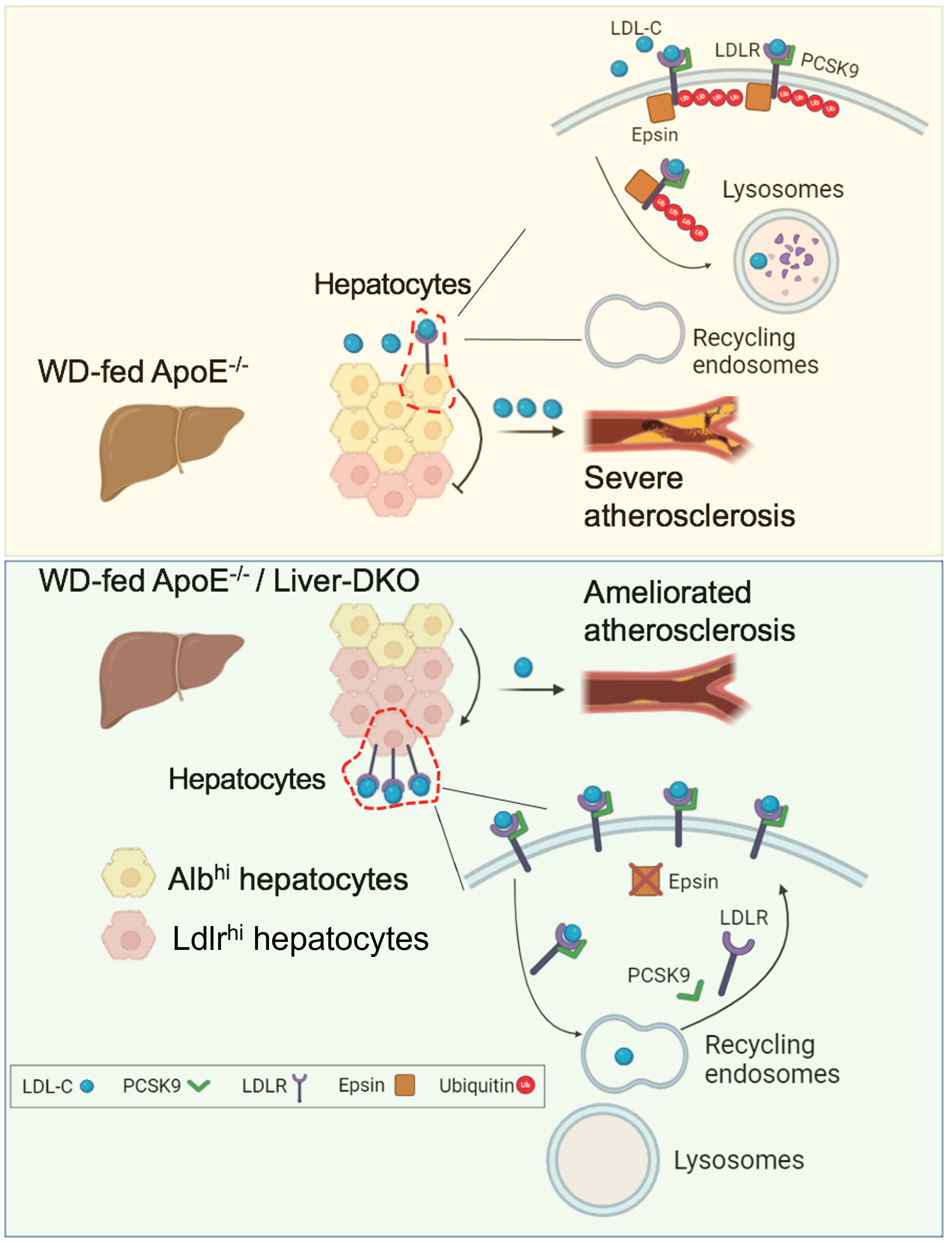
Abstract Body (Do not enter title and authors here): Background: The low-density lipoprotein receptor (LDLR) in the liver plays a crucial role in clearing low-density lipoprotein cholesterol (LDL-C) from the bloodstream. Under atherogenic conditions, Proprotein Convertase Subtilisin/Kexin Type 9 (PCSK9), secreted by the liver, binds to LDLR on hepatocytes, preventing its recycling and enhancing its lysosomal degradation. Epsins, a family of ubiquitin-binding endocytic adaptors, are key regulators of atherogenesis. We aimed to determine whether and how liver epsins contribute to PCSK9-mediated LDLR endocytosis and degradation, thereby impairing LDL-C clearance and accelerating atherosclerosis. Methods: We utilized single-cell RNA sequencing (scRNA-seq), along with molecular, cellular, and biochemical analyses, to investigate the role of liver epsins in PCSK9-mediated LDLR degradation. Liver-specific epsin knockout (Liver-DKO) atherosclerotic models were generated in ApoE-/- and PCSK9-AAV8-induced atheroprone mice fed on a Western diet. Additionally, we explored the therapeutic potential of nanoparticle-encapsulated siRNAs targeting epsins 1 and 2 in ApoE-/- mice with established atherosclerosis. Results: Western diet (WD)-induced atherosclerosis was significantly attenuated in ApoE-/- /Liver-DKO mice compared with ApoE-/- controls, as well as in PCSK9-AAV8-induced Liver-DKO mice compared with PCSK9-AAV8-induced wild-type (WT) mice accompanied by reductions in blood cholesterol and triglyceride levels. Mechanistically, hepatocyte-derived scRNA-seq data analysis revealed increased pathways of LDL particle clearance in WD-fed ApoE-/- /Liver-DKO mice compared with WD-fed ApoE-/- controls, correlating with decreased plasma LDL-C levels. The absence of liver epsins led to an upregulation of LDLR protein expression in hepatocytes. We further demonstrated that epsins bind LDLR via the ubiquitin-interacting motif (UIM), enabling PCSK9-mediated LDLR degradation. Depleting epsins abolished this degradation, thereby preventing atheroma progression. Lastly, targeting liver epsins with nanoparticle-encapsulated epsins siRNAs effectively ameliorates dyslipidemia and inhibits atherosclerosis progression. Conclusions: Liver epsins drive atherogenesis by promoting PCSK9-mediated LDLR degradation, elevating circulating LDL-C levels and heightening lesional inflammation. Targeting epsins in the liver represents a promising therapeutic strategy to mitigate atherosclerosis by preserving LDLR and enhancing LDL-C clearance in the liver.
Zhu, Bo
( Boston Children's Hospital, Harvard Medical School
, Boston
, Massachusetts
, United States
)
Gupta, Krishan
( Boston Children's Hospital, Harvard Medical School
, Boston
, Massachusetts
, United States
)
Cui, Kui
( Boston Children's Hospital, Harvard Medical School
, Boston
, Massachusetts
, United States
)
Wang, Beibei
( Boston Children's Hospital, Harvard Medical School
, Boston
, Massachusetts
, United States
)
Singh, Bandana
( Boston Children's Hospital, Harvard Medical School
, Boston
, Massachusetts
, United States
)
Gao, Jianing
( Boston Children's Hospital, Harvard Medical School
, Boston
, Massachusetts
, United States
)
Linton, Macrae
( Vanderbilt University Medical Center
, Nashville
, Tennessee
, United States
)
Chen, Kaifu
( Boston Children's Hospital, Harvard Medical School
, Boston
, Massachusetts
, United States
)
Chen, Hong
( Boston Children's Hospital, Harvard Medical School
, Boston
, Massachusetts
, United States
)
Author Disclosures:
Bo Zhu:DO NOT have relevant financial relationships
| Krishan Gupta:DO NOT have relevant financial relationships
| Kui Cui:No Answer
| Beibei Wang:No Answer
| Bandana Singh:DO NOT have relevant financial relationships
| Jianing Gao:DO NOT have relevant financial relationships
| Macrae Linton:DO have relevant financial relationships
;
Research Funding (PI or named investigator):Novartis:Active (exists now)
; Research Funding (PI or named investigator):REGENXBIO:Past (completed)
; Consultant:Alexion Pharmaceuticals:Past (completed)
; Consultant:Esperion:Past (completed)
; Research Funding (PI or named investigator):Amgen:Past (completed)
; Research Funding (PI or named investigator):Sanofi:Past (completed)
; Research Funding (PI or named investigator):Regeneron:Past (completed)
; Research Funding (PI or named investigator):IONIS:Past (completed)
; Research Funding (PI or named investigator):NHLBI:Active (exists now)
| Kaifu Chen:No Answer
| Hong Chen:DO NOT have relevant financial relationships