Patient-specific iPSC-derived Cardiomyocytes Reveal Variable Phenotypic Severity in a KCNH2 p.Y427H Parent-Proband Trio
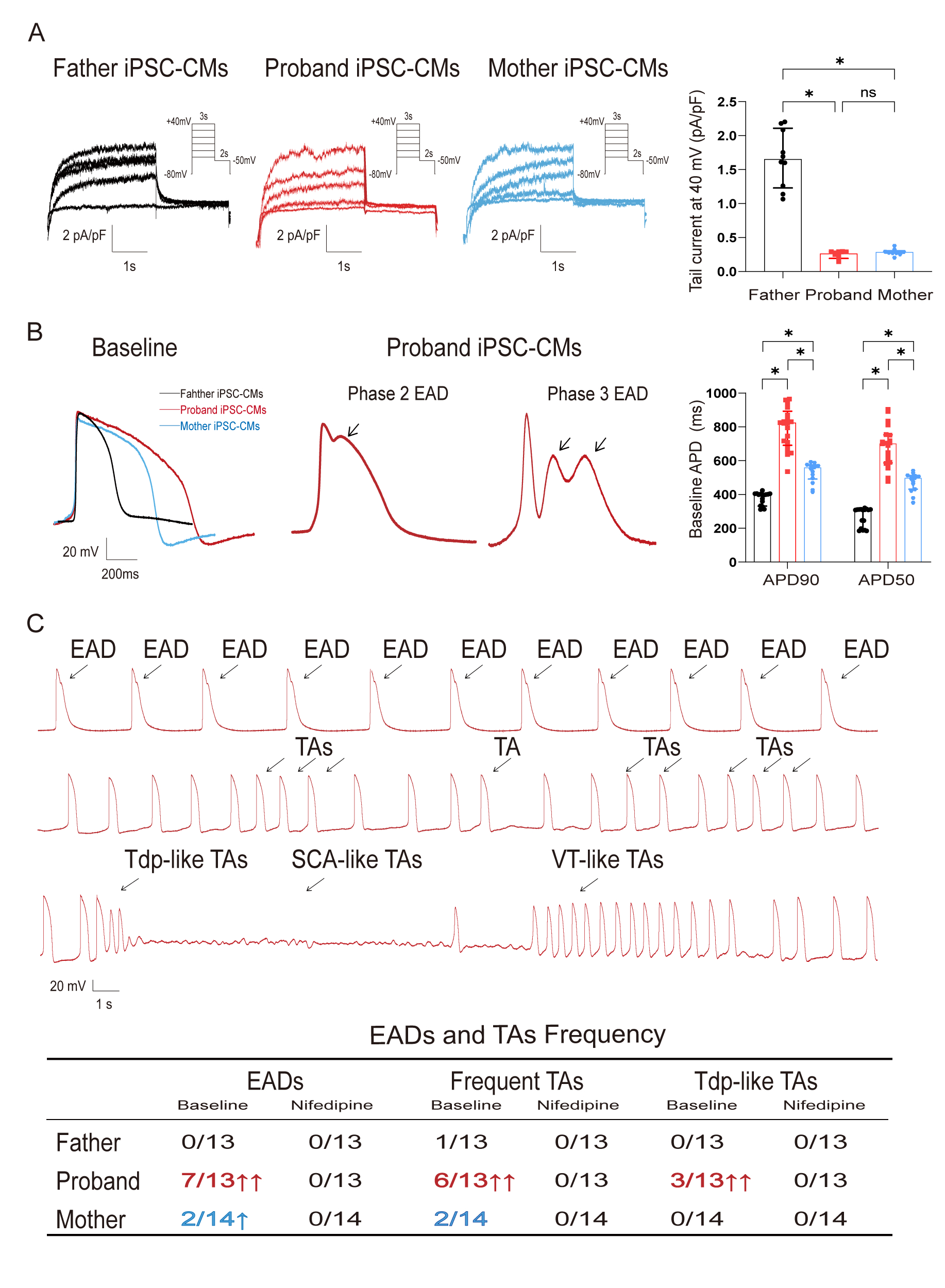
Abstract Body (Do not enter title and authors here): Background: Type 2 Long QT Syndrome (LQT2), caused by KCNH2 mutations, is associated with an increased risk of sudden cardiac death (SCD). Clinical severity varies considerably among carriers. We investigated a family harboring the KCNH2 p.Y427H variant, comprising a symptomatic proband (nine cardiac events), an asymptomatic carrier mother, and a mutation-negative father. Hypothesis: We hypothesized that patient-specific induced pluripotent stem cell-derived cardiomyocytes (iPSC-CMs) can recapitulate the observed clinical phenotype discordance in vitro. Methods: Whole-exome sequencing identified the variant. Peripheral blood mononuclear cells (PBMCs) from all three individuals were reprogrammed into iPSCs and differentiated into cardiomyocytes. Electrophysiological assessment included patch-clamp recordings of IKr and ICa,L, measurements of action potential duration APD90 and APD50 under pacing, and evaluation of early afterdepolarizations (EADs) and triggered activities (TAs) under spontaneous conditions. Nifedipine, an L-type calcium channel blocker, was used to evaluate arrhythmia suppression. Results: IKr was markedly reduced in the proband-derived iPSC-CMs (0.26 [0.19–0.29] pA/pF) and mother-derived iPSC-CMs (0.29 [0.27–0.30]) compared to the father-derived iPSC-CMs (1.65 [1.23–2.11], P = 0.001). APD90 was significantly prolonged in the proband-derived iPSC-CMs (824 [691–893] ms) versus the mother-derived iPSC-CMs (559 [491–574] ms, P = 0.010) and father-derived iPSC-CMs (397 [331–403] ms,P < 0.001). Proband-derived iPSC-CMs exhibited a higher incidence of spontaneous EADs and TAs. Notably, ICa,L was upregulated in the proband-derived iPSC-CMs (–18.4 [–19.6 to –13.0] pA/pF) compared to the mother-derived iPSC-CMs (–7.23 [–9.5 to –5.9], P = 0.002) and father-derived iPSC-CMs (–7.49 [–8.66 to –5.91], P = 0.001). Nifedipine significantly suppressed EADs and TAs in the proband-derived iPSC-CMs. Conclusion: The KCNH2 p.Y427H variant induces IKr loss-of-function. Divergent calcium current responses among family members may reflect a compensatory mechanism modulating phenotypic severity. Patient-specific iPSC-CMs reproduce this variability, providing a platform for mechanistic insights, personalized risk assessment, and therapy in LQT2.
Li, Qing
(
Tsinghua University
, Beijing , China )
Wang, Yifei
(
Tsinghua University
, Beijing , China )