Pulmonary Hypertension Associated with Rheumatic Heart Disease Presents a Major Unmet Disease Burden in Sub-Saharan Africa
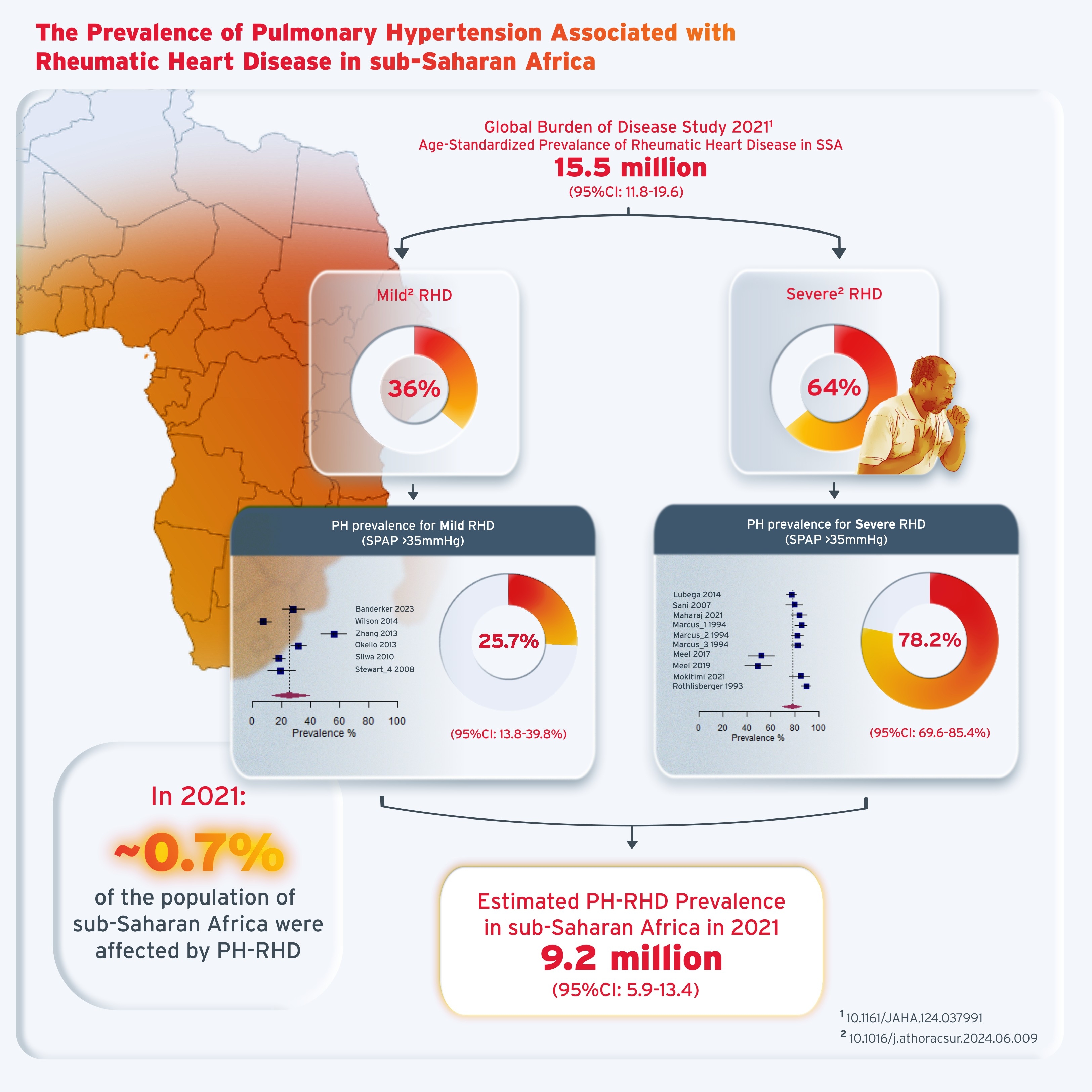
Abstract Body (Do not enter title and authors here): Background: In rheumatic heart disease (RHD), post-streptococcal rheumatic fever causes valvular heart destruction leading to pulmonary hypertension (PH), a prognostic and potentially modifiable cause of adverse outcomes. Indeed, RHD is a major contributor to global disease burden with most patients living in low-middle income countries, such as sub-Saharan Africa (SSA). The prevalence of PH-RHD in SSA is unknown, but its determination is a key step toward population health initiatives to mitigate RHD burden and improve clinical care. Methods: We conducted a systematic literature search following PRISMA and GATHER guidelines searching PubMed, Embase, Web of Science, and LILACS for studies published until 09/2023 on patients in SSA with RHD, diagnosed based on WHO criteria, who underwent echocardiography or right heart catheterization. We excluded studies without a clear PH definition and performed a meta-analysis using a random-effects model of proportions. Risk of bias was assessed for all studies. We then extrapolated results to the total RHD population in SSA, while accounting for RHD severity. Results: In total, we included N=18 studies compromising N=3,181 patients (mean age, 32±14 years; male, 17±12%) of which 72%, 11%, and 17% originated from high-middle, lower-middle and low-income countries, respectively. The majority of studies had a retrospective (61%) and single-centre design (83%). In n=16 studies (89%), echocardiography was used to diagnose PH. The estimated PH prevalence based on estimated systolic pulmonary arterial pressure (sPAP) >35mmHg was 58.9% (95%CI: 43.3–73.7% from n=16 studies), which was three-fold greater in severe vs. mild RHD (78.2% [95%CI: 69.6–85.4%], n=10 studies vs. 25.7% [95%CI: 13.8–39.8%], n=6 studies; p<0.001). Based on data from the Global Burden of Disease Study, RHD affected 15.5 (95%CI: 11.8–19.6) million people in SSA in 2021. Using this is a referent and weighting our calculations by the proportion of those who have severe vs. mild RHD, we extrapolated that 9.2 (95%CI: 6.5–11.9) million people are affected by PH-RHD, corresponding to ~0.7% of the SSA population in 2021 (Figure 1). Conclusion: PH is common in RHD, and PH-RHD prevalence exceeds disorders of seemingly greater notoriety, such as ischemic or congenital heart disease. Public health measures aimed at reducing PH-RHD risk through primary prevention of RHD are expected to improve longevity in this large and highly vulnerable at-risk population.
Zeder, Katarina
(
University of Maryland
, North Bethesda , Maryland , United States )
Wang, Lanjing
(
George Washington University
, Washington , District of Columbia , United States )
Santi, Armella
(
University of Maryland
, North Bethesda , Maryland , United States )
Ngah, Veranyuy
(
Stellenbosch University
, Cape Town , South Africa )
Robbins, Eric
(
University of Maryland School of Medicine
, Baltimore , Maryland , United States )
Diao, Guoqing
(
George Washington University
, Washington , District of Columbia , United States )
Maron, Brad
(
University of Maryland
, North Bethesda , Maryland , United States )
Author Disclosures:
Katarina Zeder:DO NOT have relevant financial relationships
| Lanjing Wang:DO NOT have relevant financial relationships
| Armella Santi:No Answer
| Veranyuy Ngah:No Answer
| Eric Robbins:DO NOT have relevant financial relationships
| Guoqing Diao:DO NOT have relevant financial relationships
| Brad Maron:DO NOT have relevant financial relationships