
Logo

American Heart Association

  18
  0


Final ID: Su4021

Mitochondrial dynamics modulators promoted favorable patterns of cardiac metabolic reprogramming in doxorubicin-induced heart failure

Abstract Body (Do not enter title and authors here): Background: Doxorubicin is an effective chemotherapeutic agent for various types of cancer. Unfortunately, the clinical utilization of doxorubicin is limited due to doxorubicin-induced heart failure. The pathophysiology of heart failure is strongly correlated with cardiac mitochondrial dysfunctions and cardiac metabolic reprogramming. In fact, these two parameters reciprocally link to the development of heart failure. A previous study showed that mitochondrial dynamics modulators could improve cardiac mitochondrial functions and attenuate doxorubicin-induced heart failure. However, the effect of mitochondrial dynamics modulators on cardiac metabolic reprogramming has never been determined.
Hypothesis: We hypothesized that improving mitochondrial functions by mitochondrial dynamics modulators could promote favorable patterns of cardiac metabolic reprogramming, leading to the alleviation of doxorubicin-induced heart failure.
Aims: We investigated the effects of a mitochondrial fission inhibitor (MDiVi1) and a mitochondrial fusion promoter (M1) on cardiac metabolic reprogramming in rats treated with doxorubicin.
Methods: Male Wistar rats received either 1) vehicle, 2) 6 doses of 3 mg/kg of doxorubicin and vehicle, 3) 6 doses of 3 mg/kg of doxorubicin and 1.2 mg/kg/day of MDiVi1, or 4) 6 doses of 3 mg/kg of doxorubicin and 2 mg/kg/day of M1 for 30 days. Then, the rats were euthanized to collect cardiac tissues for mass spectrometry-based metabolomics studies.
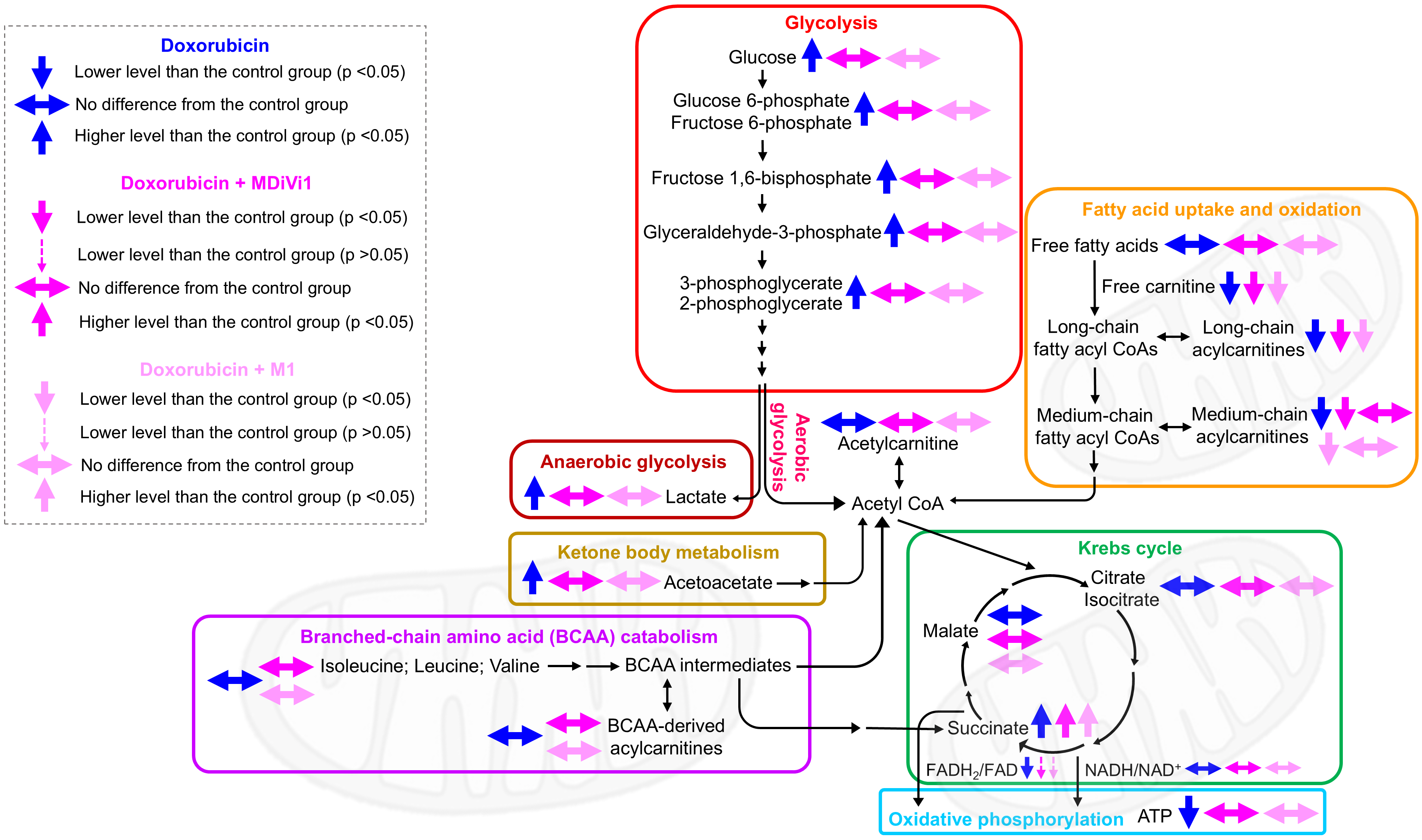
Results: Doxorubicin increased glycolysis, increased ketone body metabolism, decreased fatty acid utilization, decreased succinate oxidation, and decreased ATP production. Either co-treatment with MDiVi1 or M1 promoted favorable patterns of cardiac metabolic reprogramming, as detailed in the figure.
Conclusions: Our findings highlight the potential of mitochondrial dynamics modulation in the promotion of favorable patterns of cardiac metabolic reprogramming. Also, metabolomics may be used as tools for diagnosis and treatment monitoring in doxorubicin-induced heart failure.
  • Thonusin, Chanisa  ( Chiang Mai University , Chiang Mai , Thailand )
  • Maneechote, Chayodom  ( Chiang Mai University , Chiang Mai , Thailand )
  • Chattipakorn, Siriporn  ( Chiang Mai University , Chiang Mai , Thailand )
  • Chattipakorn, Nipon  ( Chiang Mai University , Chiang Mai , Thailand )
  • Author Disclosures:
    Chanisa Thonusin: DO NOT have relevant financial relationships | Chayodom Maneechote: DO NOT have relevant financial relationships | Siriporn Chattipakorn: No Answer | Nipon Chattipakorn: No Answer
Meeting Info:

Scientific Sessions 2025

2025

New Orleans, Louisiana

Session Info:

New Genomic and Precision Medicine Treatment Strategies for Amyloidosis and Cardiometabolic Disease

Sunday, 11/09/2025 , 11:30AM - 12:30PM

Abstract Poster Board Session

More abstracts on this topic:
β1-adrenergic autoantibodies (β1-AA) augment macropinocytosis in CD4+ T cells, leading to the expansion of CD4+CD28 T cell subsets in heart failure.

Sun Fei, Yao Junyan, Li Bingjie, Zhang Suli, Liu Huirong

Aminoacylase-1 Regulates Hepatic Mitochondrial Respiration and Whole-Body Metabolism

Guan Yuntian, Banks Alexander, Gerszten Robert, Benson Mark, Jonas Zachary, Wang Alissa, Tendoh Foje-geh, Manish Mahesh, Shah Radhe, Hofmann Alissa, Shen Dongxiao, Cortopassi Marissa

More abstracts from these authors:
Prebiotic Banana (musa sapientum l.) Snack Attenuates Cardiac Autonomic Imbalance by Modulating Mitochondrial Oxidative Stress in Prediabetic Rats

Apaijai Nattayaporn, Sa-nguanmoo Piangkwan, Pintana Hiranya, Devahastin Sakamon, Chattipakorn Siriporn, Chattipakorn Nipon

You have to be authorized to contact abstract author. Please, Login
Not Available