Sex-, Age-, and Chamber-Specific Atrial Remodeling Predicts Driver-Ablation Outcomes in Persistent Atrial Fibrillation
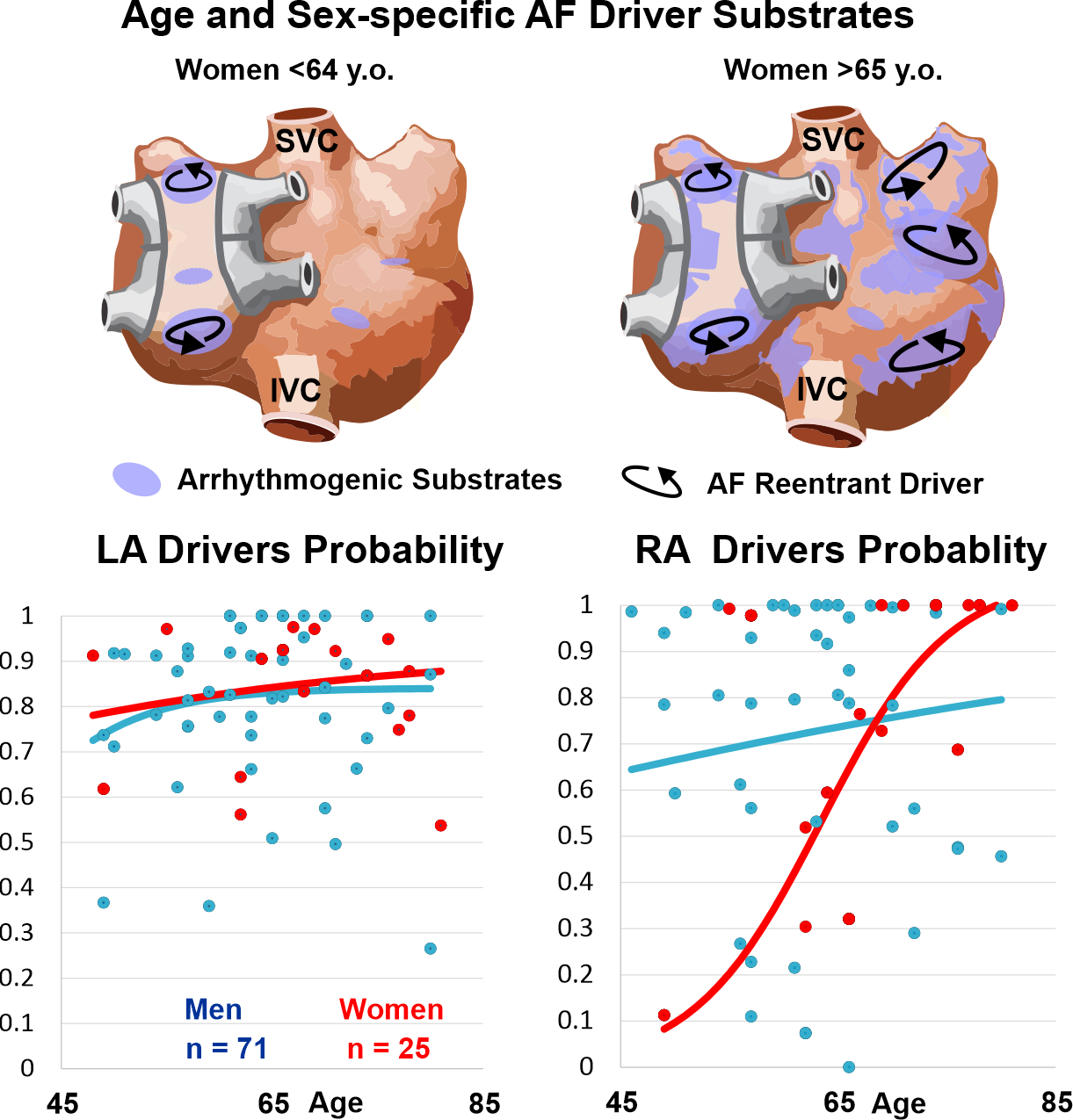
Abstract Body (Do not enter title and authors here): Background: In persistent atrial fibrillation (perAF), atrial remodeling driven by age, biological sex, and comorbidities can create arrhythmogenic substrates beyond the pulmonary veins (PVs). These substrates support localized reentrant drivers that may sustain AF and reduce the efficacy of catheter ablation. However, patient-specific predictors of these driver substrates remain poorly defined. Methods: We studied 96 patients (71 men; median age 64 years) with perAF who underwent pulmonary vein isolation (PVI), bi-atrial multi-electrode mapping (MEM), and targeted driver ablation at a single center. Preprocedural delayed-enhancement MRI (DE-MRI), procedural MEM data, and post-ablation outcomes (assessed at 12–24 months) were analyzed for recurrence of AF or atrial tachycardia (AT). To validate clinical findings, we used a large-animal model of self-sustained perAF (4–8 months), including both male and female animals. In vivo MEM, DE-MRI, and ex vivo transmural optical mapping and histology were performed. Results: Biatrial MEM identified extra-PV reentrant drivers in a patient-specific manner, located in either or both atria. In the left atrium (LA), substrate characteristics—including DE-MRI–validated fibrosis, LA dilation, and heart failure—were associated with the presence of localized drivers and AF/AT recurrence. In patients under 64 years of age, a higher number of right atrial (RA) drivers correlated with increased arrhythmia recurrence. Older women exhibited a greater RA driver burden, associated with increased transmural fibrosis. Preclinical large-animal studies confirmed these findings, demonstrating reentrant drivers co-localized with fibrotic arrhythmogenic substrate regions. Conclusion: Biological sex, age, and chamber-specific atrial remodeling significantly influence AF driver distribution and ablation outcomes in perAF. RA remodeling—particularly in older women—may be a key determinant of arrhythmia persistence. Integration of MEM-defined driver mapping with substrate imaging may enhance ablation precision and improve long-term efficacy.
Fedorov, Vadim
( The Ohio State University
, Columbus
, Ohio
, United States
)
Zakharkin, Stanislav
( The Ohio State University
, Columbus
, Ohio
, United States
)
Zhao, Jichao
( UNIVERSITY OF AUCKLAND
, Auckland
, New Zealand
)
Simonetti, Orlando
( The Ohio State University
, Columbus
, Ohio
, United States
)
Hummel, John
( The Ohio State University
, Columbus
, Ohio
, United States
)
Author Disclosures:
Vadim Fedorov:DO NOT have relevant financial relationships
| Stanislav Zakharkin:DO NOT have relevant financial relationships
| Jichao Zhao:No Answer
| Orlando Simonetti:DO NOT have relevant financial relationships
| John Hummel:DO have relevant financial relationships
;
Consultant:Medtronic:Active (exists now)
; Research Funding (PI or named investigator):Abbott:Active (exists now)
; Consultant:Element Science:Active (exists now)
; Consultant:Volta:Active (exists now)