Evolving Trends in Post-Transplant Mortality from Heart and Lung Failure: Unexpected Plateaus and Persistent Inequities in the United States Population, 1999 to 2023
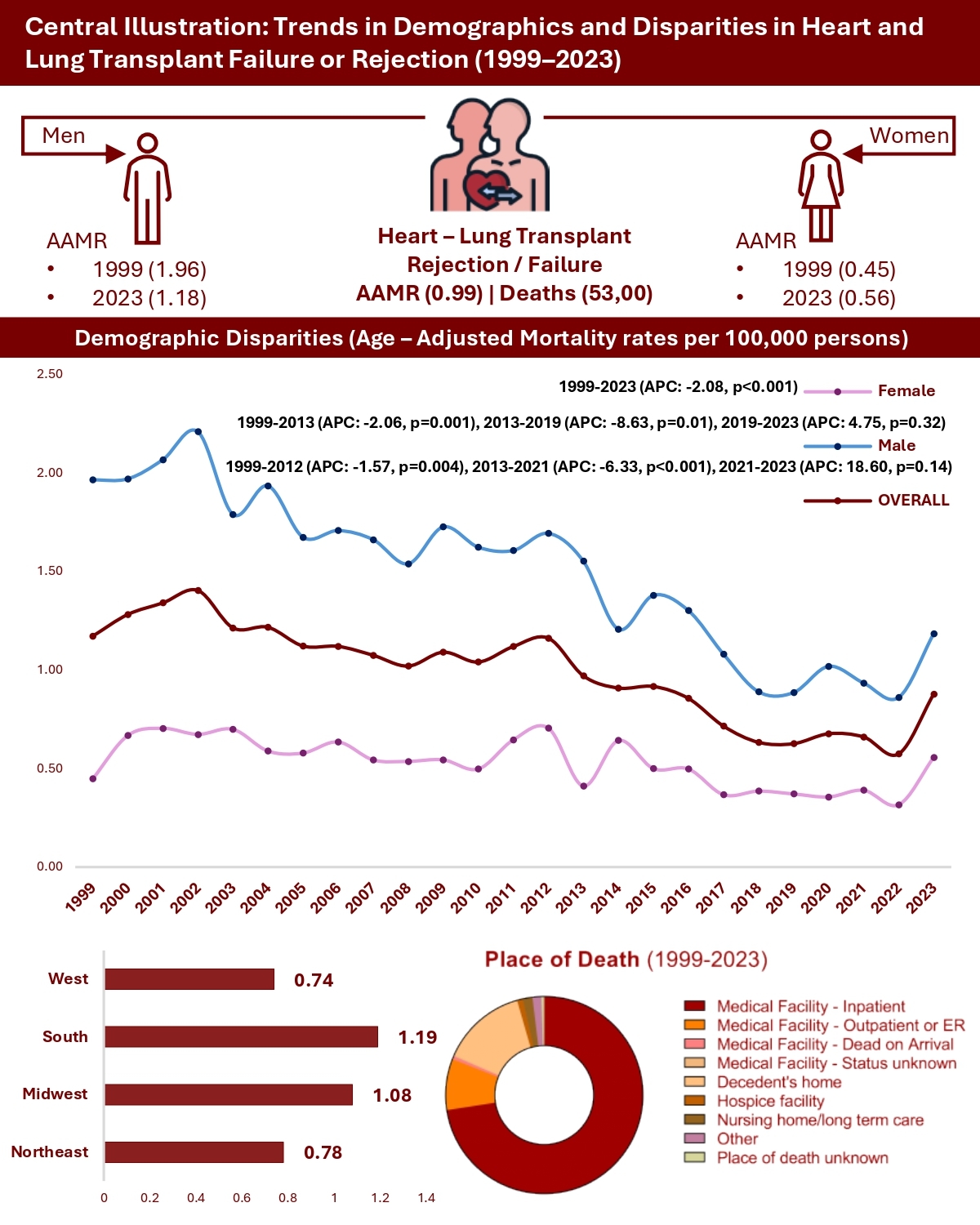
Abstract Body (Do not enter title and authors here): Background:Despite the therapeutic efficacy of heart (HTx) and lung transplantation (LTx) for end-stage organ disease, post-transplant complications remain leading contributors to mortality. Contemporary epidemiological trends in transplant-related mortality, particularly following recent technical advances including donation after circulatory death (DCD) implementation in the USA in 2019, require systematic investigation. Objective:To examine temporal mortality trends and demographic disparities associated with HTx and LTx failure or rejection-related deaths from 1999 to 2023. Methods:We conducted a retrospective analysis using CDC WONDER mortality data for adults aged 25 and older, focusing on deaths attributed to HTx and LTx failure (ICD-10 codes: T86.2, T86.3). Age-adjusted mortality rates (AAMR) per 100,000 population were calculated and stratified by demographic and geographic variables. Temporal trends were analyzed using Joinpoint regression to calculate via annual percentage change (APC). Results: Between 1999 and 2023, there were 5,300 deaths (AAMR 0.99; AAPC −1.87) attributed to HTx and LTx failure. Overall AAMR declined from 1.17 in 1999 to 1.16 in 2012 (APC: −1.57; 95% CI: −2.58 to −0.55), followed by a sharper decrease to 0.66 by 2021 (APC: −6.33; 95% CI: −8.62 to −3.98), stabilizing thereafter (APC: 18.60; 95% CI: −5.98 to 49.63). Men exhibited higher mortality than women (AAMR: 1.50 vs. 0.53), with declining trends in both sexes (AAPC: men −2.66, P = 0.019; women −2.08, P = 0.0004). However, male mortality showed an upward trend post-2019 (APC: 4.75; 95% CI: −4.73 to 15.17, P = 1.032). Racial disparities were evident, with African Americans experiencing the highest AAMR (1.79), nearly twice that of White individuals (0.90). Geographically, the South had the highest AAMR (1.19), followed by the Midwest (1.08), Northeast (0.78), and West (0.74), with nonmetropolitan areas demonstrating elevated mortality. Most deaths occurred in medical facilities (82.7%), predominantly inpatient (73.4%), while 14.1% occurred at home. Conclusion: HTx and LTx failure-related mortality declined from 1999–2021 but stabilized thereafter, with persistent sex, racial, and geographic disparities. The recent plateau in mortality particularly among men post-2019 despite advances in transplant technology, calls for further investigation. Targeted interventions are needed to mitigate disparities and improve post-transplant survival across all populations.
Khalid, Arbab
(
Kirk Kerkorian School Of Medicine
, Las Vegas , Nevada , United States )
Hemida, Mohamed Fawzi
(
Alexandria Faculty of Medicine
, Alexandria , Egypt )
Faizan, Muhammad
(
Shalamar Medical and Dental College
, Lahore , Pakistan )
Mehmood, Hamid
(
Hitec institute of medical science
, Taxila , Pakistan )
Munim, Abdul
(
Hitec institute of medical science
, Taxila , Pakistan )
Basit Kayani, Abdul
(
Hitec institute of medical science
, Taxila , Pakistan )
Author Disclosures:
Muhammad Raza Sarfraz:No Answer
| Abdul Basit kayani:No Answer
| Muhammad Nisar Ahmad:DO NOT have relevant financial relationships
| Asma Chaudhary:DO NOT have relevant financial relationships
| Saqlain Anwar:DO NOT have relevant financial relationships
| Arbab Khalid:DO NOT have relevant financial relationships
| Mohamed Fawzi Hemida:DO NOT have relevant financial relationships
| Muhammad Faizan:DO NOT have relevant financial relationships
| Hamid Mehmood:DO NOT have relevant financial relationships
| Abdul Munim:DO NOT have relevant financial relationships