
Logo

American Heart Association

  12
  0


Final ID: MP2552

Not What It Seems: A Case of Dynamic LVOT Obstruction Masquerading as Prosthetic Aortic Valve Stenosis

Abstract Body (Do not enter title and authors here): Description of Case:
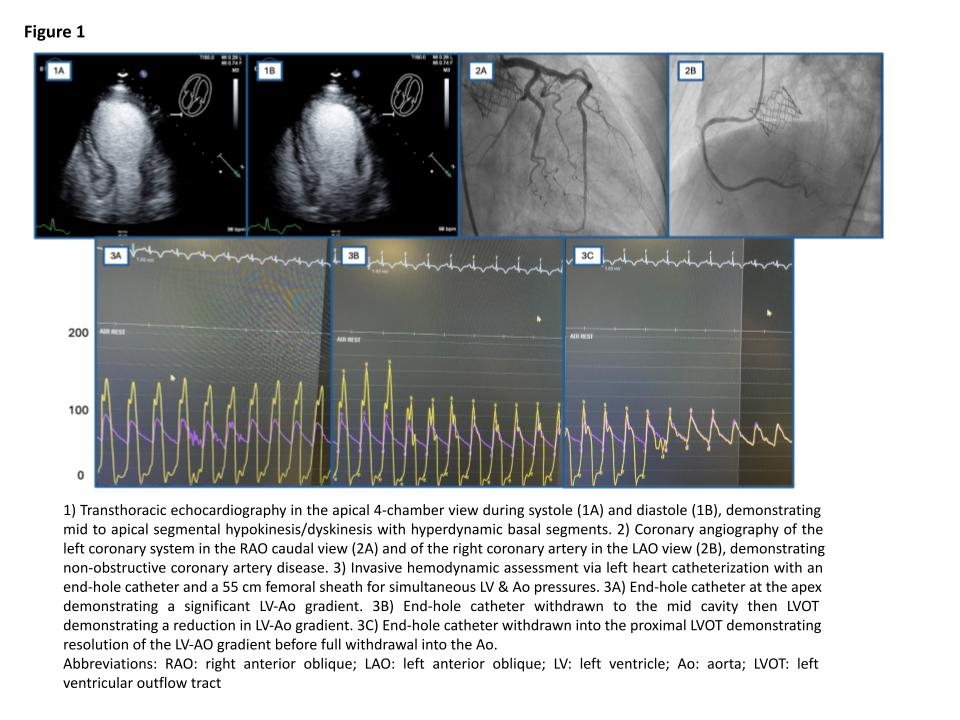
A 63-year-old woman with nonischemic cardiomyopathy (CM) with recovered ejection fraction (EF), severe bicuspid aortic valve (AV) stenosis post-transcatheter aortic valve replacement (TAVR) and prior methamphetamine use presented with chest pain, troponin >6000 ng/L, and anterolateral (V2-V6) ST elevation, T wave inversion, and Q waves. She was transferred for possible late or completed STEMI. Echocardiogram showed reduced ejection fraction (25% from 55%), mid-apical wall akinesis to dyskinesis, and a hyperdynamic base. Continuous wave doppler through the AV revealed a mean gradient of 44 mmHg (previously 11 mmHg) raising concern for valve dysfunction.

Coronary angiography revealed nonobstructive coronary artery disease. Left heart catheterization via a 55 cm femoral sheath using an end-hole catheter with slow pullback in the left ventricle (LV) demonstrated a significant LV-aortic gradient at the apex that progressively diminished and resolved near the left ventricular outflow tract (LVOT) below the aortic valve, confirming dynamic LVOT obstruction.

Cardiac magnetic resonance imaging (MRI) showed patchy late gadolinium enhancement (LGE), raising concern for myocarditis versus stress CM due to methamphetamine exposure. The patient improved with medical therapy and was discharged in stable condition.

Discussion:
The dynamic LVOT obstruction in this case resulted from hyperdynamic basal contraction against an akinetic apex, causing mid-cavity collapse and a falsely elevated transvalvular gradient, mimicking prosthetic valve stenosis. This underrecognized mechanism can mislead post-TAVR assessments, especially in the setting of catecholamine excess or myocardial inflammation. Initial concern for valve failure or infarction was redirected by invasive hemodynamics and multimodal imaging. Recognition of this physiology avoided unnecessary intervention and guided therapy.

Traditionally, the absence of LGE supported stress CM, but recent studies show stress CM can present with LGE. This overlap underscores the evolving understanding of myocardial injury and highlights that myocarditis can mimic stress CM when LGE is present. This case emphasizes the importance of invasive pressure assessment, multimodal imaging, and diagnostic flexibility in evaluating post-TAVR patients with suspected acute coronary syndrome.
  • Slehria, Trisha  ( University of Iowa Healthcare , Coralville , Iowa , United States )
  • Alzahrani, Ashraf  ( University of Iowa Healthcare , Coralville , Iowa , United States )
  • Benson, Christopher  ( University of Iowa Healthcare , Coralville , Iowa , United States )
  • Rossen, James  ( University of Iowa Healthcare , Coralville , Iowa , United States )
  • Author Disclosures:
    Trisha Slehria: DO NOT have relevant financial relationships | Ashraf Alzahrani: No Answer | Christopher Benson: No Answer | James Rossen: No Answer
Meeting Info:

Scientific Sessions 2025

2025

New Orleans, Louisiana

Session Info:
More abstracts on this topic:
A Beta Tubulin Mutation Suppresses Arrhythmias and Improves Connexin 43 Localization in Heart of Duchenne Muscular Dystrophy Mice

Zhou Delong, Liu Tong, Yehia Ghassan, Romanienko Peter, Rodney George, Wehrens Xander, Lampe Paul, Gourdie Robert, Xie Lai-hua, Fraidenraich Diego, Nouet Julie, Mesa Elam, Yegneshwaran Vasisht, Geukgeuzian Geovanni, Adibemma Ifeanyichukwu, Nandakumar Swetha, Ramirez Edwin, Li Hong

Aortic Stenosis is Promoted by Ferroptosis via 5-Lipoxygenase

Qin Zihan, Haftbaradaran Esfahani Payam, Pawelzik Sven-christian, Bosman Matthias, Bergstrom Goran, Guns Pieter-jan, Franco-cereceda Anders, Back Magnus

You have to be authorized to contact abstract author. Please, Login
Not Available