
Logo

American Heart Association

  23
  0


Final ID: Sa3067

VC108, a GPR39 Blocker, Increases Coronary Blood Flow and Inhibits the Vascular Effects of 15-Hydroxyeicosatetraenoic Acid

Abstract Body (Do not enter title and authors here): Background: We previously showed that GPR39 is present in cardiac arteriolar vascular smooth muscle cells (VSMCs) and that 15-hydroxyeicosatetraenoic acid (15-HETE) is the endogenous GPR39 agonist that increases cystosolic Ca++, causes VSMC contraction. VC108 is a selective GPR39 blocker undergoing pre-clinical development. We tested that hypothesis that GPR39 blockade will increase resting coronary blood flow (CBF) and attenuate the effect of 15-HETE on the normal canine coronary microcirculation.
Methods: Eight open-chest anesthetized dogs underwent placement of a flow probe on the left anterior descending coronary artery (LAD) to measure CBF with 2 catheters placed in its distal branches: one for mean LAD pressure measurement and another for intracoronary (IC) drug administration. Microvascular resistance was calculated from LAD pressure and CBF. After transient (20 s) coronary occlusion to establish the basal hyperemic response, varying doses of VC108 were infused IC, and CBF and LAD pressure measured. After baseline coronary hemodynamics were attained, a single dose of 15-HETE (measured by mass spectroscopy) was injected IC with dose varying (50 to 450 uM) between separate animals followed by injection of the same dose in presence of VC108.
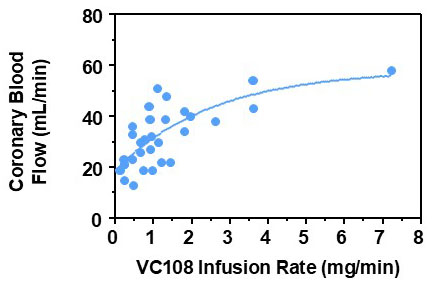
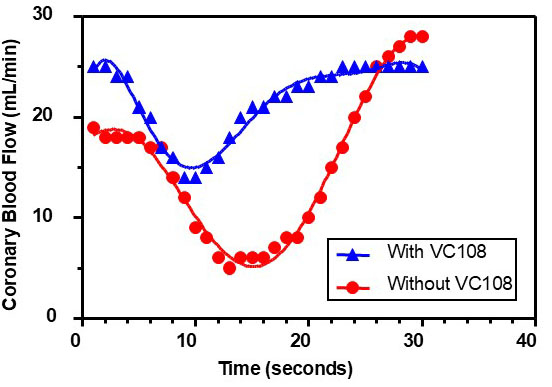
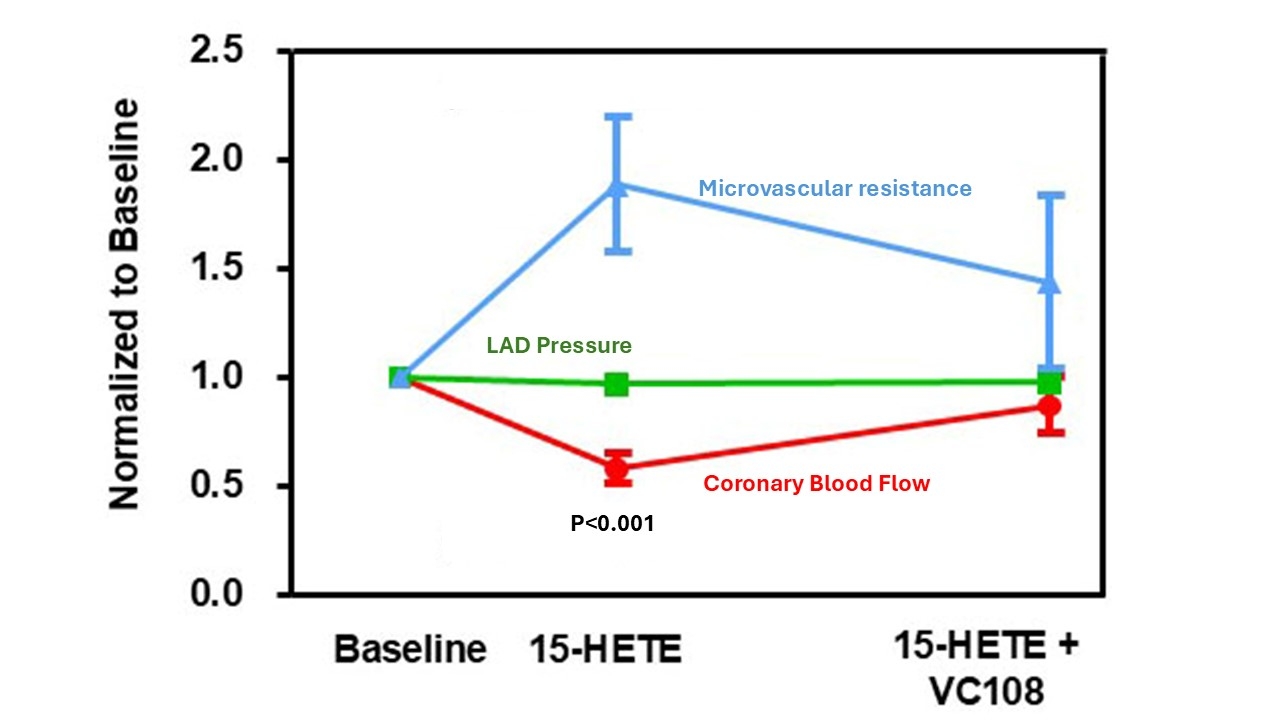
Results: Hyperemic response after 20 s of LAD occlusion was 162 ± 25% of basal CBF. The relation between incremental doses of VC108 and CBF are shown Figure 1. The relation is exponential with highest CBF (at 2 to 4 mg/min of VC108) equal to the hyperemic response, indicating maximal coronary vasodilation. IC HETE caused no change in LADP but decreased CBF depending on dose, reflecting its microvascular site of action. The effect lasted only a few seconds (≤20 s) followed by a hyperemic response. This effect was attenuated both in magnitude and duration when VC108 was co-administered with 15-HETE (Figure 2). Aggregate results from all 8 animals are shown in Figure 3. CBF decreased and microvascular resistance increased with IC 15-HETE, and this effect was mostly attenuated when VC108 was co-administered with 15-HETE.
Conclusions: VC108, a specific GPR39 blocker, increases CBF in a dose-dependent manner, achieving maximal coronary hyperemia. 15-HETE decreases CBF; this effect is very brief and is significantly attenuated by co-administration of VC108. These results provide evidence that VC108 is an effective coronary vasodilator and GPR39 antagonist, with direct implications for its clinical use.
  • Le, Dai-trang  ( VA Portland Health Care System , Portland , Oregon , United States )
  • Kajimoto, Masaki  ( OREGON HEALTH SCIENCE UNIVERSITY , Portland , Oregon , United States )
  • Zhao, Yan  ( OREGON HEALTH SCIENCE UNIVERSITY , Portland , Oregon , United States )
  • Methner, Carmen  ( OREGON HEALTH SCIENCE UNIVERSITY , Portland , Oregon , United States )
  • Kaul, Sanjiv  ( OREGON HEALTH SCIENCE UNIVERSITY , Portland , Oregon , United States )
  • Author Disclosures:
    Dai-Trang Le: DO NOT have relevant financial relationships | Masaki Kajimoto: DO NOT have relevant financial relationships | Yan Zhao: DO NOT have relevant financial relationships | Carmen Methner: DO NOT have relevant financial relationships | Sanjiv Kaul: DO NOT have relevant financial relationships
Meeting Info:

Scientific Sessions 2025

2025

New Orleans, Louisiana

Session Info:

Metabolic & Lipid-Focused Therapies for CAD

Saturday, 11/08/2025 , 02:30PM - 03:30PM

Abstract Poster Board Session

More abstracts on this topic:
Arrhythmia and Left Ventricular Functional Recovery in Arrhythmic Myocarditis Following Immunosuppressive Therapy

Chelikam Nikhila, Katapadi Aashish, Darden Douglas, Gopinathannair Rakesh, Kabra Rajesh, Pothineni Naga Venkata, Atkins Donita, Lakkireddy Dhanunjaya

Early Nebulized Inhaled Nitroglycerin Enhances Carotid Blood Flow Without Compromising Coronary Perfusion Pressure During CPR in a Swine Cardiac Arrest Model

Youngquist Scott, Kelly Christopher, Palatinus Helen, Ewer Nicole, Hoareau Guillaume, Johnson Michael

More abstracts from these authors:
GPR39 Orchestrates the Myogenic Response in Coronary Autoregulation

Le Dai-trang, Kajimoto Masaki, Zhao Yan, Kaul Sanjiv

Coronary Autoregulation Requires Arachidonic Acid and GPR39

Kajimoto Masaki, Methner Carmen, Kaul Sanjiv

You have to be authorized to contact abstract author. Please, Login
Not Available