
Logo

American Heart Association

  26
  0


Final ID: Mo4071

Coronary Autoregulation Requires Arachidonic Acid and GPR39

Abstract Body (Do not enter title and authors here): Background: The molecular basis of coronary autoregulation is unknown. Based on our large animal data and previous reports by others, we hypothesized that arachidonic acid (AA) is required for autoregulation and it acts through its metabolite, 15-hydroxyeicosatetraenoic acid (15-HETE), which interacts with GPR39 present in coronary vascular smooth muscle cells. 15-HETE is the endogenous agonist for GPR39 and causes vascular smooth muscle contraction by increasing cystolic Ca++.
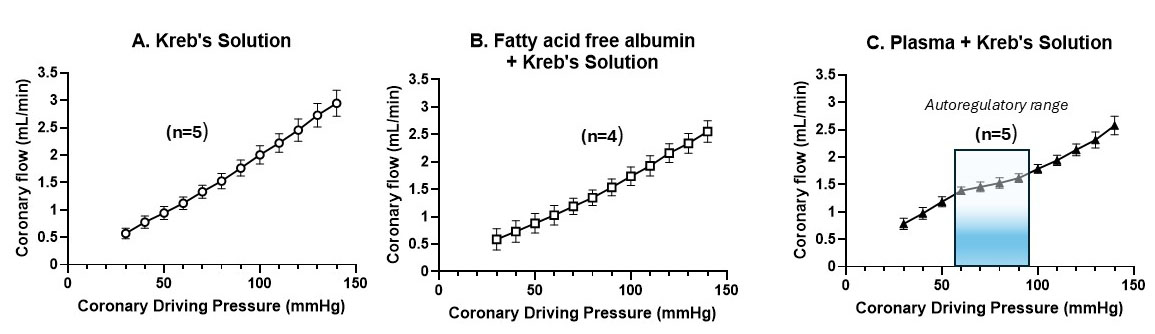
Methods: Wild-type (WT) and GPR39 knockout (KO) mouse hearts were isolated and perfused in a Langendorff system where coronary pressure could be altered over a wide range (<40-150 mmHg). WT hearts were perfused with Kreb solution (KS, n= 5); fatty acid free albumin (FAFA) + KS (n=4 ); plasma + KS (n=5); and AA+FAFA+KS (n=6) over a wide range of perfusion pressures. GPRKO hearts were also perfused with KS+FAFA+AA (n=5).
Results: Infusion with KS resulted in a linear relation between coronary pressure and coronary flow (Figure 1A), with no autoregulation. Addition of FAFA to KS achieved similar results with no autoregulation (Figure 1B). Addition of 10% plasma to KS resulted in coronary autoregulation with coronary flow nearly flat in the autoregulatory range (coronary pressure of 55-95mmHg, Figure 1C). This indicated that a fatty acid in plasma was responsible for coronary autoregulation. We then added AA (infused at 1 ug/min) to KS and FAFA and found the same effect, that is, autoregulation was noted in the coronary pressure range of 55-95 mmHg (Figure 2A). We have previously shown that 15-HETE, an AA metabolite, plays a role in coronary autoregulation in the dog, and is the endogenous agonist for GPR39. Therefore, we repeated these experiments in GPR39 KO animals and found that there was no autoregulation (Figure 2B).
Conclusions: Coronary autoregulation is not an intrinsic property of the coronary microvasculature. Instead, it is mediated by AA through its metabolite 15-HETE acting on GPR39 to cause vascular smooth muscle contraction. Changes in coronary perfusion pressure are mechanosended by the coronary microcirculation, which then releases AA that gets converted to 15-HETE at a concentration commensuate with the coronary pressure.
  • Kajimoto, Masaki  ( Oregon Health & Science University , Portland , Oregon , United States )
  • Methner, Carmen  ( Oregon Health & Science University , Portland , Oregon , United States )
  • Kaul, Sanjiv  ( Oregon Health & Science University , Portland , Oregon , United States )
  • Author Disclosures:
    Masaki Kajimoto: DO NOT have relevant financial relationships | Carmen Methner: DO NOT have relevant financial relationships | Sanjiv Kaul: DO NOT have relevant financial relationships
Meeting Info:

Scientific Sessions 2025

2025

New Orleans, Louisiana

Session Info:

Novel Molecular Drivers of Coronary Circulation and Cardiometabolic Disease

Monday, 11/10/2025 , 10:30AM - 11:30AM

Abstract Poster Board Session

More abstracts on this topic:
Central Arterial Stiffness in Young Adults with Perinatal HIV Exposure

Urbina Elaine, Yu Wendy, Williams Paige, Sawyer George, Van Dyke Russell, Colan Steven, Lipshultz Steven

Ring of Power: Unraveling a Rare Diagnosis in a Young Male with Palpitations

Jafry Ali, Silverstein Joshua, Thosani Amit, Farah Victor, Lygouris Georgios, Poornima Indu

More abstracts from these authors:
Reduction in Myocardial Infarct Size by GPR39 Inhibition Maybe Related to its Direct Tissue Effects

Thompson Allura, Methner Carmen, Liu Lijuan, Plascencia Mary, Kajimoto Masaki, Kaul Sanjiv

VC108, a GPR39 Blocker, Increases Coronary Blood Flow and Inhibits the Vascular Effects of 15-Hydroxyeicosatetraenoic Acid

Le Dai-trang, Kajimoto Masaki, Zhao Yan, Methner Carmen, Kaul Sanjiv

You have to be authorized to contact abstract author. Please, Login
Not Available