Pulmonary Arterial Elastance as a Prognostic Marker for In-Hospital Mortality in STEMI With Cardiogenic Shock or Severe Heart Failure
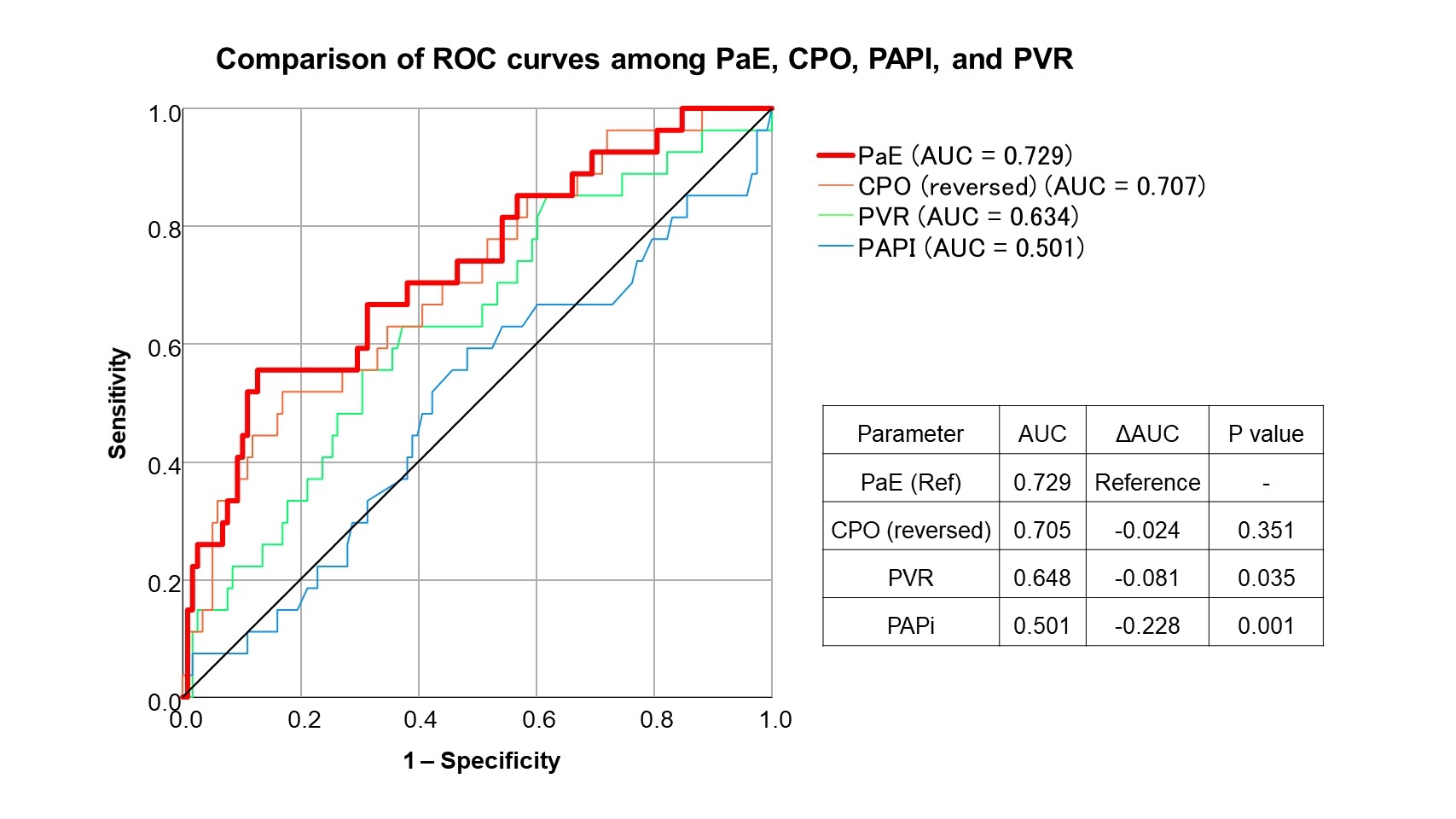
Abstract Body (Do not enter title and authors here): Background: While early reperfusion therapy via PCI has significantly reduced mortality in STEMI patients, outcomes remain poor for those presenting with cardiogenic shock (CS) or severe heart failure. With increasing use of mechanical circulatory support (MCS), hemodynamic parameters measured by pulmonary artery catheters (PAC), such as cardiac power output (CPO) and pulmonary artery pulsatility index (PAPi), are being re-evaluated for prognostic purposes. Pulmonary arterial elastance (PaE), reflecting right ventricular afterload, is one such parameter. In this study, we used a simplified form of PaE, defined as systolic pulmonary artery pressure (sPAP) divided by stroke volume (SV), to assess its prognostic utility in STEMI patients with CS or severe heart failure. Methods: From a cohort of 1,390 STEMI patients who underwent PCI between January 2014 and December 2023, we included 145 patients who presented with Killip class 3–4 heart failure, had no missing PAC data, and were not treated with V-A ECMO or IMPELLA. All patients underwent right heart catheterization immediately after PCI. Simplified PaE (sPAP/SV), CPO, and PAPi were calculated, and their associations with in-hospital mortality were assessed using ROC curves and multivariable logistic regression. Results: In-hospital mortality occurred in 18.6% of patients. Simplified PaE showed the highest prognostic value (AUC = 0.729), outperforming CPO (AUC = 0.707) and PAPi (AUC = 0.501). The optimal cutoff value for simplified PaE was 1.38 mmHg/mL, above which in-hospital mortality was 50.0%, compared to 10.4% below the cutoff (p < 0.001). In multivariable analysis, simplified PaE remained independently associated with in-hospital death (OR per 0.1 mmHg/mL increase: 1.15; 95% CI: 1.06–1.24; p = 0.0004). Conclusions: Among PAC-derived parameters, simplified pulmonary arterial elastance (sPAP/SV) was the strongest predictor of in-hospital mortality in STEMI patients with CS or severe heart failure. Its ease of calculation and immediate availability may make it a useful tool for early bedside risk stratification in this critically ill population.
Kawai, Shotaro
(
Miyazaki Medical Assoc Hospital
, Miyazaki City , Japan )
Kimura, Toshiyuki
(
Miyazaki Medical Association Hospit
, Miyazaki , Japan )
Kensaku, Nishihira
(
Miyazaki Medical Assoc Hospital
, Miyazaki City , Japan )
Kuriyama, Nehiro
(
Miyazaki Medical Assoc Hospital
, Miyazaki City , Japan )
Ohishi, Mitsuru
(
KAGOSHIMA UNIV
, Kagoshima , Japan )
Shibata, Yoshisato
(
Miyazaki Medical Assoc Hospital
, Miyazaki City , Japan )
Author Disclosures:
Shotaro Kawai:DO NOT have relevant financial relationships
| Toshiyuki Kimura:DO NOT have relevant financial relationships
| Nishihira Kensaku:No Answer
| Nehiro Kuriyama:No Answer
| Mitsuru Ohishi:DO NOT have relevant financial relationships
| Yoshisato Shibata:No Answer