
Sex-Based Troponin Kinetics from Symptom Onset In Suspected Acute Coronary Syndrome Patients Undergoing Coronary Angiography
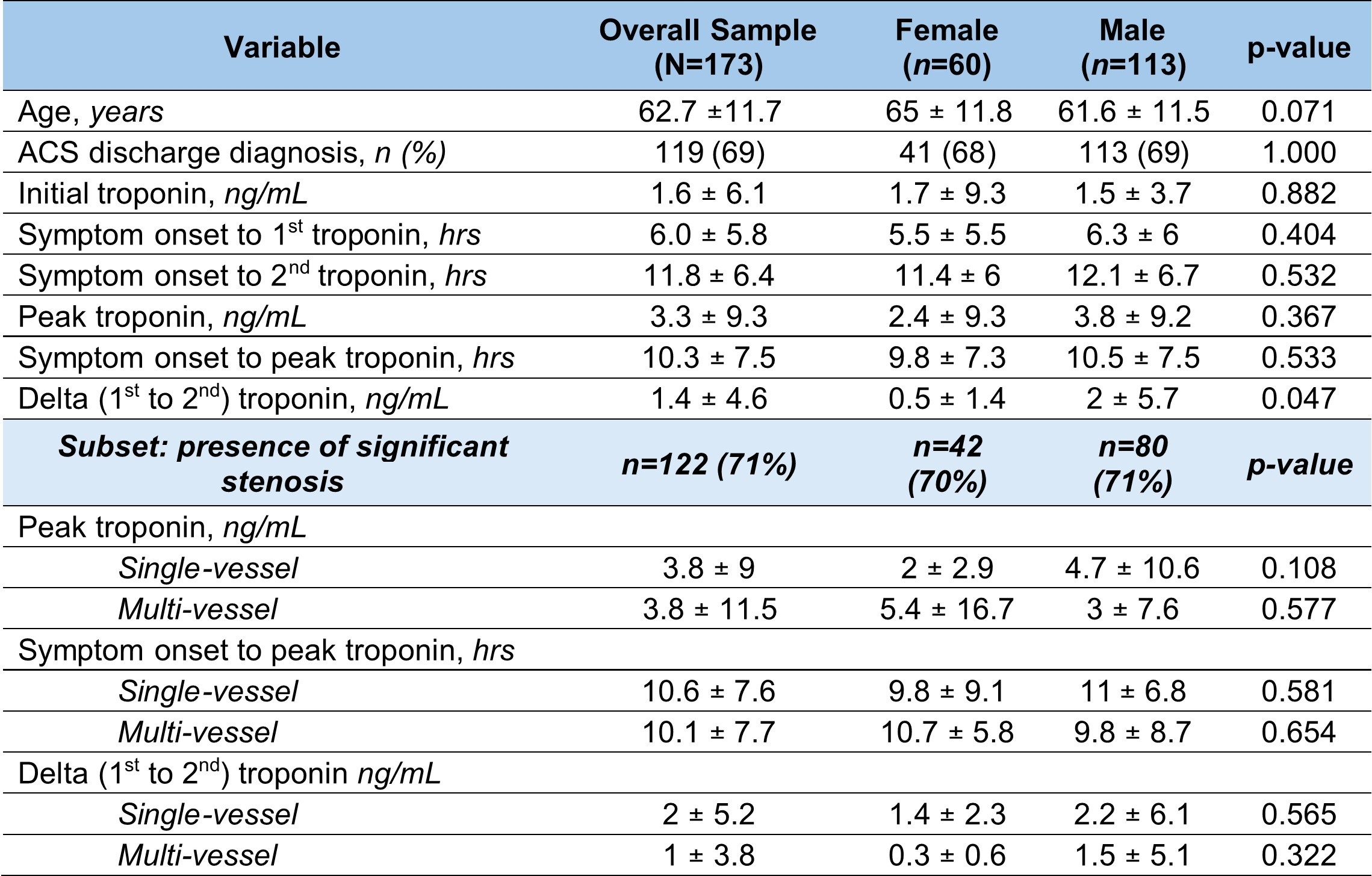
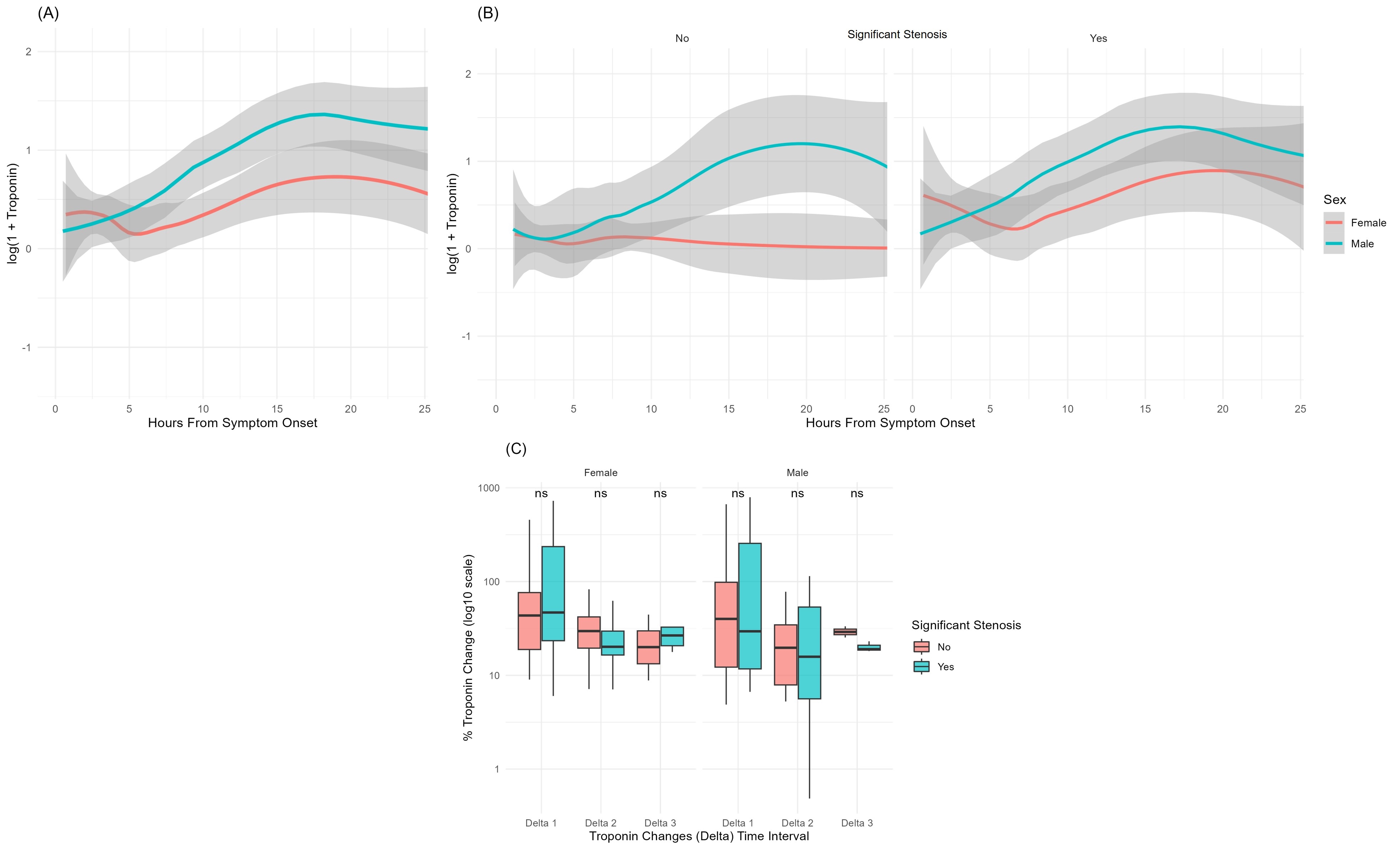
Abstract Body (Do not enter title and authors here): Background: Cardiac troponin I (cTnI) is a critical diagnostic biomarker in evaluating acute coronary syndrome (ACS), particularly in non-ST-segment elevation (NSTE). Serial cTnIs are typically timed from hospital presentation; however, limited data exist on how they evolve (kinetics) relative to symptom onset. Given sex differences in ACS symptom presentation, we hypothesized that cTnI kinetics measured from symptom onset may offer new insights on sex-specific diagnosis accuracy or treatment timing. Research Aims: (1) To characterize cTnI kinetics from symptom onset in patients with symptoms suggestive of NSTE-ACS; (2) To assess whether the association between the first positive cTnI and coronary artery stenosis is influenced by time from symptom onset to troponin measurement, stratified by sex. Methods: Secondary analysis of 173 adult patients (60 females, 113 males) undergoing coronary angiography. Pre-hospital symptom onset, serial values and timing of cTnI and were extracted from the EHR. Positive cTnL was >0.04 ng/mL. For Aim 1, descriptive statistics and log-transformed smoothed plots were used to assess cTnI trends by sex and stenosis. For Aim 2, logistic regression was used to test the interaction between first positive cTnI and symptom-to-draw time in predicting stenosis (≥50% left main or ≥70% in other major arteries), stratified by sex. Results: Mean time from symptom onset to initial cTnI was 6.0±5.8 hours (hrs); peak cTnI occurred at 10.3±7.5 hrs. Peak and delta cTnI trended higher in males than females across single- and multi-vessel disease (Table). Smoothed plots (Figure 1) showed a steeper and earlier cTnI rise in males, beginning ~5 hrs. Among patients with stenosis, time to first positive cTnI did not differ by sex (p=0.07). In multivariable models, the interaction between time and first positive cTnI was not significantly associated with stenosis (p_interaction=0.48); no sex-based effect modification was observed. Conclusion: Sex-based differences in cTnI kinetics were observed, but time from symptom onset did not modify the association between first positive cTnI and coronary stenosis. Females with stenosis exhibited early cTnI fluctuation, followed by a steady rise beyond 10 hours. Repeat cTnI testing beyond 10 hrs from symptom onset may be important in females. Larger studies using high-sensitivity cTnI may clarify the clinical significance of symptom-onset–aligned troponin trends.
Suba, Sukardi
( University of Rochester
, Rochester
, New York
, United States
)
Mitchell, Dana
( University of Rochester
, Rochester
, New York
, United States
)
Carey, Mary
( University of Rochester
, Rochester
, New York
, United States
)
Krishnamoorthy, Vijay
( University of Rochester
, Rochester
, New York
, United States
)
Pelter, Michele
( Univ California San Francisco
, Reno
, Nevada
, United States
)
Author Disclosures:
Sukardi Suba:DO NOT have relevant financial relationships
| Dana Mitchell:No Answer
| Mary Carey:DO NOT have relevant financial relationships
| Vijay Krishnamoorthy:No Answer
| Michele Pelter:DO have relevant financial relationships
;
Consultant:Cardinal Health:Past (completed)
; Other (please indicate in the box next to the company name):GE Healthcare - data use agreement:Past (completed)