
Logo

American Heart Association

  26
  0


Final ID: MP1573

Relevance Of Stellate Ganglion Blockade In Patients With Refractory Ventricular Arrhythmias- A Systematic Review

Abstract Body (Do not enter title and authors here): BACKGROUND
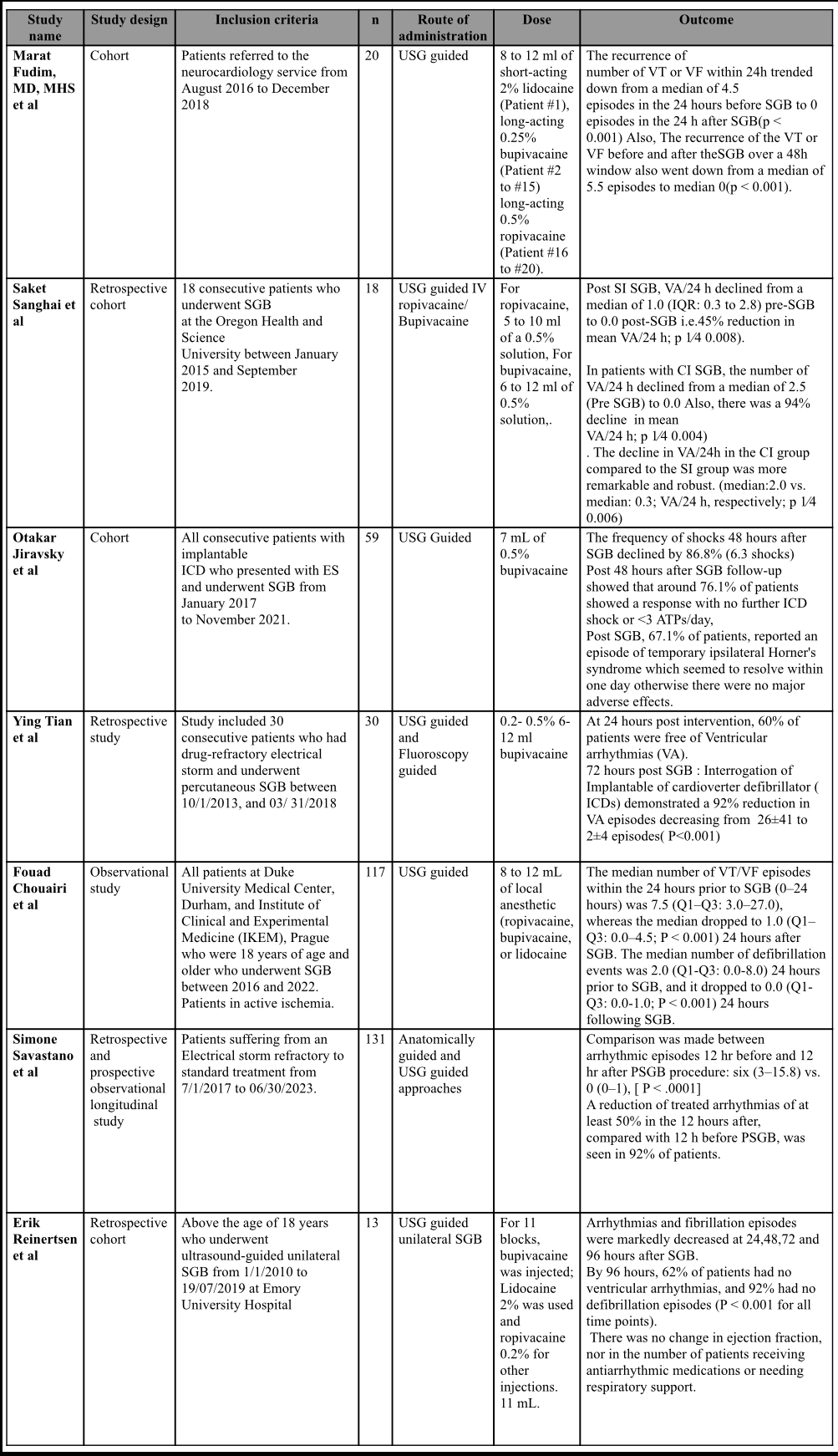
Life-threatening cardiac arrhythmias such as ventricular tachycardia (VT) and ventricular fibrillation (VF) may persist despite treatment. Given the significant morbidity and mortality associated with these resistant arrhythmias, the development of alternative therapeutic strategies is imperative. Recently, the Stellate Ganglion Blockade (SGB), a neuro-modulatory treatment which targets sympathetic cardiac innervation, has gained popularity as a potential treatment option. This review evaluates recent evidence on the therapeutic efficacy and safety of ultrasound-guided (USG) SGB in treating patients with drug-refractory VT/VF.
METHODS
A thorough literature review covering research published between 2006 and 2024 was undertaken. The inclusion criteria focused on adult patients receiving USG-guided SGB for refractory VT/VF. A total of seven studies were reviewed. The primary outcomes assessed included arrhythmia recurrence and adverse effects following SGB. Statistical analysis was performed using the Student’s t-test.
RESULTS
In a pooled cohort of 377 patients with drug-refractory VT/VF, SGB was associated with a statistically significant reduction in arrhythmia burden. Within the first 24 hours of USG SGB with long-acting local anesthetics (ropivacaine, lidocaine, or bupivacaine 0.25–0.5%), VT/VF episodes markedly decreased. The median number of events dropped from 4.5 to 0 (p < 0.001). In other analyses, the median arrhythmic burden dropped by more than 60%, and up to 74.6% of patients remained arrhythmia-free 48 hours post-intervention. Up to 92% of patients had no VF by 72 hours, and as many as 72% showed total suppression of arrhythmias within the first 24 hours. In cases of electrical storm, over half of the patients who received SGB experienced full arrhythmic resolution in less than 12 hours. Transient Horner's syndrome was the most common adverse event, occurring in about 86% of patients. No long-term neurological impairments, hemodynamic compromise, or procedural complications were reported.
CONCLUSION
For severely sick patients with refractory VT/VF, SGB appears to be a valuable adjunctive therapy that can rapidly and permanently control potentially lethal arrhythmias. Transitory Horner's syndrome is the most common adverse effect. Despite encouraging results, small-scale, non-randomized research provides the majority of the data currently available. Larger, multicenter RCTs are required to verify efficacy and evaluate long-term outcomes.
  • Pannu, Sagal  ( University of Oklahoma , Oklahoma City , Oklahoma , United States )
  • Madan, Hritik  ( Adesh medical college and hospital , Sonipat , India )
  • Patel, Nandan  ( AIIMS, Jodhpur , Vadodara , India )
  • Sood, Dhriti  ( Jefferson Health Medical Education/Jefferson Einstein Philadelphia Hospital , Philadephia , Pennsylvania , United States )
  • Singh Sodhi, Gurasis  ( Jefferson Health Medical Education/Jefferson Einstein Philadelphia Hospital , Philadephia , Pennsylvania , United States )
  • Nathani, Pratiksha Shankarlal  ( Mayo Clinc , Phoenix , Arizona , United States )
  • Dawer, Prachi  ( University College of Medical Sciences , Delhi , India )
  • Singla, Ankur  ( Northwest Health-Porter , Valparaiso , Indiana , United States )
  • Author Disclosures:
    Sagal Pannu: DO NOT have relevant financial relationships | Hritik Madan: DO NOT have relevant financial relationships | Nandan Patel: DO NOT have relevant financial relationships | Dhriti Sood: No Answer | Gurasis Singh Sodhi: No Answer | Pratiksha Shankarlal Nathani: No Answer | Prachi Dawer: DO NOT have relevant financial relationships | Ankur Singla: DO NOT have relevant financial relationships
Meeting Info:

Scientific Sessions 2025

2025

New Orleans, Louisiana

Session Info:

Advances in VT: Cutting-Edge Therapies, Techniques, and Risk Management

Sunday, 11/09/2025 , 11:50AM - 01:05PM

Moderated Digital Poster Session

More abstracts on this topic:
A Case of Spike-on-T Phenomenon and Polymorphic Ventricular Tachycardia

Tran Brittany, Thimmiah Harun, Rosenthal Lawrence

A Bifunctional Actuator Reverses NaV1.5 Dysfunction Linked To Cardiac Arrhythmias

Fossier Lucile, Yehya Marc, Mahling Ryan, Gabelli Sandra, Colecraft Henry, Ben Johny Manu

More abstracts from these authors:
A Hemodynamic Warning Sign: Continuous Mitral Regurgitation and Normal Sinus Rhythm

Mahi Ishani, Chowdhury Mahdi, Madan Hritik, Garg Vaani

Comprehensive Ranking of Maintenance Immunosuppressive Therapies for Heart Transplant Recipients: A Systematic Review and Bayesian Network Meta-Analysis

Hammadeh Bara, Singla Ankur, Shaban Noor, Jaffal Rana, Alsufi Muaath, Al Matairi Alzahra'a, Aldib Layan

You have to be authorized to contact abstract author. Please, Login
Not Available