
Logo

American Heart Association

  18
  0


Final ID: Su4025

Enhancing the PREVENT Equation with a Polygenic Risk Score: Clinical Utility Evaluation

Abstract Body (Do not enter title and authors here): Introduction
The PREVENT risk prediction equations for primary prevention of atherosclerotic cardiovascular disease (ASCVD) was developed to overcome limitations of prior ACVD equations. Despite the inclusion of additional risk factors, there has been criticism that PREVENT underestimates risk. We explored the impact of adding a polygenic risk score (PRS) to improve clinical utility of PREVENT.
Methods
We used Genetic Epidemiology Resource in Adult Health and Aging (GERA) cohort of 60,544 members of Kaiser Permanente of Northern California between the ages of 30-74 years at baseline in 2007-08 (68% female, 81.2% European, 3.4% African-American, 7.0% Hispanic, 7.6% Asian) . There were 3,026 CHD (stable/ unstable angina, myocardial infarction, coronary revascularization, CHD death) incident events during 14 years of follow-up. A validated 12-SNP polygenic risk score (PRS) optimized for CHD (CARDIO inCode-Score) was used to capture genetic predisposition to CHD (Low=quintile 1; Intermediate=quintiles 2-4; High=quintile 5). We implemented time-to-event survival analysis and clinical utility evaluation of adding PRS to a model containing PREVENT.
Results
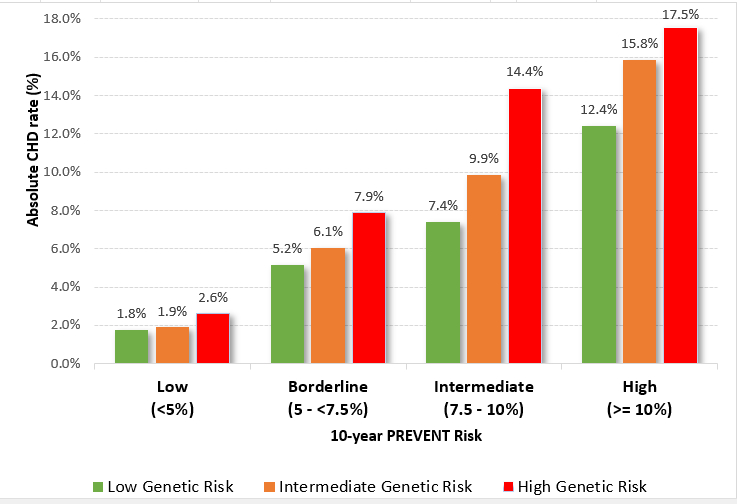
Mean (SD) age of cohort was 59 (9) years. Mean (SD) 10-year PREVENT risk was 4.8% (3.8%). Distribution of PREVENT risk groups was: 61% low (<5%), 18% borderline (5≤7.5%), 11% intermediate (7.5-10%) and 10% high (≥10%). Absolute CHD rates (per 100 persons) according to joint categories of PREVENT and polygenic risk are shown in the Figure. Among subjects with high PRS (n=10,865), 29% were at borderline/intermediate PREVENT risk and, of those, 50.2% were not taking statins at baseline. Notably, individuals with borderline PREVENT/high PRS had significantly higher rate than intermediate PREVENT/low PRS and similar for intermediate PREVENT/high PRS versus high PREVENT/low PRS. In a Cox model with simultaneous entry of categories of PREVENT and polygenic risk adjusting for 10 principal components of genetic ancestry, adding PRS to model containing PREVENT increased Harrell’s C statistic by 0.01 (0.747 to 0.757; p<0.0001). The category based Net Reclassification Improvement was 10.7 (7.6-13.9) in borderline/intermediate PREVENT risk.
Conclusion
A polygenic risk score added significant and clinically meaningful predictive information to the PREVENT equation and may help refine risk assessment, particularly among PREVENT borderline/intermediate individuals where decisions to initiate/intensify therapy is critical.
  • Iribarren, Carlos  ( KAISER PERMANENTE , Pleasanton , California , United States )
  • Lu, Meng  ( Kaiser Permanente , Sunnyvale , California , United States )
  • Wong, Nathan  ( University of California Irvine , Irvine , California , United States )
  • Gulati, Martha  ( Cedars-Sinai , Los Angeles , California , United States )
  • Elosua, Roberto  ( FUND INST MAR DINVESTIGACIONS MED , Barcelona , Spain )
  • Rana, Jamal  ( KAISER PERMANENTE , Oakland , California , United States )
  • Author Disclosures:
    Carlos Iribarren: DO have relevant financial relationships ; Research Funding (PI or named investigator):Gen inCODE, Pls:Active (exists now) | Meng Lu: No Answer | Nathan Wong: DO have relevant financial relationships ; Research Funding (PI or named investigator):Amgen, Novartis, Ionis:Active (exists now) ; Consultant:Ionis:Past (completed) ; Speaker:Novartis:Past (completed) ; Consultant:Heart Lung, Amgen, Novartis:Active (exists now) ; Research Funding (PI or named investigator):Novo Nordisk, Regeneron:Past (completed) | Martha Gulati: DO have relevant financial relationships ; Consultant:New Amsterdam:Past (completed) ; Consultant:Novartis:Past (completed) ; Consultant:Medtronic:Past (completed) | Roberto Elosua: No Answer | Jamal Rana: DO NOT have relevant financial relationships
Meeting Info:

Scientific Sessions 2025

2025

New Orleans, Louisiana

Session Info:

Early Detection of Cardiovascular Disease 1

Sunday, 11/09/2025 , 11:30AM - 12:30PM

Abstract Poster Board Session

More abstracts on this topic:
More abstracts from these authors:
Trends in Premature Cardiac Arrest Mortality Among Adults with Obesity (1999-2023) in the United States

Faheem Muhammad Shaheer Bin, Fida Tooba, Saeed Muhammad Usama, Sattar Yasar, Rana Jamal

Finding Lp(a): “little” Things, Big Consequences

Wong Nathan, Donato Leslie, Fayad Zahi

You have to be authorized to contact abstract author. Please, Login
Not Available