Intracranial Hemorrhage in Patients with Acute Myocardial Infarction Complicated by Cardiogenic Shock
Abstract Body (Do not enter title and authors here): Background: The incidence and predictors of intracranial hemorrhage (ICH) in patients with acute myocardial infarction (AMI) complicated by cardiogenic shock (AMI-CS) remain unclear.
Objectives: To determine the incidence of ICH in AMI-CS patients and validate a risk score for predicting ICH in this population.
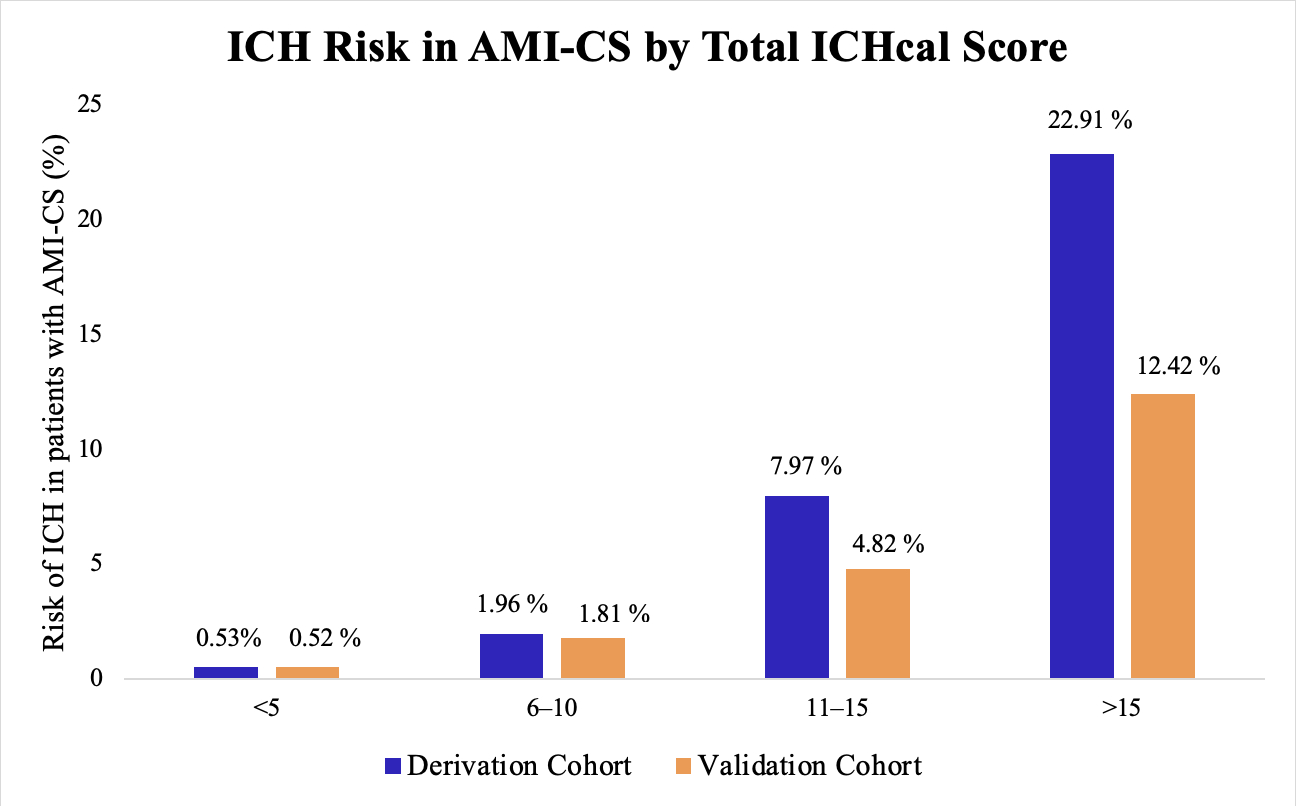
Methods: Patients with AMI-CS were identified using ICD-10 codes from January 2016 to December 2019 in the U.S. Nationwide Readmissions Database, and were stratified by the incidence of ICH. Independent predictors of ICH were identified using multivariate logistic regression in the derivation cohort. Based on these predictors, the ICHcal risk score was developed, which was validated in a validation cohort using receiver operating characteristic curves.
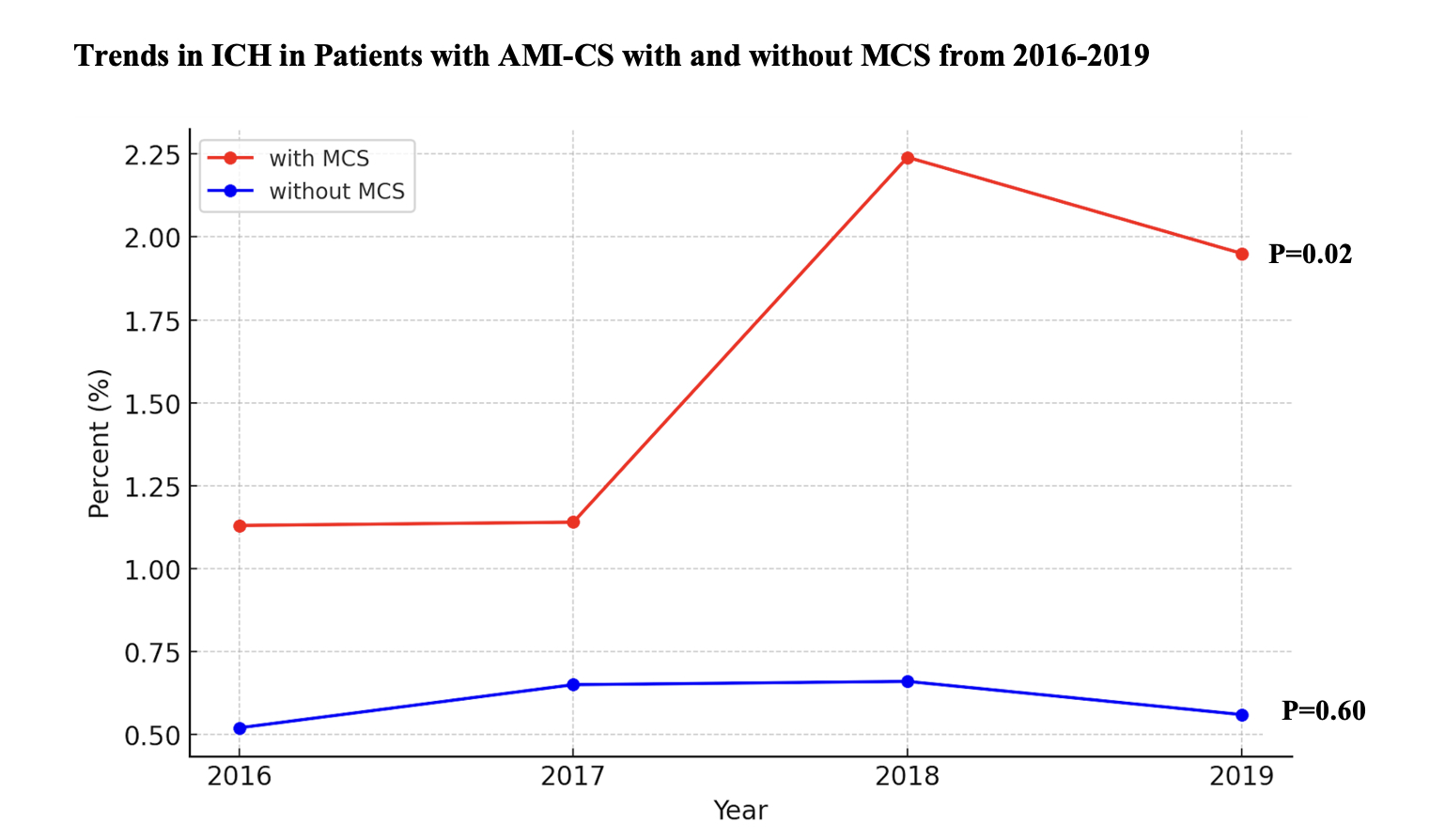
Results: Among 84,615 patients with AMI-CS, 608 (0.72%) experienced ICH. Of patients treated with mechanical circulatory support (MCS) devices, 162 experienced intracranial hemorrhage, corresponding to an overall incidence of 1.72%. The incidence of ICH in patients with MCS was 1.13% in 2016 and rose over time, with a marked increase between 2017 and 2018 (from 1.14% to 2.24%, P=0.02). Predictors of ICH included: VA-ECMO (OR 9.08, 95% CI 4.61-17.89, P<0.001), ischemic stroke (OR 5.21, 95% CI 3.81-7.14, P<0.001), thrombophilia (OR 2.27, 95% CI 1.68-3.07, P<0.001), microaxial MCS (OR 2.03, 95% CI 1.58-2.60, P<0.001), sepsis (OR 2.01, 95% CI 1.60-2.52, P<0.001), thrombolysis (OR 1.99, 95% CI 1.25-3.18, P<0.004), AKI (OR 1.61, 95% CI 1.30- 1.98, P<0.001), and age <65 years (OR 1.27, 95% CI 1.05-1.54, P<0.015). The ICHcal risk score, developed from these predictors, demonstrated a C-statistic of 0.69 in the derivation cohort and 0.72 in the validation cohort.
Conclusion: Patients with AMI-CS have a higher incidence of ICH, particularly those with MCS, compared to patients with AMI alone. A higher ICHcal risk score predicts a higher risk of ICH in these patients and may inform the degree of anticoagulation used to reduce this risk.
Potarazu, Deepika
(
Temple University
, Philadelphia , Pennsylvania , United States )
Zlotshewer, Brooke
(
Temple University
, Philadelphia , Pennsylvania , United States )
Zhao, Huaqing
(
Temple University
, Philadelphia , Pennsylvania , United States )
Shafi, Irfan
(
Temple University
, Philadelphia , Pennsylvania , United States )
Lakhter, Vladimir
(
Temple University
, Philadelphia , Pennsylvania , United States )
Manoj, Laya
(
Temple University
, Philadelphia , Pennsylvania , United States )
Katz, Paul
(
Temple University
, Philadelphia , Pennsylvania , United States )
Bashir, Riyaz
(
Temple University
, Philadelphia , Pennsylvania , United States )
Author Disclosures:
Deepika Potarazu:DO NOT have relevant financial relationships
| Brooke Zlotshewer:DO NOT have relevant financial relationships
| Huaqing Zhao:No Answer
| Irfan Shafi:No Answer
| Vladimir Lakhter:No Answer
| Laya Manoj:No Answer
| Paul Katz:DO NOT have relevant financial relationships
| Riyaz Bashir:No Answer