Incomplete Adoption of 2022 American Heart Association Guidelines for Intravenous Iron in Heart Failure with Reduced Ejection Fraction with Iron Deficiency: A TriNetX-Based Retrospective Study
Abstract Body (Do not enter title and authors here): Background: On Apr. 1, 2022, the AHA/ACC/HFSA released guidelines recommending intravenous (IV) iron for patients with heart failure with reduced ejection fraction (HFrEF) and iron deficiency (ID) based on evidence from randomized trials suggesting improved patient outcomes. However, adherence to this Class 2a recommendation remains understudied.
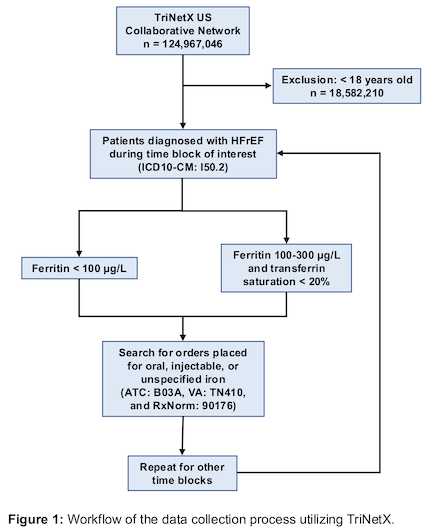
Methods: Using TriNetX’s US Collaborative Network, an aggregation of ~125 million de-identified patient electronic health records, we identified HFrEF patients with ID across eight 6-month time blocks relative to Apr. 1, 2022: one before and seven after, ending on May 16, 2025—the date of data extraction. For each time block, we applied a standardized cohort selection workflow to identify adults with HFrEF (ICD-10-CM: I50.2) and ID, defined as ferritin <100 μg/L or 100–300 μg/L with transferrin saturation <20%. We then searched for orders for oral, injectable, or unspecified iron placed after the diagnosis of ID and extracted relevant data. Chi-square tests were used to assess trends.
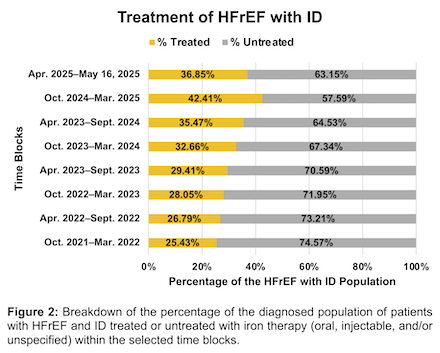
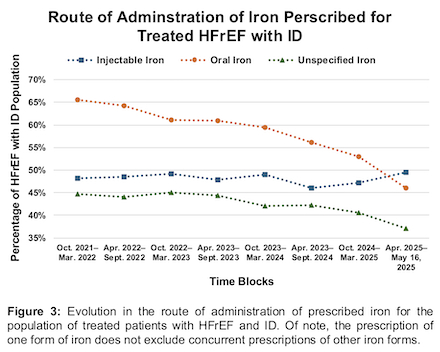
Results: The sample of HFrEF patients with ID in each time block ranged from 1,753 to 35,810. In the 6 months prior to guideline release, the treatment rate was 25.4%. Post-guidelines, we observed a consistent increase in the treatment rates (p<0.001), peaking at 42.4% between Oct. 2024 and Mar. 2025 before decreasing between Apr. 2025 and May 16, 2025. Additionally, the percentage of treated patients prescribed oral and unspecified iron decreased (p<0.001 for both), whileinjectable formulations remained relatively consistent at approximately 48% with a slight overall increase across time blocks (p<0.001).
Conclusions: Despite updated national guidelines endorsing IV iron therapy for HFrEF patients with ID, treatment remains suboptimal across U.S. clinical settings. A marked increase in treatment rates was observed following guideline publication, suggesting growing clinician awareness and evolving practice patterns. Notably, even when accounting for all forms of iron, treatment rates remained below 50%, highlighting a significant gap relative to guideline intent, which specifically recommends IV iron. The shift away from oral and unspecified formulations toward consistent use of injectable iron likely reflects increased alignment with evidence-based care and improved documentation. These findings highlight the need for targeted interventions to promote consistent adoption of guideline-directed therapies in this high-risk population.
Lei, Kevin
(
University of Toledo
, Toledo , Ohio , United States )
Shabpiray, Hoda
(
University of Toledo
, Toledo , Ohio , United States )
Girn, Megha
(
University of Toledo
, Toledo , Ohio , United States )
Khorsand Askari, Mani
(
University of Toledo
, Toledo , Ohio , United States )
Author Disclosures:
Kevin Lei:DO NOT have relevant financial relationships
| Hoda Shabpiray:No Answer
| Megha Girn:No Answer
| Mani Khorsand Askari:DO NOT have relevant financial relationships