Impact of Aorto-Mitral Length on Aortic Valve Following Mitral Valve Surgery
Abstract Body (Do not enter title and authors here): Introduction: Advancements in cardiac imaging technology have enabled the acquisition of detailed anatomical information. The mitral valve is anatomically adjacent to the aortic valve, connected through the aorto-mitral curtain, therefore suturing during mitral valve surgery potentially can interfere with the aortic valve. However, detailed information regarding the aorto-mitral length and its impact on surgical outcomes are little known.
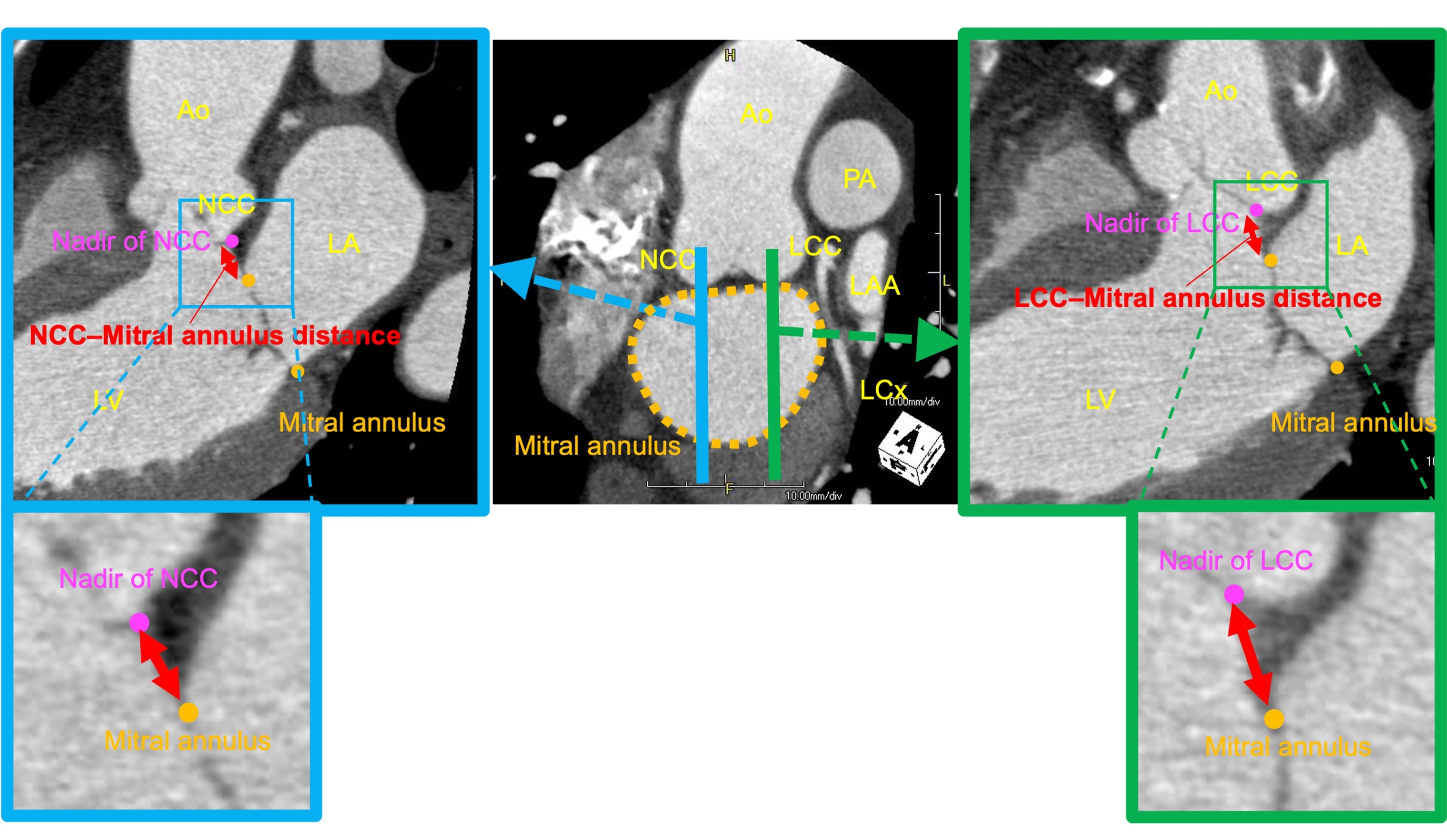
Methods: Among 857 patients who underwent mitral valve surgery between 2010–2022, those with planned concomitant aortic valve surgery, infective endocarditis, and history of aortic valve surgery (n=343) were excluded. Of the remaining 514 patients, 276 patients (53.7%) with preoperative enhanced cardiac computed tomography (CT) were included in the final analysis. The aorto-mitral length was measured as the shortest length between the non- or left-coronary cusp (NCC or LCC) and mitral annulus (Fig.1). Worsening of aortic insufficiency (AI) was defined as either (1) an increase of at least one severity grade relative to the pre-operative assessment or (2) the need for unplanned aortic valve surgery due to severe intra-operative AI. Data are presented as % or median (interquartile range).
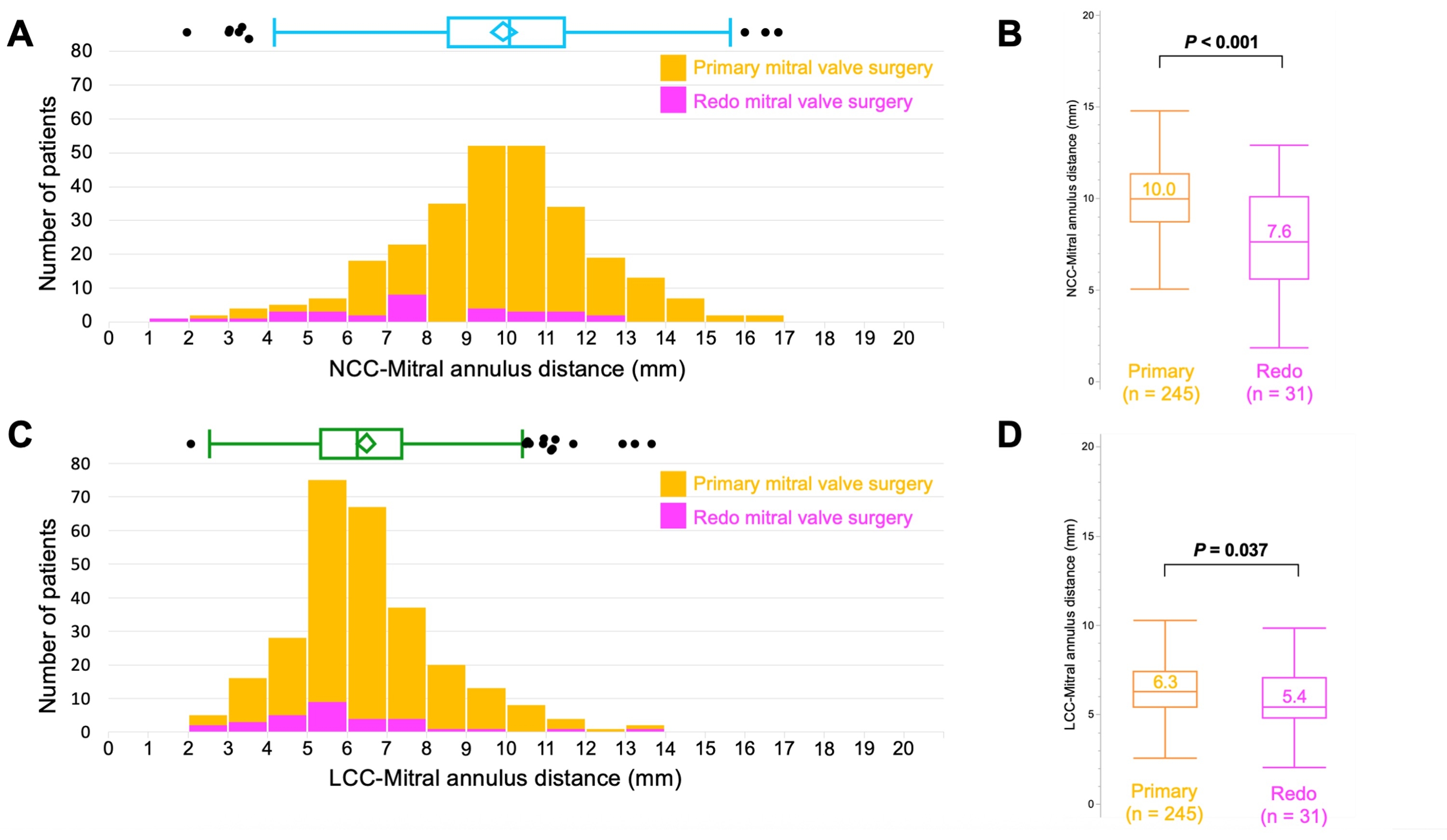
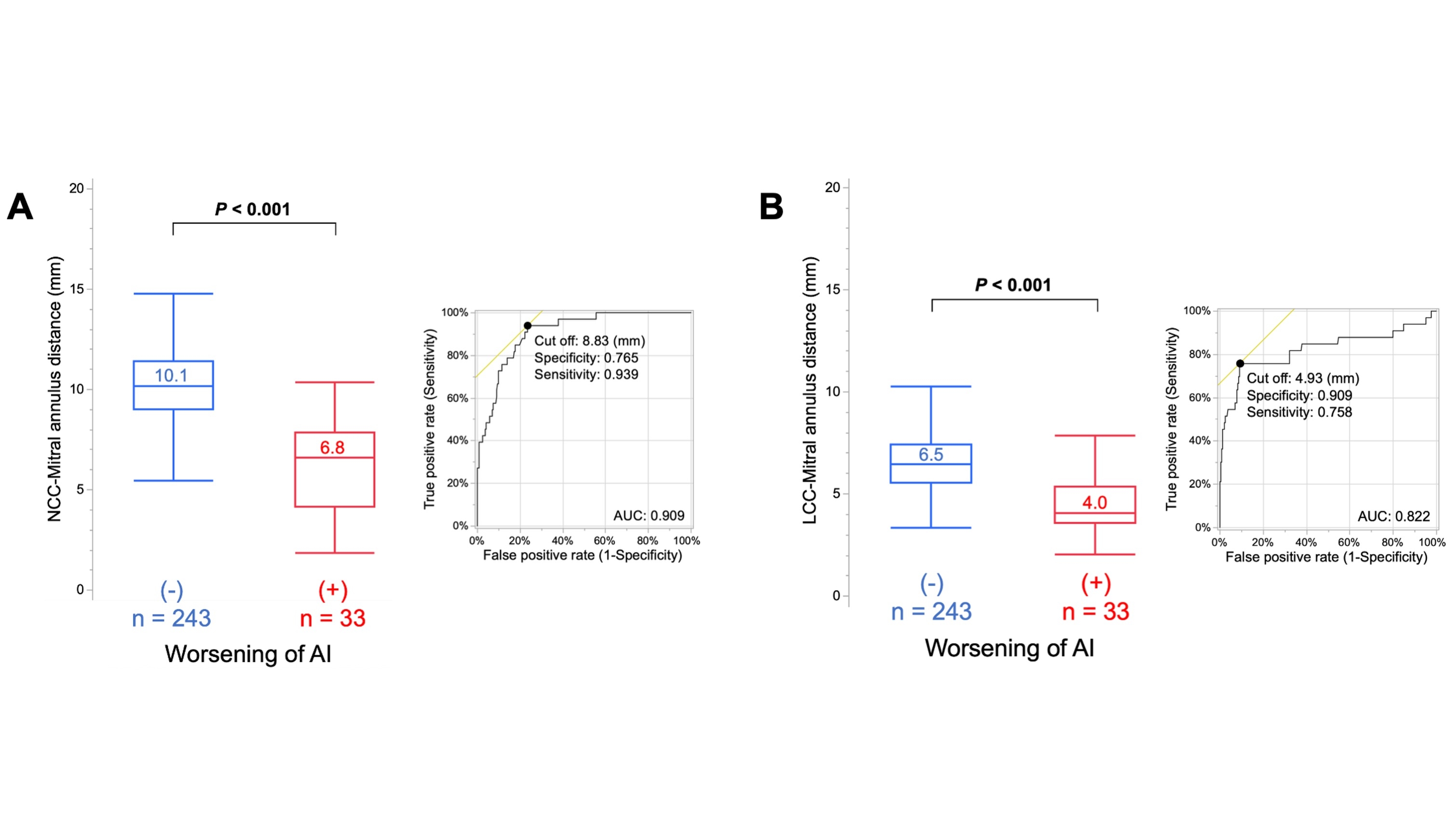
Results: The patient demographics were as follows: age, 68 [55–76] years; male, 65.2%; primary mitral valve surgery, 88.8% (all cases with mitral regurgitation), and redo mitral valve surgery, 11.2%. The NCC–mitral annulus length was 9.8 mm (8.3–11.2 mm). In redo cases, this length was shorter than in primary cases (7.6 mm [5.6–10.1 mm] vs 10.0 mm [8.7–11.3 mm]; P<0.001). The LCC–mitral annulus length was 6.2 mm (5.3–7.4 mm), which was shorter than the NCC–mitral annulus length (P<0.001). Likewise, in redo cases the LCC–mitral annulus length was shorter than in primary cases (5.4 mm [4.8–7.0 mm] vs 6.3 mm [5.4–7.4 mm]; P=0.037: Fig.2). Postoperative worsening of AI occurred in 12.0% (n=33/276), including three patients requiring unplanned aortic valve replacement. LCC- and NCC-mitral annulus length of worsening AI group were shorter than those in the non-worsening AI group (6.8 [4.6–8.0] vs. 10.7 [8.7–11.8] mm, P<0.001; 4.0 [3.6–5.8] vs. 6.5 [5.8–7.8] mm, P<0.001), associated with worsening of AI (cutoff value, 4.93 and 8.83mm: Fig.3).
Conclusions: The aorto-mitral length can be precisely measured using preoperative cardiac CT, and a shorter aorto-mitral length would be associated with worsening of AI following mitral valve surgery.
Handa, Kazuma
(
The University of Osaka Graduate School of Medicine
, Osaka , Japan )
Yajima, Shin
(
The University of Osaka Graduate School of Medicine
, Osaka , Japan )
Yanagino, Yusuke
(
The University of Osaka Graduate School of Medicine
, Osaka , Japan )
Kakizawa, Yumi
(
The University of Osaka Graduate School of Medicine
, Osaka , Japan )
Yoshioka, Daisuke
(
The University of Osaka Graduate School of Medicine
, Osaka , Japan )
Kawamura, Takuji
(
The University of Osaka Graduate School of Medicine
, Osaka , Japan )
Kawamura, Ai
(
The University of Osaka Graduate School of Medicine
, Osaka , Japan )
Misumi, Yusuke
(
The University of Osaka Graduate School of Medicine
, Osaka , Japan )
Saito, Shunsuke
(
The University of Osaka Graduate School of Medicine
, Osaka , Japan )
Shimamura, Kazuo
(
The University of Osaka Graduate School of Medicine
, Osaka , Japan )
Yamauchi, Takashi
(
The University of Osaka Graduate School of Medicine
, Osaka , Japan )
Miyagawa, Shigeru
(
The University of Osaka Graduate School of Medicine
, Osaka , Japan )
Author Disclosures:
Kazuma Handa:DO NOT have relevant financial relationships
| Kazuo Shimamura:DO NOT have relevant financial relationships
| Takashi Yamauchi:No Answer
| Shigeru Miyagawa:No Answer
| Shin Yajima:No Answer
| Yusuke Yanagino:DO NOT have relevant financial relationships
| Yumi Kakizawa:No Answer
| Daisuke Yoshioka:No Answer
| Takuji Kawamura:DO NOT have relevant financial relationships
| Ai Kawamura:No Answer
| Yusuke Misumi:No Answer
| Shunsuke Saito:No Answer