
Logo

American Heart Association

  15
  0


Final ID: MP1389

Unveiling the Dual Impact of HCN4 Gene Mutation: A Case of Cardiac and Mood Disorder Manifestation

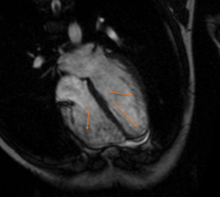
Abstract Body (Do not enter title and authors here): A 16-year-old-male presented in 2016 after a fall with a concussion due to dizziness. Chest X-ray showed a prominent cardiac silhouette. Further workup showed an echocardiogram with no left ventricular hypertrophy and mild left ventricular dilation. A Holter monitor recorded 1259 single PACs and 87 aberrantly conducted PACs. The patient was diagnosed with anxiety in 2017 and started on sertraline and later changed to fluoxetine. These medications were stopped at the end of 2022. In early 2023, he presented with symptomatic sinus bradycardia. A coronary angiogram revealed no obstructive CAD. MRI showed LV noncompaction towards the ventricular apex. Genetic testing showed a heterozygous HCN4 gene mutation.
The HCN4 gene mutation variants affect the cyclic nucleotide-gated cardiac ion channels, potentially leading to arrhythmias. It is most associated with patients with sinus node dysfunction. Specific mutations have been known to also present with left ventricular noncompaction (like in our patient), sick sinus syndrome, and susceptibility to ventricular fibrillation. Emerging evidence suggests that HCN4 gene may have potential expression in the brain. It is known that the HCN1 and HCN2 genes are common in the brain, but they are finding that the HCN4 gene is used as an “on-off” button that can control the way neurons respond to synaptic input.
This gene mutation, Gln375Ter, is associated with LV noncompaction or sinus node dysfunction. However, very few cases show an association of arrhythmias with mood disorders. There is evidence that the HCN4 gene may be associated with anxiety and depression because of its presence in the brain and specifically its location in the frontal cortex, and thalamocortical network. Our case illustrates how symptoms related to the mutation gradually emerged in the interval of presentation and diagnosis of the HCN4 gene mutation.
For patients presenting with symptomatic bradycardia, screening for anxiety and depression using DSM-V criteria could be crucial in identifying a genetic basis for their condition. Given that the HCN4 gene mutation can manifest in diverse ways due to its expression in both the heart and brain, awareness of these potential symptoms can aid the care team in accurately diagnosing this mutation.
  • Muppala, Sindhu  ( UPMC , Harrisburg , Pennsylvania , United States )
  • Kozuch, Beverley  ( UPMC , Harrisburg , Pennsylvania , United States )
  • Specht, Shane  ( UPMC , Harrisburg , Pennsylvania , United States )
  • Author Disclosures:
    Sindhu Muppala: DO NOT have relevant financial relationships | Beverley Kozuch: No Answer | Shane Specht: No Answer
Meeting Info:

Scientific Sessions 2025

2025

New Orleans, Louisiana

Session Info:

Clinical Case: Congenital and Inherited Heart Disease

Sunday, 11/09/2025 , 09:15AM - 10:10AM

Moderated Digital Poster Session

More abstracts on this topic:
Association of left ventricular summit arrhythmias with pathogenic gene variants

Kondamudi Nitin, Bevan Graham, Nazer Babak, Stergachis Andrew, Hisama Fuki, Chatterjee Neal

Patterns of Lifestyle Risk Behaviors for Cardiovascular Disease in Family Caregivers: A Latent Class Analysis

Ahn Soojung, Son Elisa H, Mogos Mulubrhan, Muchira James, Sheng Ying, Park Chorong, Lee Lena

You have to be authorized to contact abstract author. Please, Login
Not Available