
Logo

American Heart Association

  19
  0


Final ID: MP2307

Differential Associations by Sex Between Sleep-Wake Regularity and All-Cause and Cardiovascular Mortality

Abstract Body (Do not enter title and authors here): Introduction
Highly irregular sleep-wake timing is prospectively associated with higher all-cause and cardiovascular (CVD) mortality rates. These relationships are hypothesized to reflect harmful effects of inconsistent patterns of exposures (eg, light-dark), behaviors (eg, sleep-wake), and circadian rhythms (ie, intrinsic time-varying physiology). Sex differences span sleep and circadian physiology, yet sex-specific relationships between sleep regularity and mortality have not been assessed.

Question
Using the Sleep Regularity Index (SRI), a metric that captures circadian disruption through the average probability that participants are in the same sleep-wake state 24 hours apart, this study examined whether associations between the day-to-day regularity of sleep-wake timing and mortality differ by sex.

Methods
The study included UK Biobank participants with week-long accelerometer-derived sleep-wake data. To reduce reverse causality bias, deaths within one year of recordings were excluded. SRI was calculated by sleepreg. All-cause and CVD mortality were ascertained from inpatient hospital records and death registrars. Age-adjusted Cox proportional hazards models estimated adjusted hazards ratios (aHRs) between SRI categories and time to all-cause or CVD mortality without and with SRI × sex interaction term. SRI–sex combinations were compared using estimated marginal means.

Results
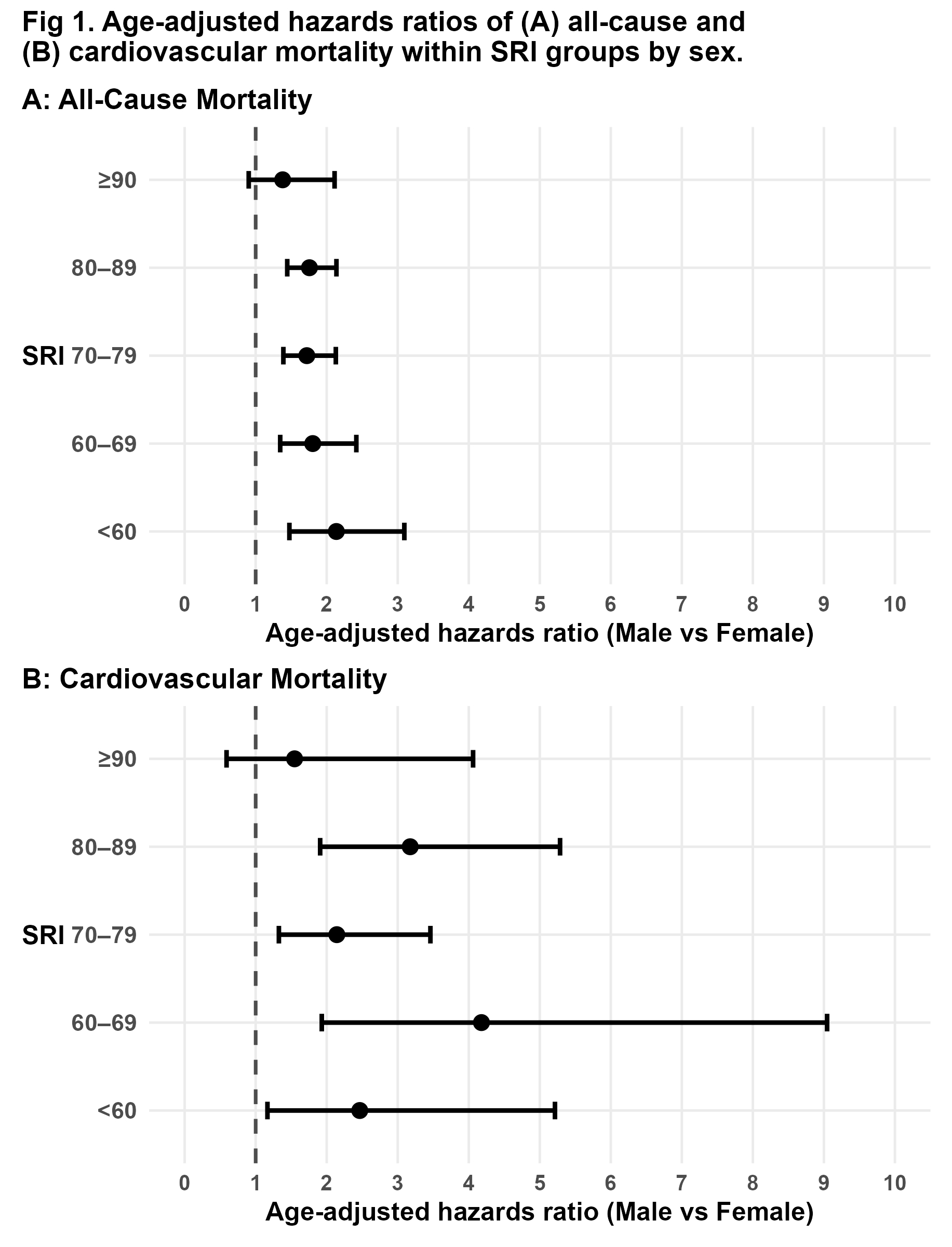
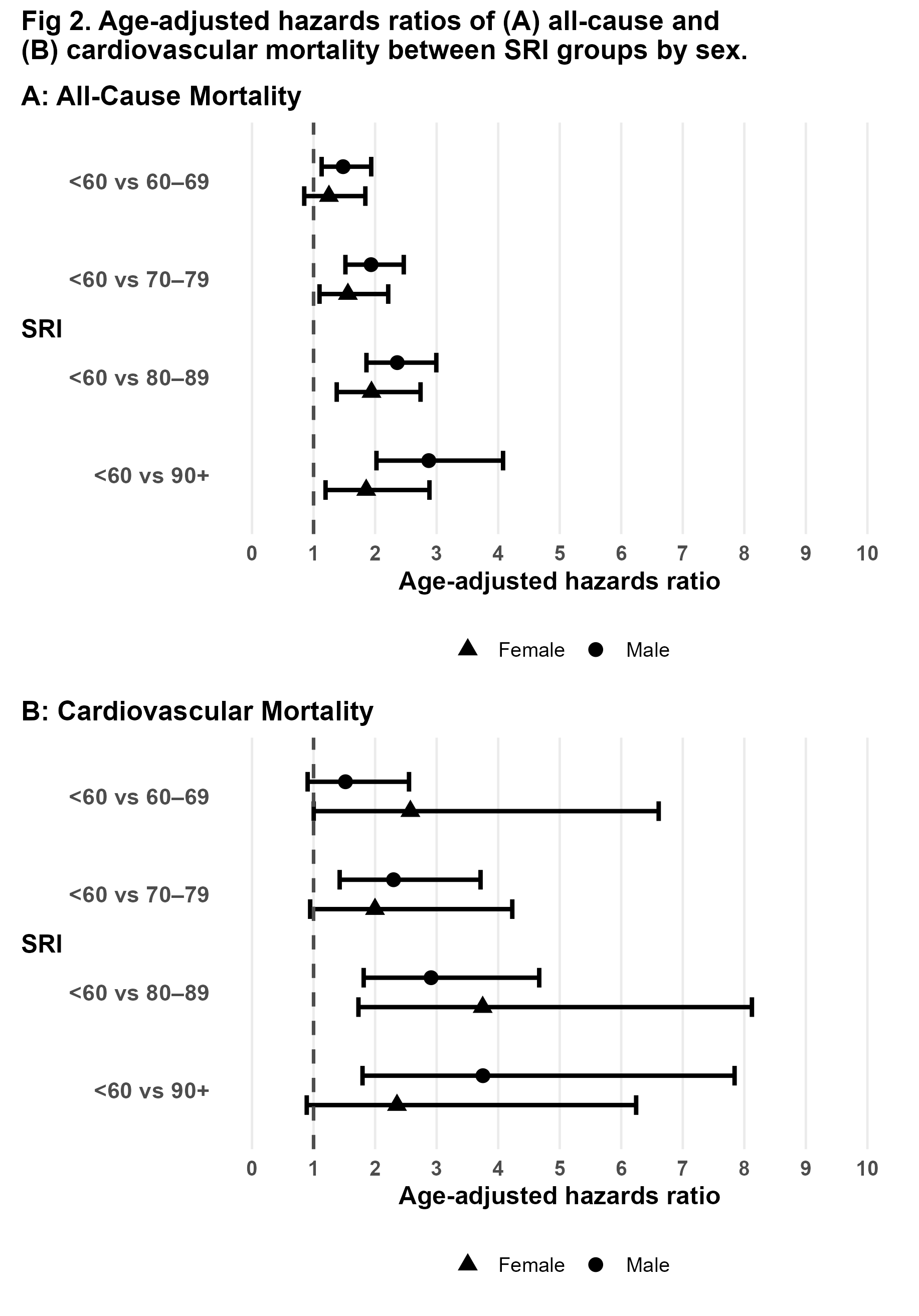
Among 73,647 adults (41,489 [56.3%] female, mean age 62.5±7.8 y) followed for a mean of 7.5±0.9 y, there were 2631 deaths; 20.5% were from primarily CVD causes. Higher age-adjusted mortality rates were observed with the lowest SRI (<60) compared to the highest (≥90) for both all-cause (aHR=2.4; 95% CI=2.0–2.9) and CVD mortality (3.2; 2.1–4.6) (Fig 1). Significant interaction terms were identified for SRI <60 × male (all-cause) and SRI 60–69 × male (CVD). Higher all-cause and CVD mortality rates were associated among males with SRI <60 versus ≥90 (all-cause 2.9; 2.1–4.0; CVD 3.8; 1.9–7.5) and compared to females with SRI <60 (all-cause 2.1; 1.5–3.0; CVD 2.5; 1.2–5.0) (Fig 2). In contrast, neither all-cause nor CVD mortality differed by sex among individuals with SRI ≥90.

Conclusion
Higher mortality rates associated with highly irregular sleep-wake timing are particularly pronounced among males, especially for CVD mortality. The absence of sex differences among those with high sleep regularity suggests that consistent sleep-wake patterns may attenuate heightened male mortality rates.
  • Czeisler, Mark  ( Brigham and Women's Hospital , Boston , Massachusetts , United States )
  • Leota, Josh  ( Monash University , Melbourne , Victoria , Australia )
  • Le, Flora  ( Monash University , Melbourne , Victoria , Australia )
  • Kontopidis, Andreas G.  ( Boston Scientific Corp. , Marlborough , Massachusetts , United States )
  • Rajaratnam, Shantha M.w.  ( Monash University , Melbourne , Victoria , Australia )
  • Rao, Prashant  ( Beth Israel Deaconess Medical Cente , Boston , Massachusetts , United States )
  • Pase, Matthew  ( Monash University , Clayton , Victoria , Australia )
  • Kramer, Daniel  ( Beth Israel Deaconess Medical Cente , Boston , Massachusetts , United States )
  • Author Disclosures:
    Mark Czeisler: DO have relevant financial relationships ; Consultant:Nychthemeron LLC:Active (exists now) | Josh Leota: No Answer | Flora Le: DO NOT have relevant financial relationships | Andreas G. Kontopidis: DO NOT have relevant financial relationships | Shantha M.W. Rajaratnam: No Answer | Prashant Rao: DO NOT have relevant financial relationships | Matthew Pase: DO NOT have relevant financial relationships | Daniel Kramer: DO NOT have relevant financial relationships
Meeting Info:

Scientific Sessions 2025

2025

New Orleans, Louisiana

Session Info:

Interrelationships Between Sleep, Cardiovascular Health, and Outcomes

Monday, 11/10/2025 , 01:45PM - 02:45PM

Moderated Digital Poster Session

More abstracts on this topic:
A Contemporary Machine Learning-Based Risk Stratification for Mortality and Hospitalization in Heart Failure with Preserved Ejection Fraction Using Multimodal Real-World Data

Fudim Marat, Weerts Jerremy, Patel Manesh, Balu Suresh, Hintze Bradley, Torres Francisco, Micsinai Balan Mariann, Rigolli Marzia, Kessler Paul, Touzot Maxime, Lund Lars, Van Empel Vanessa, Pradhan Aruna, Butler Javed, Zehnder Tobias, Sauty Benoit, Esposito Christian, Balazard Félix, Mayer Imke, Hallal Mohammad, Loiseau Nicolas

Chronotype and Cardiovascular Disease Risk Factors among Middle-aged and Older Adults: A Mendelian Randomization Study

Kianersi Sina, Potts Kaitlin, Wang Heming, Sofer Tamar, Noordam Raymond, Rutter Martin, Rexrode Kathryn, Redline Susan, Huang Tianyi

More abstracts from these authors:
Sleep quality and consolidation: effects on the cardio-neuro axis

Pase Matthew, Baril Andree-ann, Shechter Ari

Association of Sleep and Exercise with Chronic Disease: Insights from Long-Term Wearable Data Among All of Us Participants

Kalyanasundaram Asanish, Gerszten Robert, Rao Prashant, Barber Jacob, Mi Michael, Keyes Michelle, Tahir Usman, Robbins Jeremy, Peters Nicholas, Sofer Tamar, Kramer Daniel

You have to be authorized to contact abstract author. Please, Login
Not Available