Sex-based Differences of Risk Factors Associated with Cumulative Limb Amputation in Thromboangiitis Obliterans (Buerger’s Disease)
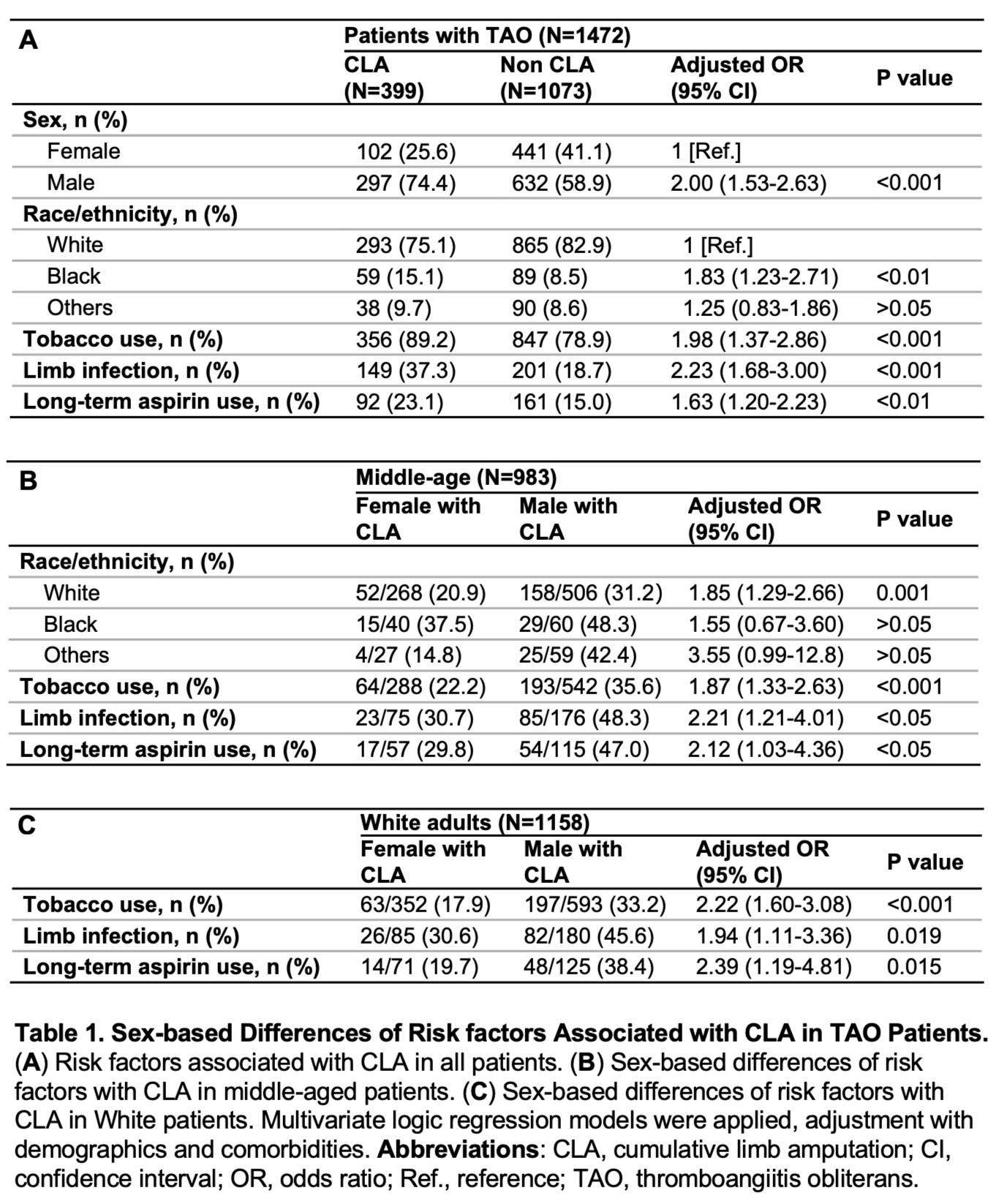
Abstract Body (Do not enter title and authors here): Backgroud: Thromboangiitis obliterans (TAO) is a rare, nonatherosclerotic, inflammatory disease that usually onsets in young male patients with heavy smoking. Up to 1/3 of patients with TAO will experience limb amputation. Little is known about how risk factors have affected cumulative limb amputation (CLA) by sex for patients with TAO in real-world settings during modern times. Method: Patients with TAO were identified by ICD-10-CM in National Inpatient Sample (NIS) of United States, from calendar year 2016 to 2022. Patients were excluded if they were less than 18 years old, or combined with atherosclerotic disease, ischemic stroke, diabetes mellitus, rheumatoid arthritis, systemic lupus erythematosus, thrombophilia, arterial embolism, and pregnancy. Behavior disorders, comorbidities, antithrombotic therapy and CLA were identified using appropriate ICD-10-CM codes. Multivariate logistic regression model was employed to analyze association between risk factors and CLA. Sex-based differences were performed in subgroups of middle-age and White patients. Result: There were 4577 all-cause hospitalizations for patients with TAO, from 2016 to 2022 in NIS datasets. Finally, 1472 patients with TAO were enrolled in this study after exclusion. After adjustment with variables, sex (male vs female, OR=2.00, p<0.001), race (Black vs White, OR=1.83, p<0.01), tobacco user (OR=1.98, p<0.001), limb infection (OR=2.23, p<0.001) and aspirin user (OR=1.63, p<0.01) were risk factors associated with higher CLA rate (Table 1A). Sex-based differences (ORs>1.85, p<0.05, Table 1B) were observed in sub-analysis in White patients, tobacco users, limb infection, long-term aspirin users among middle-aged patients. In addition, sex-based differences (ORs>1.94, p<0.05, Table 1C) were observed in sub-analysis in tobacco users, limb infection and long-term aspirin users among White patients. Conclusion: Male, Black, limb infection, tobacco and aspirin use were risk factors associated with higher CLA rate. Moreover, sex-based differences were observed in limb infection, tobacco and aspirin users in middle-aged and White patients. Further studies are warranted to explore mechanisms and patient-centered, personalized multidisciplinary care to improve TAO prognosis.
Li, Wenzhu
(
Independent
, Brookline , Massachusetts , United States )
Author Disclosures:
Wenzhu Li:DO NOT have relevant financial relationships