Area Deprivation, Social Vulnerability, and Incident Hypertension in Men and Women at Midlife: The Coronary Artery Risk Development in Young Adults (CARDIA) Study
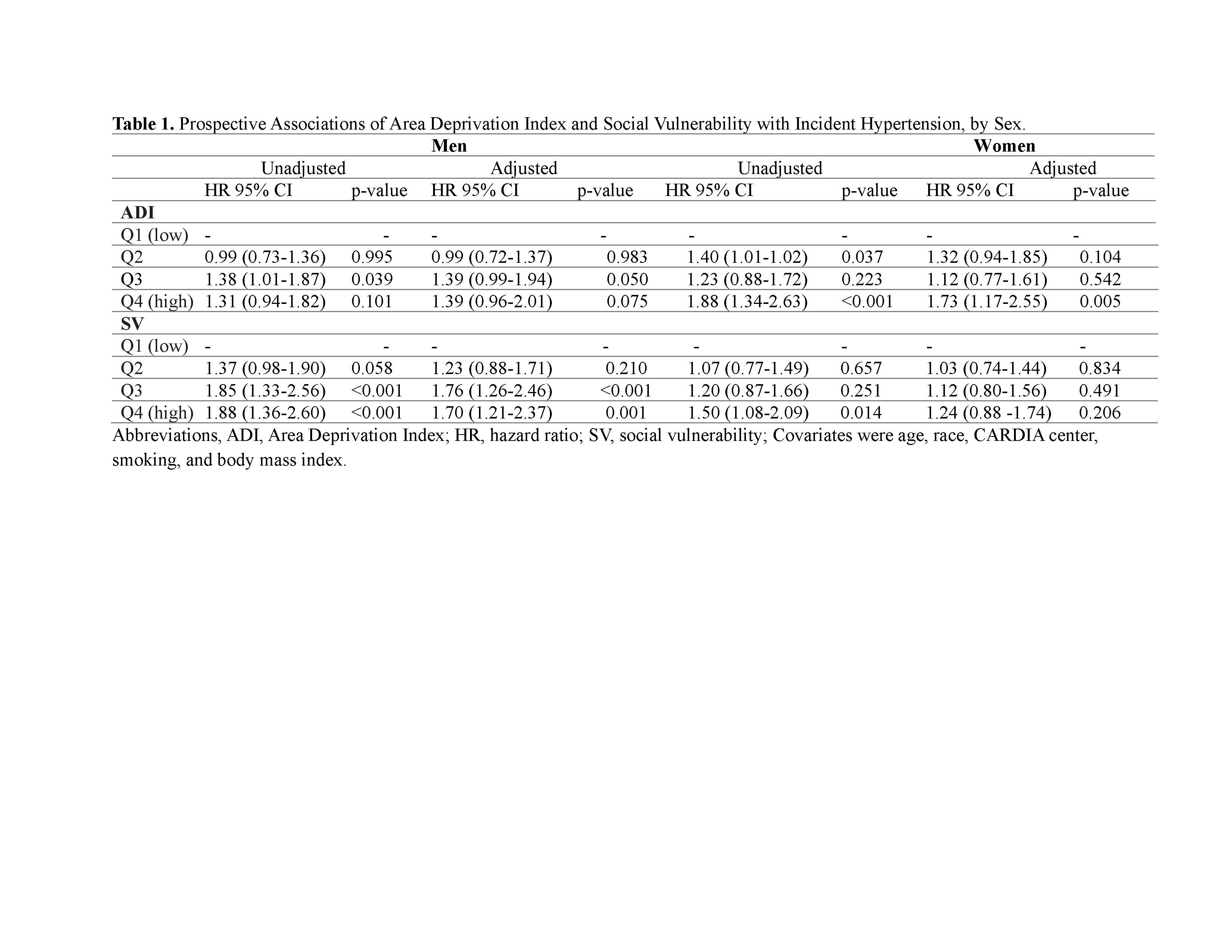
Abstract Body: Introduction: Social adversity is associated with hypertension (HTN) risk across the lifespan. Yet, it remains unclear whether area-based deprivation or individual-level social vulnerability (SV; from childhood and adulthood) has a stronger association. In women, HTN risk rises sharply post-menopause, but less is known about how social factors influence HTN in premenopausal women. The objective was to assess if area- and individual-level social factors are differentially associated with HTN risk in premenopausal women and same-aged men. Hypotheses: Area-based deprivation and individual-level SV would each be associated with greater risk of HTN, and associations would differ by sex. Methods: We used data from the CARDIA study, which recruited a biracial sample aged 18-30 in 1985-86, followed for 30 years. To target midlife, the baseline was set at Year 15, with up to 15 years of follow-up. Exclusions were prior HTN, cardiovascular disease, or menopause. The sample was 2196 adults (median age: 40 [IQR: 37,43], 59% women, 43% Black). HTN was defined as blood pressure ≥140 or ≥90 mmHg or antihypertensive use. Proportional hazards regression models for interval-censored data assessed prospective relations of the Area Deprivation Index (ADI; Census-level disadvantage), and SV (z-scored composite of early life trauma, discrimination, healthcare access, social support, neighborhood cohesion, and chronic burden), with incident HTN. ADI and SV were divided into quartiles (Q1=low, Q4=high), and analyses were sex-stratified. Covariates were CARDIA center, age, race, smoking, and body mass index (from Year 15). Results: Overall, 35% of men and 23% of women developed HTN over 5.7 and 5.5 average years. In unadjusted ADI analyses, men in Q3 had 38% greater HTN risk vs Q1, and women in Q2 and Q4 had 40% and 88% greater risk than those in Q1 (Table 1). After adjustment, ADI was only significant for women, as Q4 was associated with 73% greater HTN risk than Q1. In SV models, men in Q3 and Q4 had 80-90% greater HTN risk vs Q1; and women in Q4 had 50% greater risk vs Q1. After adjustment, SV Q3 and Q4 were still associated with 70-76% greater HTN risk for men, but not for women. Adding ADI to SV models did not alter results. Conclusions: Ultimately, area-based deprivation influenced midlife HTN risk in women, while individual-level SV factors were influential for men. Our findings feature the value of exploring sex-specific pathways linking social adversity to HTN.
Gaffey, Allison
(
Yale School of Medicine
, New Haven , Connecticut , United States )
Burg, Matthew
(
Yale School of Medicine
, New Haven , Connecticut , United States )
Lewis, Cora
(
Univeristy of Alabama at Birmingham
, Birmingham , Alabama , United States )
Gunderson, Erica
(
Kaiser Permanente Northern Californ
, Oakland , California , United States )
Yano, Yuichiro
(
Juntendo University Faculty of Medi
, Otsu , Japan )
Knutson, Kristen
(
Northwestern University
, Chicago , Illinois , United States )
Haskell, Sally
(
Department of Veterans Affairs
, West Haven , Connecticut , United States )
Schwartz, Joseph
(
Stony Brook University
, East Setauket , New York , United States )
Author Disclosures:
Allison Gaffey:DO NOT have relevant financial relationships
| Matthew Burg:No Answer
| Cora Lewis:No Answer
| Erica Gunderson:No Answer
| Yuichiro Yano:DO NOT have relevant financial relationships
| Kristen Knutson:DO NOT have relevant financial relationships
| Sally Haskell:No Answer
| Joseph Schwartz:DO NOT have relevant financial relationships