
Logo

American Heart Association

  21
  0


Final ID: Su3029

Meta-Analysis of Outcomes Following Lead Extraction for Cardiac Implantable Electronic Device-Related Infections in Patients with Left Ventricular Assist Devices

Abstract Body (Do not enter title and authors here): There is a class I recommendation for lead extraction in cardiac implantable electronic device (CIED) infections. However, in patients supported by left ventricular assist devices (LVAD) the calculus is more complicated due to multiple prior vascular accesses, long lead dwell times, LVAD hardware infections, and the inherent risks of performing invasive procedures in a hemodynamically fragile population. Comprehensive outcome data to guide management in this subset of patients is limited.

We aimed to evaluate the procedural efficacy, complication rates, and mortality following CIED lead extraction in patients with LVADs who developed device-related infections.

A systematic literature review of five electronic databases was conducted. We included all published studies of LVAD patients undergoing lead extraction for CIED-related infection and our unpublished, retrospectively gathered institutional cohort. The primary outcome was the pooled rate of complete procedural success. Secondary outcomes included minor and major procedural complications and 30-day and 1-year mortality. Outcomes of interest were pooled and analyzed using a random-effects model (DerSimonian-Laird). Heterogeneity was quantified using I^2 and τ^2 statistics.

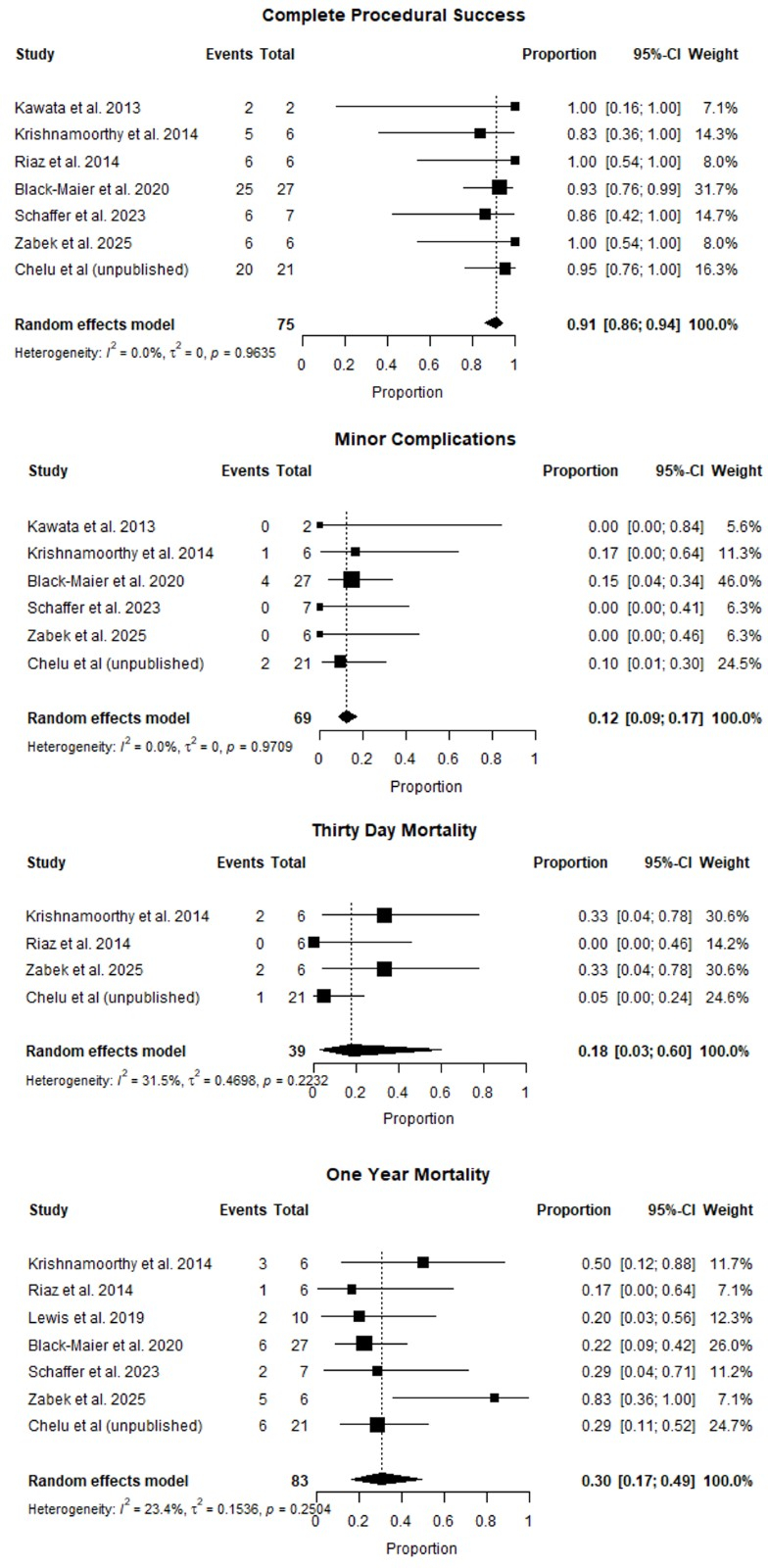
Seven published observational studies and our unpublished institutional data comprised 88 patients (22.7% female, mean age 58.7 years). The pooled rate of complete procedural success was 91% [95% CI: 86%–94%]. Minor complications occurred in 12% [95% CI: 9%–17%]. The 30-day mortality was 18% [95% CI: 3%–60%] and the 1-year mortality was 30% [95% CI: 17%–49%]. Heterogeneity was low to moderate across outcomes (I^2: 0–31.5%). No procedural mortality or major complications were reported.

CIED lead extraction in LVAD recipients with device-related infection is associated with high procedural success and low complication rates. The lack of major complications associated with lead extractions suggests that the high post-extraction mortality is a consequence of the high-risk population rather than the procedure itself. Our results suggest that when clinically indicated, CIED lead extraction in LVAD recipients is a feasible and effective intervention.
  • Baqai, Faiz  ( Baylor College of Medicine , Houston , Texas , United States )
  • Lewis, Alexandra  ( Baylor College of Medicine , Houston , Texas , United States )
  • Draeger, Derrick  ( Baylor College of Medicine , Houston , Texas , United States )
  • Xiao, Emily  ( Baylor College of Medicine , Houston , Texas , United States )
  • Lynch, Patrick  ( Baylor College of Medicine , Houston , Texas , United States )
  • Chelu, Mihail  ( Baylor College of Medicine , Houston , Texas , United States )
  • Author Disclosures:
    Faiz Baqai: DO NOT have relevant financial relationships | Alexandra Lewis: DO NOT have relevant financial relationships | Derrick Draeger: DO NOT have relevant financial relationships | Emily Xiao: DO NOT have relevant financial relationships | Patrick Lynch: No Answer | Mihail Chelu: No Answer
Meeting Info:

Scientific Sessions 2025

2025

New Orleans, Louisiana

More abstracts from these authors:
Slow Coronary Flow is Associated with Left Ventricular Diastolic Dysfunction and Left Atrial Dilation

Draeger Derrick, Katsnelson Michael, Bhalja Mehul, Diez Jose

Pre-Existing Atrial Fibrillation and Mortality in Left Ventricular Assist Device Recipients

Castillo Rodriguez Beatriz, Razavi Mehdi, Civitello Andrew, Oberton Selby, Simpson Leo, Xie Lola, Nair Ajith, Chelu Mihail, Uppalapati Lakshmi, Lynch Patrick, Maloof Alexandra, Badjatiya Anish, Segar Matthew, Molina Razavi Joanna, Rasekh Abdi, Saeed Mohammad

You have to be authorized to contact abstract author. Please, Login
Not Available