
Logo

American Heart Association

  18
  0


Final ID: Sa4032

Impact of Novel Genetic Variants of Thoracic Aortic Aneurysm and Dissection Derived from a Community Cohort Study in Yamagata, Japan, for Preventive Aortic Therapy

Abstract Body (Do not enter title and authors here): Background: Thoracic aortic aneurysms and dissections (TAAD) are primarily associated with acquired factors. However, 20% of cases exhibit familial clustering, indicating a genetic contribution. Although multiple causative genes have been identified, there may be as yet unknown etiologic variants, and it remains to be determined how these may affect prognosis.
Research Questions: To explore the possibility that the discovery of minor alleles with new pathological significance may lead to early detection and personalized preventive aortic therapy based on individual risk profiles. Whether the presence of rare single nucleotide polymorphisms (SNPs) in TAAD-related genes established in a prospective regional cohort affects long-term outcome and may be an independent risk factor for TAAD-related mortality.
Methods: The Yamagata cohort is a longitudinal study of 25000 residents who participated in community health screenings. Of 5948 individuals with whole-genome data, 5722 with complete baseline information were analyzed (median age: 65 years; 45.9% male; smoking history: 32.4%; hypertension: 43.5%; diabetes mellitus: 19.2%; dyslipidemia: 50.7%; obesity: 27.7%). Based on the Japanese Circulation Society guidelines, SNPs in genes categorized as Strong/Definitive for TAAD association were comprehensively screened. Individuals harboring homozygous minor alleles with <5% frequency in the cohort were defined as the carrier group and compared to the non-carrier group.
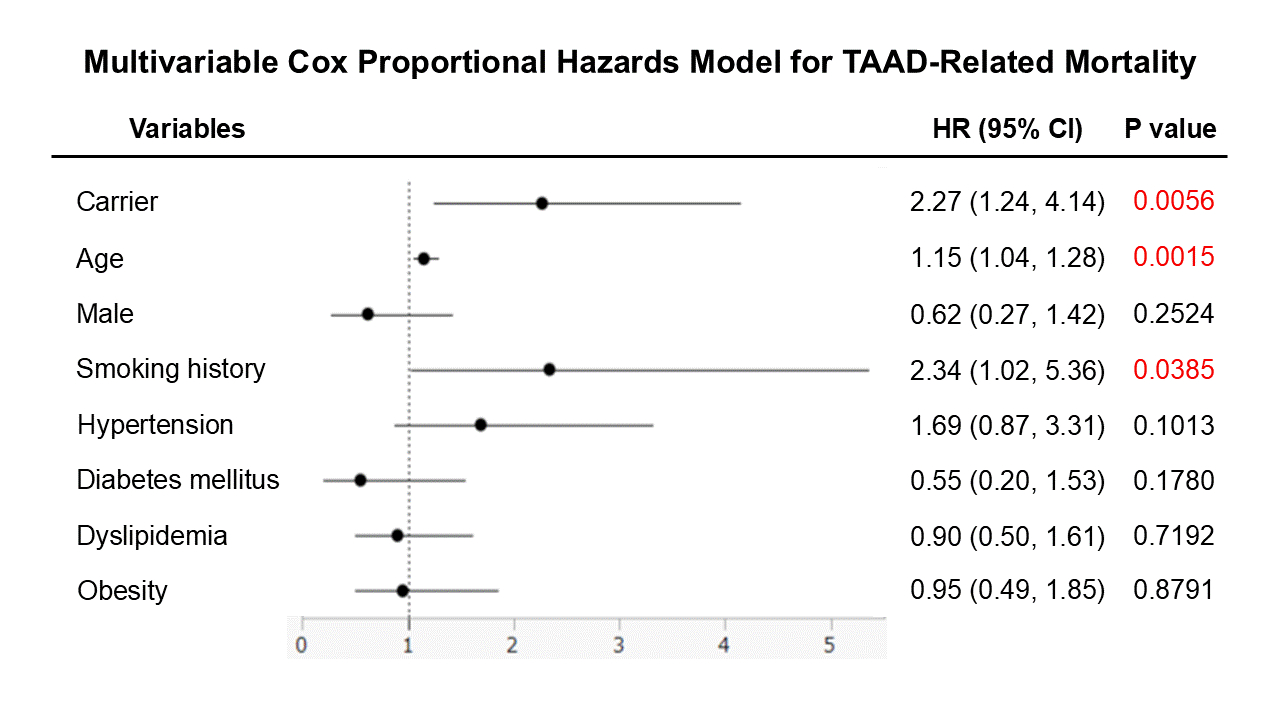
Results: Fourteen SNPs were identified, all located in regions related to smooth muscle contraction or TGF-β signaling. None had previously been reported as pathogenic. There were 1499 carriers and 4223 non-carriers. Median follow-up duration was 4984 days. TAAD-related deaths occurred in 8 individuals (0.53%) in the carrier group and 4 individuals (0.09%) in the non-carrier group. Kaplan-Meier analysis revealed a significantly higher mortality risk in the carrier group (P = 0.001). Multivariate Cox proportional hazards analysis demonstrated that SNP carriage was an independent risk factor for TAAD-related death (HR = 2.27, 95% CI: 1.24-4.14, P = 0.0056).
Conclusion: Carriage of rare SNPs not previously reported as pathogenic was significantly associated with TAAD-related death, suggesting the existence of novel genetic risk factors. These findings support the importance of further variant discovery and the potential utility of early genetic screening to facilitate pre-symptomatic therapeutic intervention.
  • Akabane, Kentaro  ( Yamagata University , Yamagata , Japan )
  • Nakamura, Ken  ( Nihonkai General Hospital , Yamagata , Japan )
  • Uchida, Tetsuro  ( Yamagata University , Yamagata , Japan )
  • Author Disclosures:
    Kentaro Akabane: DO NOT have relevant financial relationships | Ken Nakamura: DO NOT have relevant financial relationships | Tetsuro Uchida: DO NOT have relevant financial relationships
Meeting Info:

Scientific Sessions 2025

2025

New Orleans, Louisiana

Session Info:

Genomic Insights into Cardiac Valve and Aortic Disease

Saturday, 11/08/2025 , 10:30AM - 11:30AM

Abstract Poster Board Session

You have to be authorized to contact abstract author. Please, Login
Not Available