The Inflammasome and Fibroblast Activation Protein in Heart Failure with Reduced Ejection Fraction
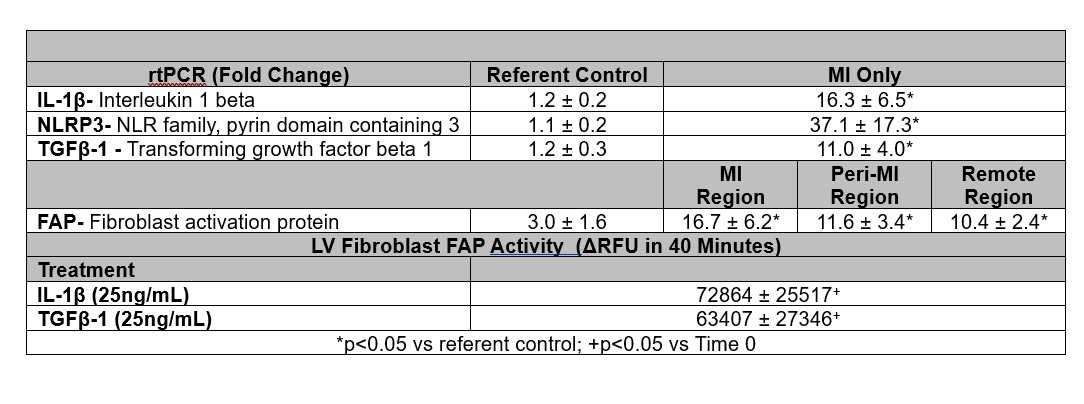
Abstract Body (Do not enter title and authors here): Background: An important cause of HF is that of left ventricular (LV) pump failure, termed HF with reduced ejection fraction (HFrEF), and is primarily caused by ischemic heart disease, such as myocardial infarction (MI). Recently, innate immune activation, specifically the inflammasome NOD-like receptor protein 3 (NOD-, LRR- and pyrin domain-containing protein 3,NLRP-3) has been identified in HFrEF. However, the relationship between LV structure, function and downstream proteolytic pathways, particularly fibroblast activation protein (FAP), with the development of HFrEF remains unknown. Using a large animal model of MI and HFrEF, the study tested the hypothesis that NLRP-3 activation occurs, and more importantly is associated with shifts in cytokine signaling and FAP expression. Methods and Results: MI was induced in pigs (25kg, n=10) and additional pigs served as referent controls (n=10). At 28 days post-MI, the HFrEF phenotype was observed with a reduced EF (43±4 vs 64±3%, p=<0.05). NLRP-3 expression increased by over 20-fold with HFrEF, (p<0.05; Table). A downstream proinflammatory/profibrotic cytokine, induced by NLRP-3, IL-1β, increased by over 15-fold (p<0.05), as did transforming growth factor- β (p<0.05). In addition, FAP expression increased by over 15- fold within the MI region, but interestingly was also increased in the remote region with HFrEF (p<0.05, n=5). Finally, in LV fibroblast cultures (n=4) both IL-1β and TGF- β (25 ng/mL) induced robust increase in FAP activity at 24hrs. Thus, a feed forward loop of NLRP-3 expression, IL1- β signaling and FAP induction was identified with HFrEF. Conclusions: While exogenous inflammatory pathways have been identified post-MI, this is the first study to directly quantify and integrate the inflammasome (NLRP-3); with a key proteolytic pathway (FAP) the development of HFrEF. This study uncovered a potent positive feedback loop of NLRP-3 induction whereby interruption of this NLRP-3/IL-1 β /TGF-β/FAP axis holds a novel therapeutic direction for HFrEF.
Mattia, Victoria
(
USC SCHOOL MEDICINE
, Columbia , South Carolina , United States )
Churillo, Amelia
(
University of South Carolina SOM and Columbia VA Health Care Center
, Columbia , South Carolina , United States )
Freeburg, Lisa
(
University of South Carolina SOM and Columbia VA Health Care Center
, Columbia , South Carolina , United States )
Maclaren, Janna
(
University of South Carolina SOM and Columbia VA Health Care Center
, Columbia , South Carolina , United States )
Samani, Stephanie
(
University of South Carolina SOM and Columbia VA Health Care Center
, Columbia , South Carolina , United States )
Delgra, Vivian
(
USC SCHOOL MEDICINE
, Columbia , South Carolina , United States )
Hofacre, Courtney
(
University of South Carolina
, Columbia , South Carolina , United States )
Barlow, Shayne
(
University of South Carolina
, Columbia , South Carolina , United States )
Jones, Traci
(
University of South Carolina
, Columbia , South Carolina , United States )
Cavalli, Eliana
(
University of South Carolina SOM and Columbia VA Health Care Center
, Columbia , South Carolina , United States )
Shazly, Tarek
(
University of South Carolina
, Columbia , South Carolina , United States )
Thorn, Stephanie
(
YALE UNIVERSITY
, New Haven , Connecticut , United States )
Sinusas, Albert
(
YALE UNIVERSITY
, New Haven , Connecticut , United States )
Goldsmith, Edie
(
USC SCHOOL MEDICINE
, Columbia , South Carolina , United States )
Spinale, Francis
(
University of South Carolina SOM and Columbia VA Health Care Center
, Columbia , South Carolina , United States )
Author Disclosures:
Victoria Mattia:DO NOT have relevant financial relationships
| Eliana Cavalli:DO NOT have relevant financial relationships
| Tarek Shazly:No Answer
| Stephanie Thorn:DO NOT have relevant financial relationships
| Albert Sinusas:DO have relevant financial relationships
;
Research Funding (PI or named investigator):Siemens:Active (exists now)
; Consultant:MicroVide:Active (exists now)
; Research Funding (PI or named investigator):Revalia:Active (exists now)
; Research Funding (PI or named investigator):Jubilant:Active (exists now)
| Edie Goldsmith:DO NOT have relevant financial relationships
| Francis Spinale:DO NOT have relevant financial relationships
| Amelia Churillo:DO NOT have relevant financial relationships
| Lisa Freeburg:DO NOT have relevant financial relationships
| Janna Maclaren:No Answer
| Stephanie Samani:DO NOT have relevant financial relationships
| Vivian Delgra:DO NOT have relevant financial relationships
| Courtney Hofacre:No Answer
| Shayne Barlow:DO NOT have relevant financial relationships
| Traci Jones:DO NOT have relevant financial relationships