
Logo

American Heart Association

  29
  0


Final ID: MP770

Prevalence and discrimination of ongoing fibrillation in isolated pulmonary vein in non-paroxysmal atrial fibrillation ablation

Abstract Body (Do not enter title and authors here): Backgrounds
Pulmonary vein isolation (PVI) usually results in abolishment of PV potentials (PVP) rather than concomitant termination of non-paroxysmal atrial fibrillation (non-PAF). It is unclear whether ongoing fibrillation in isolated PVs (OFIP) might co-exist with AF in non-PAF ablation. This study sought to explore the prevalence of OFIP in non-PAF ablation and to develop a concise discriminating algorithm to distinguish between OFIP and isolation failure, thereby minimizing excessive ablation and associated risks.
Methods
Non-PAF patients undergoing first-time ablation were divided into retrospective induction cohort (IC) and prospective validation cohort (VC). In case of ongoing PV fibrillation after PV ablation, PVI completion was assessed based on unique PVP phenomena and after systemic gaps mapping and ablation.
Results
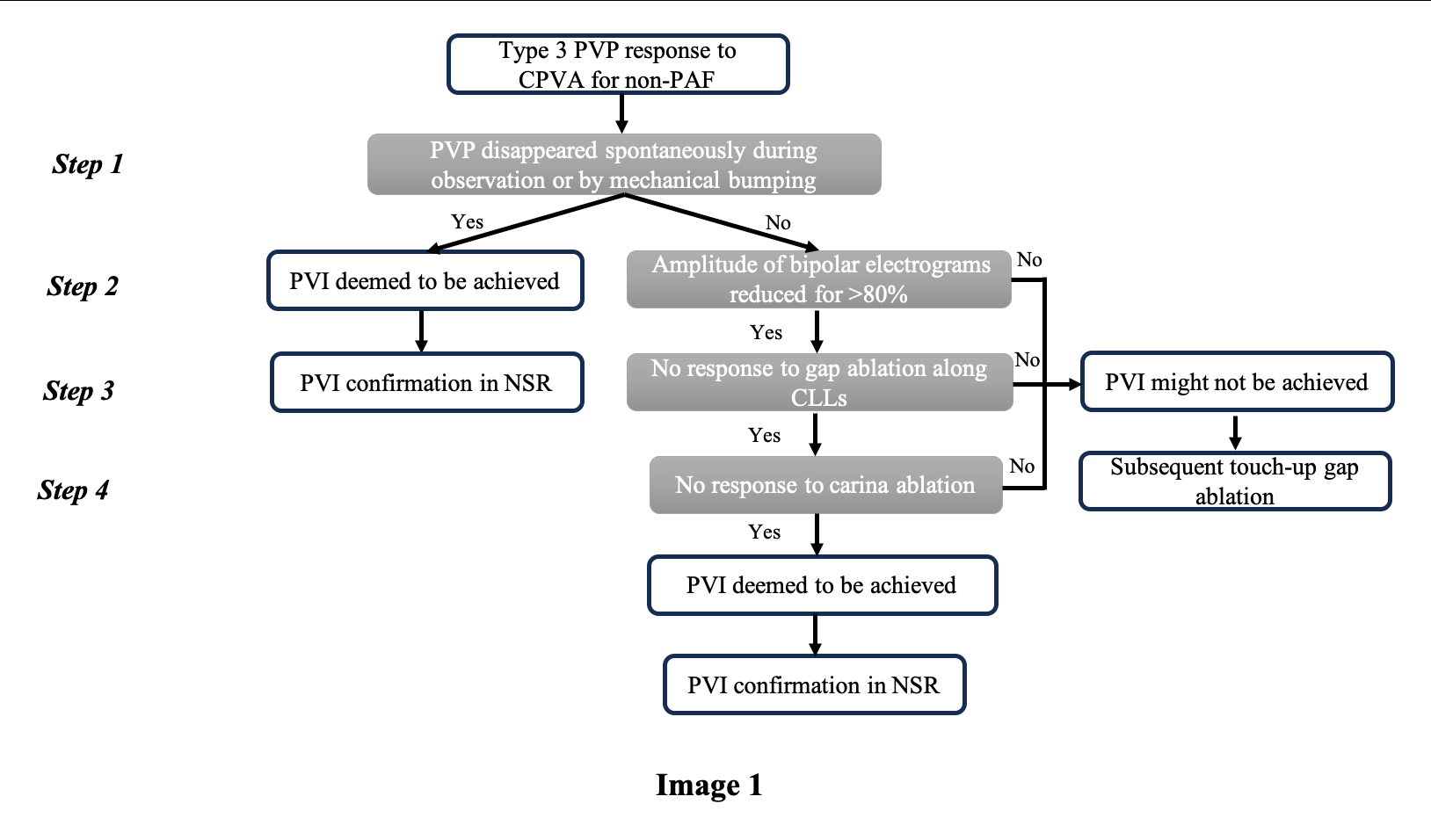
Twenty (3.55%) of 563 had OFIP, including 9/300 from the IC and 11/263 from the VC. No significant predictors of OFIP were identified in terms of baseline characteristics or procedural factors. Based on 3 right-sided, 5 left-sided, 1 bilateral OFIP cases in the IC, either spontaneous or bumping-induced PVP disappearance, or a combination of bipolar voltage reduction > 80%, local activation time later than PV recordings and no response to carina ablation were adopted as the major criteria for developing a discriminating algorithm. In 20 patients with ongoing PV fibrillation in the VC, the algorithm identified true OFIP in 11, false OFIP in 3 and true incomplete PVI in 6. The sensitivity, specificity, positive and negative predictive value was 100%, 66.7%, 78.6% and 100%, respectively.
Conclusions
OFIP was not negligible in non-PAF ablation procedures for achieving efficient and safe PVI. A novel four-step algorithm was developed to discriminate OFIP with good predictive value.
  • Kong, Lingcong  ( Ren Ji Hospital , SJTUSMU , Shanghai , China )
  • Wang, Xinhua  ( Ren Ji Hospital , SJTUSMU , Shanghai , China )
  • Author Disclosures:
    Lingcong Kong: DO NOT have relevant financial relationships | Xinhua Wang: No Answer
Meeting Info:

Scientific Sessions 2025

2025

New Orleans, Louisiana

Session Info:

Treatment of Arrhythmias: Ablation

Saturday, 11/08/2025 , 12:15PM - 01:10PM

Moderated Digital Poster Session

More abstracts on this topic:

A Large Animal Model of Persistent Atrial Fibrillation

Mostafizi Pouria, Goldman Steven, Moukabary Talal, Lefkowitz Eli, Ref Jacob, Daugherty Sherry, Grijalva Adrian, Cook Kyle Eric, Chinyere Ike, Lancaster Jordan, Koevary Jen

A novel deep learning framework identified associated genes and Interpretable deep learning translation of GWAS findings for drug repurposing in Atrial Fibrillation

Tonegawa-kuji Reina, Xu Jielin, Guntupalli Suman, Barnard John, Chung Mina, Cheng Feixiong

You have to be authorized to contact abstract author. Please, Login
Not Available