
Logo

American Heart Association

  13
  0


Final ID: MP2693

Inhibition of Satellite Glial Cell Activation in Stellate Ganglia Prevents Ventricular Arrhythmogenesis and Remodeling Following Myocardial Infarction

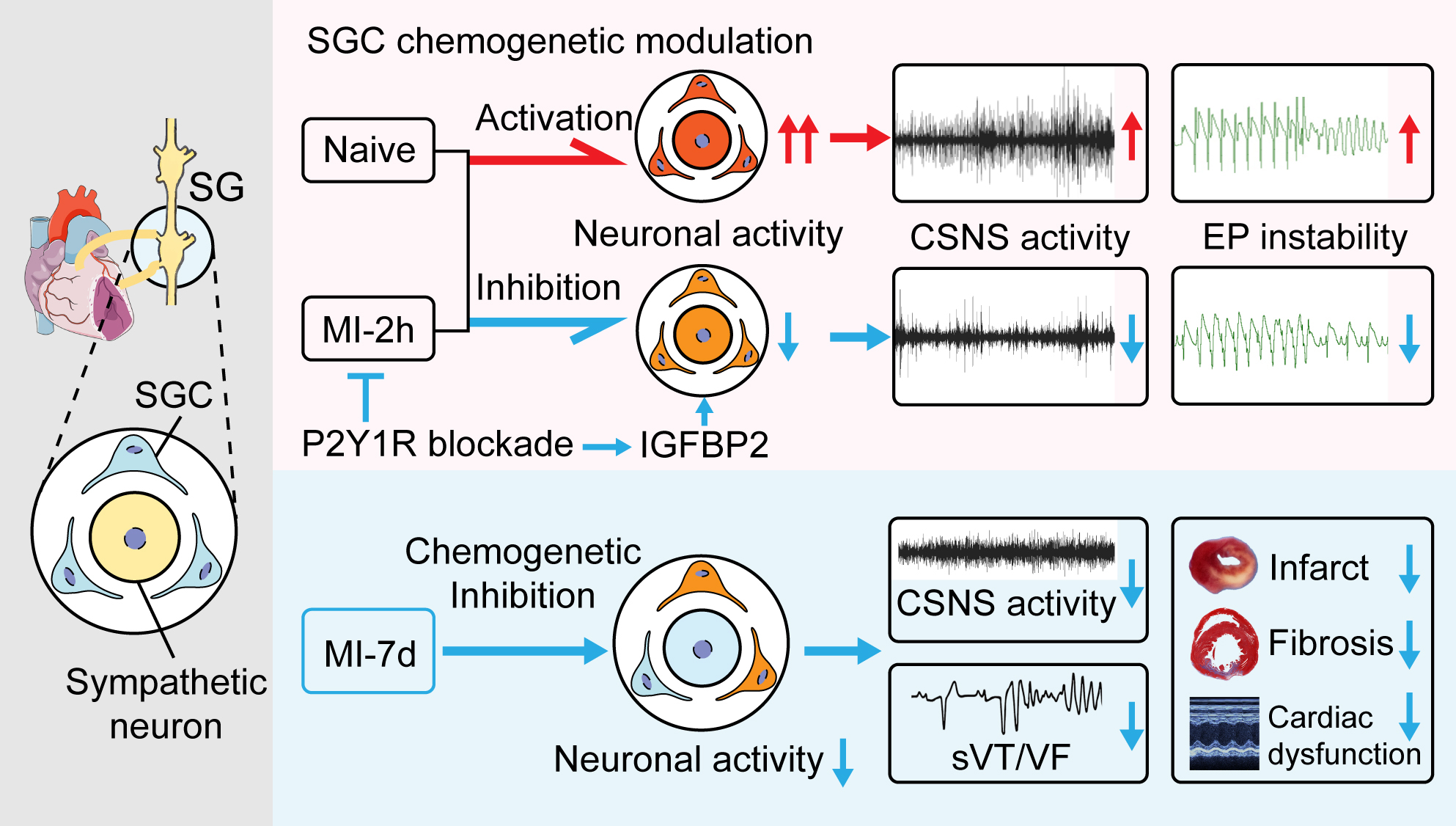
Abstract Body (Do not enter title and authors here): Background: Hyperactivity of sympathetic neurons in the stellate ganglia (SG) contributes to ventricular arrhythmias (VAs) and remodeling post-myocardial infarction (MI). However, the role of satellite glial cells (SGCs) surrounding the neurons in this process remains unknown.
Methods: SGC-specific chemogenetic manipulation was locally applied to modulate SG-SGC activity dual-directionally in the rats with naïve or infarcted hearts. Subsequently, cardiac sympathetic neural activity, ventricular electrophysiological stability in response to stimulation were evaluated, as well as cardiac neural and structural remodeling post-MI. SG bulk RNA sequencing and the interaction between SGCs and sympathetic neurons isolated from SG were employed to explore the underpinning mechanisms.
Results: SG-SGC excitation increased SG neural activity and ventricular electrophysiological instability in rats with naïve hearts whereas its inhibition influenced none of the above under physiological condition. Of note, 2h-MI provoked SG-SGC activation that positively correlated to cardiac sympathetic neurotransmitter (norepinephrine) release. Accordingly, SGC activation in the SG enhanced cardiac sympathetic hyperactivity 2h post-MI while SG-SGC inhibition suppressed MI-induced cardiac sympathetic hyperexcitability. Moreover, the persistent inhibition of SG-SGCs improved ventricular arrhythmogenesis, remodeling and dysfunction, alleviated SG and ventricular sympathetic nerve sprouting 7d post-MI. In addition, the bulk RNA sequencing with SG and pharmacological purinergic receptor P2Y1 (P2Y1R) blockage indicated that P2Y1R/insulin like growth factor binding protein 2 (IGFBP2) signaling might mediate the effects of SG-SGC activation on cardiac sympathetic hyperexcitability post-MI.
Conclusions: SGC inhibition in SG rectifies cardiac sympathetic hyperactivity, stabilizes ventricular electrophysiological properties and alleviates cardiac structural and neural remodeling post-MI, and resultantly preventing VAs and cardiac dysfunction. Neuromodulation targeting SG-SGCs exhibits a safe and fruitful strategy for the treatment of MI.
  • Zhou, Zhen  ( Department of Cardiology, Zhongnan Hospital of Wuhan University; Institute of Myocardial Injury and Repair, Wuhan University; Hubei Provincial Clinical Medical Research Center for Interventional Diagnosis and Treatment of Cardiovascular Diseases , Wuhan , China )
  • Wang, Qiongxin  ( Department of Cardiology, Zhongnan Hospital of Wuhan University; Institute of Myocardial Injury and Repair, Wuhan University; Hubei Provincial Clinical Medical Research Center for Interventional Diagnosis and Treatment of Cardiovascular Diseases , Wuhan , China )
  • He, Bo  ( Department of Cardiology, Zhongnan Hospital of Wuhan University; Institute of Myocardial Injury and Repair, Wuhan University; Hubei Provincial Clinical Medical Research Center for Interventional Diagnosis and Treatment of Cardiovascular Diseases , Wuhan , China )
  • Lu, Zhibing  ( Department of Cardiology, Zhongnan Hospital of Wuhan University; Institute of Myocardial Injury and Repair, Wuhan University; Hubei Provincial Clinical Medical Research Center for Interventional Diagnosis and Treatment of Cardiovascular Diseases , Wuhan , China )
  • Author Disclosures:
    Zhen Zhou: DO NOT have relevant financial relationships | Qiongxin Wang: DO NOT have relevant financial relationships | Bo He: No Answer | Zhibing Lu: DO NOT have relevant financial relationships
Meeting Info:

Scientific Sessions 2025

2025

New Orleans, Louisiana

Session Info:

Treatment of Arrhythmias: Pharmacologic

Monday, 11/10/2025 , 12:15PM - 01:10PM

Moderated Digital Poster Session

More abstracts on this topic:
Prognostication Of Cardioembolic Stroke Due To Underlying Atrial Fibrillation With Serum Troponin Levels

Maqsood Hamza, Hussain Alamdar, Solanki Siddhant, Furqan Muhammad, Karimi Muhammad Siddique, Younus Shifa, Khaliq Muhammad, Zafar Shahzad

Acute Effects of Isometric Handgrip Exercise on Cardiac Baroreflex Sensitivity in Chronic Kidney Disease

Sabino-carvalho Jeann, Park Jeanie

More abstracts from these authors:
Tryptophan-derived 3-Hydroxyanthranilic Acid Promotes Angiogenesis in Mouse Ischemic Hindlimbs

Ge Haijing, Xu Duo, Zhang Zixing, Xiong Hongbo, Cai Huanhuan, Lu Zhibing, Wang Qiongxin

You have to be authorized to contact abstract author. Please, Login
Not Available