Transformer-Based Survival Model Outperforms Traditional Methods for Cardiovascular Risk Prediction: Analysis of Two Million Annual Health Checkup Records in Japan
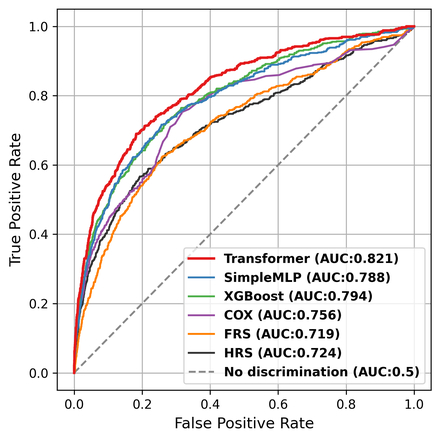
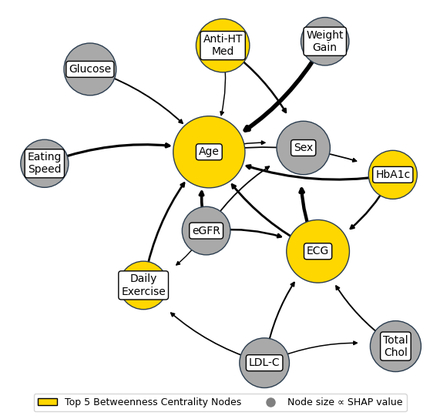
Abstract Body (Do not enter title and authors here): Background: Cardiovascular disease (CVD) is a global health concern. Traditional models often miss nonlinear dependencies among physiological and behavioral factors. Transformer-based deep learning can capture complex patterns in structured health data. We hypothesized that such a model, trained on large-scale check-up records, would improve long-term CVD risk prediction. Methods: Using annual health check-up data from Toyama Prefecture, Japan (n = 100,056; 2010–2024), we excluded individuals with baseline CVD. The outcome was time to incident CVD over 10 years, modeled as right-censored survival data. For external validation, we used data from Kanazawa City (n = 79,756). The Transformer model was trained using anthropometric, laboratory, and self-reported lifestyle data. Benchmark models included Cox regression, XGBoost survival embeddings, multilayer perceptron (MLP), the Framingham Risk Score (FRS), and the Hisayama Risk Score (HRS). Model performance was evaluated using C-index, time-dependent area under the curve (AUC), and precision-recall AUC (PR-AUC). Interpretability was assessed using SHapley Additive exPlanations (SHAP) and a Feature Attention Network (FAN), which visualizes directional relationships via Transformer attention weights. Attention was computed across all features, but only the top 12 ranked by SHAP were visualized to highlight key interactions. Results: There were 4,113 CVD events in the Toyama cohort. The Transformer achieved the best internal performance: C-index 0.796 (95% confidence interval [CI]: 0.790–0.802), 10-year AUC 0.821 (CI: 0.817–0.828), and PR-AUC 0.465 (CI: 0.456–0.475). In the Kanazawa cohort, performance remained strong (C-index 0.743; AUC 0.775; PR-AUC 0.504). SHAP identified age, electrocardiogram (ECG), antihypertensive medication, and sex as key predictors. FAN highlighted interpretable relationships—for example, weight gain shaped the model’s interpretation of age-related risk. Age was the most connected node in the attention network, linking behavioral and physiological features. Conclusion: The Transformer-based model outperformed conventional methods in both discrimination and calibration for long-term CVD risk prediction. Its consistent performance across distinct populations supports its utility in community-level risk stratification. By combining SHAP and FAN, the model reveals how modifiable behaviors influence physiological risk, supporting personalized prevention and public health strategies.
Tsurimoto, Shota
(
Kanazawa University Hospital
, Kanazawa , Japan )
Nagata, Yoshiki
(
Hokuriku health service association, Laboratory of preventive medicine
, Toyama , Japan )
Nomura, Akihiro
(
Kanazawa University Hospital
, Kanazawa , Japan )
Takamura, Masayuki
(
Kanazawa University Hospital
, Kanazawa , Japan )
Author Disclosures:
Shota Tsurimoto:DO NOT have relevant financial relationships
| Yoshiki Nagata:DO NOT have relevant financial relationships
| Akihiro Nomura:DO have relevant financial relationships
;
Research Funding (PI or named investigator):CureApp, Inc:Active (exists now)
; Advisor:Sky labs, Inc:Active (exists now)
; Research Funding (PI or named investigator):AMI, Inc:Active (exists now)
; Research Funding (PI or named investigator):Bionics, Inc:Active (exists now)
| Masayuki Takamura:DO NOT have relevant financial relationships