Logo

American Heart Association

  19
  0


Final ID: MP2712

Modifying the progression of heart failure with preserved ejection fraction (HFpEF) in pigs by a regular exercise regimen; Effects on LV function and structure

Abstract Body (Do not enter title and authors here): Background: HFpEF commonly arises from a persistent left ventricular (LV) pressure overload (LVPO) ultimately causing hypertrophy, and resistance to LV filling resulting in increased pulmonary capillary wedge pressure (PCWP) and left atrial area (LAA). Increased LV collagen content (fibrosis) is a structural underpinning of this process. While exercise programs have shown favorable results with HFpEF patients, whether and to what degree an exercise program overlaid with progressive LVPO may alter HFpEF progression remains unclear.
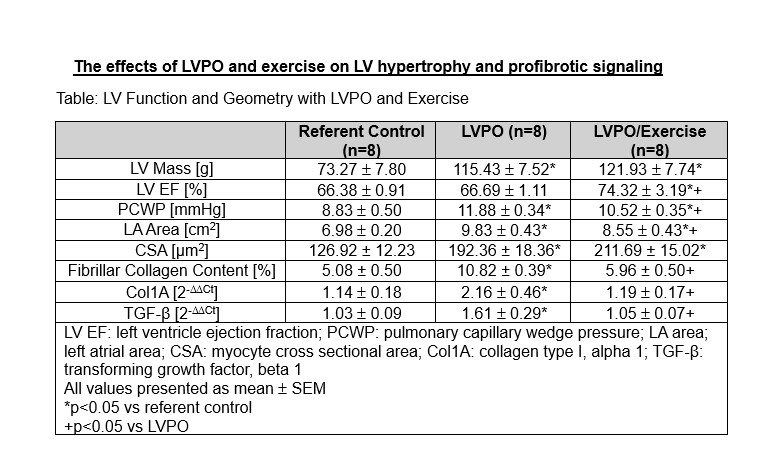
Methods/Results: Pigs (25 kg) underwent progressive LVPO for 5 weeks without (n=8) or with daily exercise (n=8, 10 degrees elevation, 2.5 mph, 10 min, 5 days/week). Age matched pigs with no LVPO served as controls (n=8). LV function and geometry was determined by transthoracic echocardiography (Table). With LVPO only, LV mass increased by over 50%, and PCWP and LAA area increased, but LVEF remained within normal limits- consistent with the HFpEF phenotype. In the LVPO group, LV mass increased to a similar degree, but PCWP and LAA were both reduced. Histomorphometry revealed myocyte cross-sectional area increased in both LVPO groups, and while LV collagen percent area increased by 2-fold with LVPO, indicative of myocardial fibrosis, this was prevented in the LVPO exercise group. (Table) LV fibrillar collagen mRNA levels (collagen type 1a, by PCR) increased by 2-fold with LVPO but returned to within referent normal values with LVPO and exercise. A similar pattern was observed for mRNA levels of the profibrotic factor transforming growth factor beta (TGF-B). (Table)
Conclusions. The unique and significant findings from this study were 2-fold. First, a concomitant exercise protocol overlayed with a progressive LVPO stimulus prevented the HFpEF phenotype, but did not alter the LV hypertrophic response. Second, the structural/molecular basis for this was likely reduced collagen content and expression. Thus, while clinical studies are required, these results suggest that a regular exercise protocol for patients at risk for HFpEF represents a potential preventive strategy.
  • Samani, Stephanie  ( UofSC SOM , Columbia , South Carolina , United States )
  • Shazly, Tarek  ( University of South Carolina , Columbia , South Carolina , United States )
  • Zile, Michael  ( MEDICAL UNIV OF SOUTH CAROLINA , Charleston , South Carolina , United States )
  • Spinale, Francis  ( USC SCHOOL MEDICINE , Columbia , South Carolina , United States )
  • Barlow, Shayne  ( University of South Carolina , Columbia , South Carolina , United States )
  • Freeburg, Lisa  ( University of South Carolina SOM , Columbia , South Carolina , United States )
  • Catherwood, Grayson  ( University of South Carolina SOM , Columbia , South Carolina , United States )
  • Churillo, Amelia  ( University of South Carolina SOM , Columbia , South Carolina , United States )
  • Jones, Traci  ( University of South Carolina , Columbia , South Carolina , United States )
  • Al-soudi, Jumanah  ( University of South Carolina SOM , Columbia , South Carolina , United States )
  • Ruiz, Ricky  ( University of South Carolina SOM , Columbia , South Carolina , United States )
  • Yigamawano, Francesco  ( University of South Carolina , Columbia , South Carolina , United States )
  • Author Disclosures:
    Stephanie Samani: DO NOT have relevant financial relationships | Tarek Shazly: No Answer | Michael Zile: DO NOT have relevant financial relationships | Francis Spinale: DO NOT have relevant financial relationships | Shayne Barlow: DO NOT have relevant financial relationships | Lisa Freeburg: DO NOT have relevant financial relationships | Grayson Catherwood: No Answer | Amelia Churillo: DO NOT have relevant financial relationships | Traci Jones: DO NOT have relevant financial relationships | Jumanah Al-Soudi: No Answer | Ricky Ruiz: No Answer | Francesco Yigamawano: DO NOT have relevant financial relationships
Meeting Info:

Scientific Sessions 2025

2025

New Orleans, Louisiana

Session Info:

Mechanisms and Modulation of Cardiomyopathy and Diastolic Dysfunction

Monday, 11/10/2025 , 09:15AM - 10:30AM

Moderated Digital Poster Session

More abstracts on this topic:
A New Biomarker of Aging Derived From Electrocardiogram Improves Risk Prediction of Incident Myocardial Infarction and Stroke.

Wilsgaard Tom, Rosamond Wayne, Schirmer Henrik, Lindekleiv Haakon, Attia Zachi, Lopez-jimenez Francisco, Leon David, Iakunchykova Olena

A Blood(y) Pressure Crisis: Diffuse Alveolar Hemorrhage as a Rare Manifestation of Severely Uncontrolled Hypertension

Nandyal Shreyas, Amdetsion Gedion Yilma, Varma Revati, Kohli Saksham, Hammo Hasan

More abstracts from these authors:
The Inflammasome and Fibroblast Transdifferentiation and Activation in Heart Failure with Reduced Ejection Fraction

Delgra Vivian, Shazly Tarek, Goldsmith Edie, Spinale Francis, Mattia Victoria, Churillo Amelia, Freeburg Lisa, Maclaren Janna, Samani Stephanie, Barlow Shayne, Jones Traci, Cavalli Eliana

Myocardial stiffness properties are improved in heart failure with preserved ejection fraction (HFpEF) in pigs by a regular exercise regime

Yigamawano Francesco, Ruiz Ricky, Zile Michael, Spinale Francis, Shazly Tarek, Samani Stephanie, Barlow Shayne, Freeburg Lisa, Catherwood Grayson, Churillo Amelia, Jones Traci, Al-soudi Jumanah

You have to be authorized to contact abstract author. Please, Login
Not Available