Logo

American Heart Association

  14
  0


Final ID: MP379

Rhythm Identification of Wide Complex Tachycardia on 12-Lead ECG Using a Convolutional Neural Network

Abstract Body (Do not enter title and authors here): BACKGROUND: Wide complex tachycardia (WCT) remains one of the most challenging dilemmas in electrocardiogram (ECG) interpretation. Supraventricular tachycardia (SVT) and ventricular tachycardia (VT) have different prognostic implications and have drastically different management. There are numerous algorithms that summarize criteria for EKG or QRS pattern recognition such as the Brugada and Vereckei criteria. However, validation studies show that depending on the training of the interpreter, the ability to recall and apply such criteria varies and affects the outcome. Artificial intelligence, especially deep learning excels at pattern recognition, making it an attractive candidate to interpret EKGs.

METHODS: Using raw ECG data of WCT (QRS > 120ms, heart rate > 120 bpm), a convolutional neural network (CNN), specifically ResNet, was developed for classification. The model characterizes WCT into SVT, VT, or paced rhythm. An initial base model was trained on all available training ECGs. The base model was fine tuned on an Electrophysiologist (EP)-adjudicated training set.
The final model was validated against a holdout dataset of 400 EKGs on the basis of definitive findings to distinguish VT from SVT with aberrancy. The models were interrogated using explainability techniques including LIME and GradCAM.

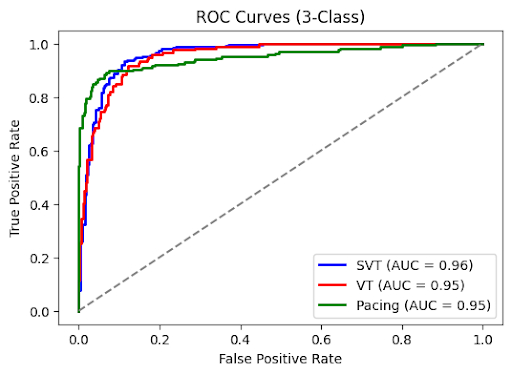
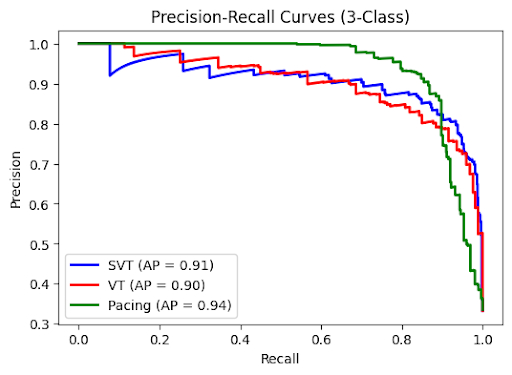
RESULTS: We extracted a total of 13792 WCT ECGs, of which 608 were VT, 12106 SVT and 1078 were pacing. The two-stage ResNet achieved an average area under the receiver operating characteristic curve (AUC) of 0.946 (95% CI 0.920-0.967), 0.950 (95% CI 0.929-0.968) and 0.975 (95% CI 0.957-0.991) for SVT, VT, and paced groups.

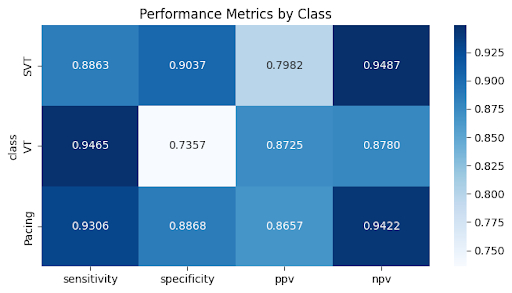
Performance metrics for the test set were as follows: SVT – sensitivity 86.9% (±6.4%), specificity 88.5% (±3.9%); VT – sensitivity 74.6% (±7.9%), specificity 94.6% (±2.7%); pacing – 94.6% (±4.2%), sensitivity 95.0% (±2.7%).

Explainability analysis revealed that the model looks at various parts of the QRS including depolarization and repolarization.

CONCLUSION: The developed ResNet model is excellent at pattern recognition, which can identify any given WCT as VT, SVT, or paced rhythm with similar performance to Cardiologist read. AI is a valuable tool in assisting clinicians with interpretations of challenging ECG rhythms such as WCT and optimizing the clinical outcomes.
  • Shi, Nan  ( London Health Sciences Centre , London , Ontario , Canada )
  • Liu, Meichen  ( London Health Sciences Centre , London , Ontario , Canada )
  • Liu, Iris  ( Schulich School of Medicine & Dentistry, Western University , London , Ontario , Canada )
  • Antiperovitch, Pavel  ( London Health Sciences Centre , London , Ontario , Canada )
  • Author Disclosures:
    Nan Shi: DO NOT have relevant financial relationships | Meichen Liu: No Answer | Iris Liu: DO NOT have relevant financial relationships | Pavel Antiperovitch: No Answer
Meeting Info:

Scientific Sessions 2025

2025

New Orleans, Louisiana

Session Info:
More abstracts on this topic:
A Deep Learning Topic Analysis Approach for Enhancing Risk Assessment in Heart Failure Using Unstructured Clinical Notes

Adejumo Philip, Pedroso Aline, Khera Rohan

9-Year Longitudinal Assessment of the 12-lead Electrocardiogram of Volunteer Firefighters

Bae Alexander, Dzikowicz Dillon, Lai Chi-ju, Brunner Wendy, Krupa Nicole, Carey Mary, Tam Wai Cheong, Yu Yichen

You have to be authorized to contact abstract author. Please, Login
Not Available