Sex Differences in Acute Hemodynamic Response to Delta-9-Tetrahydrocannabinol Compared to Placebo: Impact of Cannabis Use Frequency
Abstract Body (Do not enter title and authors here): Introduction: Combusted cannabis is associated with arrhythmia and myocardial infarction in healthy young people. While acute delta-9-tetrahydrocannabinol (THC) increases heart rate (HR) and has variable effects on blood pressure (BP), the impact of cannabis use frequency on acute hemodynamic responses to cannabis, and how sex affects this relationship, is unclear.
Methods: This double blind, placebo-controlled, within-subjects study of healthy adults included four groups divided by sex and cannabis use frequency in the prior month (“light” use [≤4 days/week] or “heavy” use [>4 days/week]). Participants attended three sessions separated by 48 hours and smoked 560 mg of a research cannabis cigarette (0% [control], 4%, or 10% THC) in random order via paced puffing procedure. Primary outcomes of HR, systolic (SBP), diastolic (DBP), and mean BP (MBP) were measured at baseline and five timepoints post-exposure. Comparisons were made with non-parametric Kruskal-Wallis test followed by Dunn’s post-hoc test with Sidak correction.
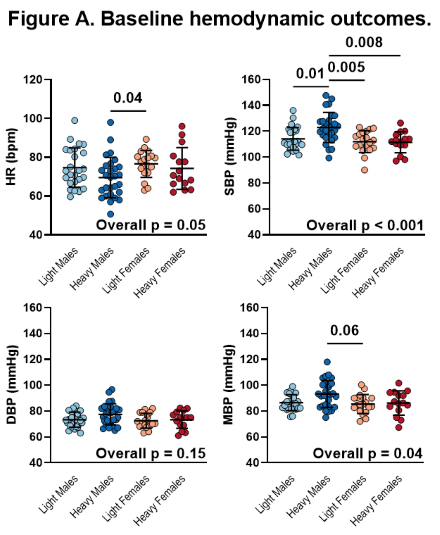
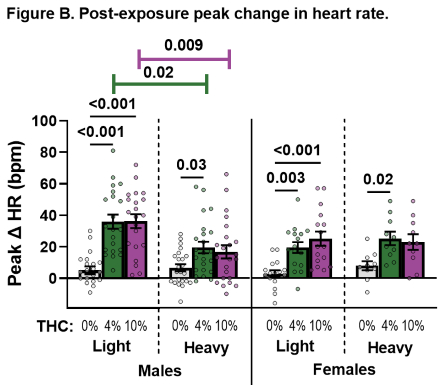
Results: 87 participants (34 female) age 30.4±7.6 years included light females (LF; n=19), heavy females (HF; n=15), light males (LM; n=25) and heavy males (HM; n=28). Groups had similar age and BMI. Cannabis use in heavy vs. light users was 6.7±0.7 vs. 2.5±1.2 days/week (p<0.001) and did not differ by sex. At baseline, HM had significantly higher SBP and lower HR than other groups (Figure A), therefore, post-exposure outcomes were analyzed as peak change. Peak ΔHR increased in all groups after 4% THC but only in light users (male and female) after 10% THC compared with 0% THC control (Figure B). HM had a blunted peak ΔHR compared to LM at 4% THC (19.4±3.7 bpm vs. 35.9±4.5 bpm, p=0.02) and 10% THC (16.7±4.2 bpm vs. 36.2±4.4 bpm, p=0.009; Figure B). No differences were observed for peak ΔSBP, ΔDBP, or ΔMBP.
Conclusion: THC in combusted cannabis drives the acute increase in HR. This expected increase in HR occurred in all groups after 4% THC exposure but only in light users after 10% THC exposure, suggesting that, paradoxically, infrequent cannabis users may be more vulnerable than heavy users to adverse acute hemodynamic changes. Further, the peak increase in HR was greater in light vs. heavy male but not female users, indicating the development of tolerance in heavy male users, a sex-based difference. Further research is needed to explore how sex-based differences in tolerance may impact cardiovascular risk.
Hampilos, Katherine
(
UCLA
, Los Angeles , California , United States )
Eversole, Alisha
(
UCLA
, Los Angeles , California , United States )
Pabon, Elisa
(
UCLA
, Los Angeles , California , United States )
Middlekauff, Holly
(
UCLA
, Los Angeles , California , United States )
Cooper, Ziva
(
UCLA
, Los Angeles , California , United States )
Author Disclosures:
Katherine Hampilos:DO NOT have relevant financial relationships
| Alisha Eversole:DO NOT have relevant financial relationships
| Elisa Pabon:DO NOT have relevant financial relationships
| Holly Middlekauff:DO NOT have relevant financial relationships
| Ziva Cooper:DO have relevant financial relationships
;
Other (please indicate in the box next to the company name):True Terpenes:Active (exists now)
; Other (please indicate in the box next to the company name):Storz and Bickle:Active (exists now)
; Other (please indicate in the box next to the company name):Canopy Growth Corportaion:Active (exists now)