
Logo

American Heart Association

  130
  0


Final ID: 4145495

Arrhythmia Risk in Healthy Young Adults Who Co-use Electronic Cigarettes & Cannabis

Abstract Body (Do not enter title and authors here): Background: Tobacco cigarette (TCIG) smoking is the most prevalent modifiable risk factor for cardiovascular (CV) disease, including sudden arrhythmic death. Although TCIG smoking among current young adults has never been lower, cannabis smoking and co-use of cannabis and electronic cigarettes (ECIG) now approaches 50%. The arrhythmia risk associated with cannabis smoking and potential amplification of risk through co-use with ECIGs remain largely unknown.

Purpose: To test the hypothesis that arrhythmia risk as estimated by abnormal ventricular repolarization is increased in people who smoke cannabis and amplified by ECIG co-use.

Methods: Three groups were assessed in a parallel group comparison study: 1) chronic (≥ 1 year) ECIG and inhaled cannabis co-users, 2) chronic exclusive cannabis smokers, and 3) control non-users. Participants were healthy adults aged 21-30 who do not smoke TCIGs. Participants fasted and abstained from ECIGs, cannabis, caffeine, and exercise for 8 hours before the study. Blood pressure (BP) and heart rate (HR) were recorded, followed by 12-lead ECG recordings for 5 minutes in supine position. ECG recordings were then analyzed for T(peak-end) (Tp-e) interval as well as Tp-e/QT and Tp-e/QTc ratios as a measure of ventricular repolarization and predictors of arrhythmia risk.

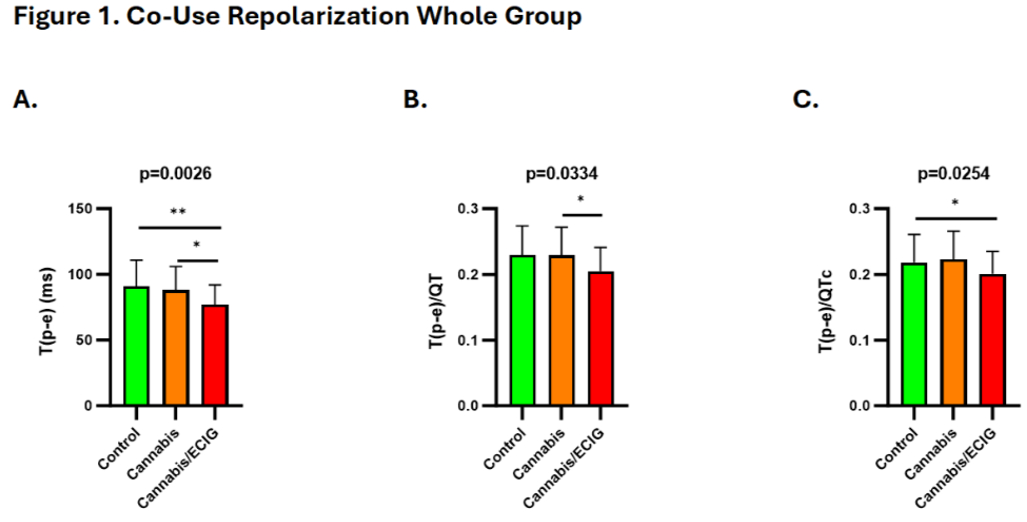
Results: A total of 134 participants were enrolled (49 Controls, 59 Exclusive Cannabis, 26 ECIG/Cannabis Co-users). Subgroups did not differ by sex (54% F), age (24.1±2.9 y), BP, or HR. The Tp-e interval was significantly shorter in the cannabis/ECIG co-users compared to both exclusive cannabis smokers and control non-users (Figure panel A). Overall, ventricular repolarization tended to be shorter in co-users compared to both other groups (Figure panels B & C).

Conclusion: In otherwise healthy young people, chronic cannabis/ECIG co-use impacts ventricular repolarization in the direction not typically associated with increased arrhythmia risk. The clinical implications of Tp-e shortening in co-users require further investigation. Additionally, these outcomes only provide a glimpse of the implications of cannabis and ECIG co-use, and other outcomes of CV risk warrant investigation.
  • Fong, Reece  ( UCLA MEDICAL CENTER , Los Angeles , California , United States )
  • Sanchez, Joshua  ( UCLA MEDICAL CENTER , Los Angeles , California , United States )
  • Lopez, Samuel  ( UCLA MEDICAL CENTER , Los Angeles , California , United States )
  • Zhao, Kevin  ( UCLA MEDICAL CENTER , Los Angeles , California , United States )
  • Cooper, Ziva  ( UCLA MEDICAL CENTER , Los Angeles , California , United States )
  • Gornbein, Jeffrey  ( UCLA school of Medicine , Los Angeles , United States Minor Outlying Islands )
  • Middlekauff, Holly  ( UCLA MEDICAL CENTER , Los Angeles , California , United States )
  • Author Disclosures:
    REECE FONG: DO NOT have relevant financial relationships | Joshua Sanchez: No Answer | Samuel Lopez: No Answer | Kevin Zhao: DO NOT have relevant financial relationships | Ziva Cooper: No Answer | Jeffrey Gornbein: DO NOT have relevant financial relationships | Holly Middlekauff: DO NOT have relevant financial relationships
Meeting Info:

Scientific Sessions 2024

2024

Chicago, Illinois

Session Info:

Risky Business: Understanding and Mitigating Risk in mHealth and Beyond

Sunday, 11/17/2024 , 08:00AM - 09:15AM

Abstract Oral Session

More abstracts on this topic:
A Cardiac Ryanodine Receptor C-terminal Truncation Causes Calcium Release Deficiency Syndrome, but not Catecholaminergic Polymorphic Ventricular Tachycardia

Tian Shanshan, Ni Mingke, Wang Hui, Zhu Hai-lei, Wang Ruiwu, Estillore John Paul, Chen Wayne

A mechanism whereby SGLT2 inhibitor dapagliflozin reverses cardiac diastolic dysfunction in a model of HFpEF

Liu Man, Liu Hong, Kang Gyeoung-jin, Kim Eunji, Neumann Mitchell, Johnson Madeline, Murikinati Ruthvika, Dudley Samuel

More abstracts from these authors:
Sex Differences in Acute Hemodynamic Response to Delta-9-Tetrahydrocannabinol Compared to Placebo: Impact of Cannabis Use Frequency

Hampilos Katherine, Eversole Alisha, Pabon Elisa, Middlekauff Holly, Cooper Ziva

Inhaled combusted cannabis use increases atherosclerosis risk in young people: A cross-sectional study

Kelesidis Theodoros, Middlekauff Holly, Fotooh Abadi Leila, Hampilos Katherine, Fong Reece, Sanchez Joshua, Ruedisueli Isabelle, Lopez Samuel, Gornbein Jeffrey, Cooper Ziva

You have to be authorized to contact abstract author. Please, Login
Not Available