Logo

American Heart Association

  26
  0


Final ID: Sa2038

Assessing the Economic and Healthcare Burden of Atherosclerotic Cardiovascular Disease in Type 2 Diabetes: A Microsimulation Approach to Cost-Effectiveness and Resource Utilization

Abstract Body (Do not enter title and authors here): Background: Type 2 diabetes mellitus (T2DM) is a chronic metabolic disorder that requires effective management strategies to optimize long-term health outcomes. While metformin is the standard first-line therapy, many patients require second-line treatments to achieve adequate glycemic control. Newer drug classes, such as Sodium-Glucose Cotransporter-2 (SGLT-2) inhibitors and Glucagon-Like Peptide-1 (GLP-1) receptor agonists (RA), offer better and more physiologic control of blood sugar along with added cardiovascular benefits. Still, their cost-effectiveness remains uncertain compared to traditional therapies.

Objective: This study uses Markov modeling and microsimulation approach to evaluate the long-term health outcomes, costs, and cost-effectiveness of SGLT-2 inhibitors, GLP1 RAs, and traditional second-line therapies.

Methods: A Markov model using TreeAge Pro software was constructed to simulate T2DM progression over a 40-year horizon, incorporating transitions between key health states: no history of cardiovascular disease (CVD), history of CVD, and death. Cost effectiveness analysis (CEA) was performed with a willingness-to-pay (WTP) threshold of $100,000 per quality-adjusted life year (QALY). Microsimulation and sensitivity analyses assessed the robustness of findings.

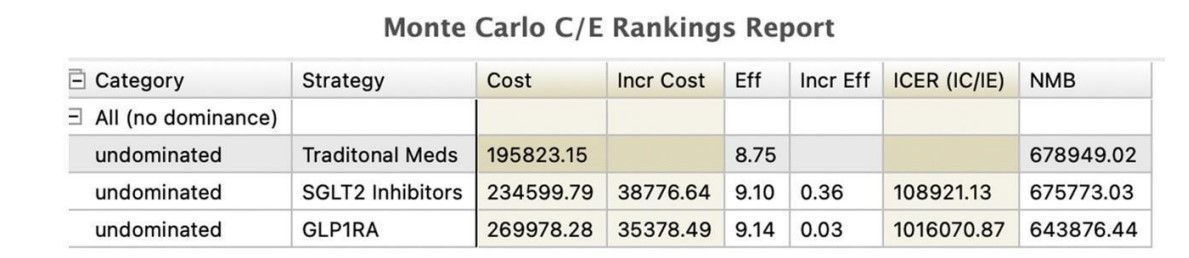
Results: The analysis provides insights into the comparative cost-effectiveness of SGLT2 inhibitors and GLP-1 RAs versus traditional second-line therapies. Our findings indicate that while newer therapies offer substantial cardiovascular benefits, their cost effectiveness depends on drug pricing and other parameters. Using the current estimated costs and a WTP of $100,000, neither of the new medicines are cost-effective compared to traditional medicines.

Conclusion: The present study highlights the importance of economic evaluation in selecting second-line therapies for T2DM. The results of our analyses could help formulate future healthcare decision-making and policy development to optimize patient outcomes while managing healthcare costs effectively.
  • Lak, Hassan Mehmood  ( Cleveland Clinic , Cleveland , Ohio , United States )
  • Glotzbecker, Michael  ( University Hospitals , Cleveland , Ohio , United States )
  • Panigrahi, Soumya  ( Case Western Reserve University , Cleveland , Ohio , United States )
  • Moazampour, Lily  ( Case Western Reserve University , Cleveland , Ohio , United States )
  • Kazemian, Pooyan  ( Case Western Reserve University , Cleveland , Ohio , United States )
  • Author Disclosures:
    Hassan Mehmood Lak: DO NOT have relevant financial relationships | Michael Glotzbecker: DO have relevant financial relationships ; Consultant:Globus:Active (exists now) ; Consultant:Orthobullets:Active (exists now) ; Individual Stocks/Stock Options:Orthobullets:Active (exists now) ; Consultant:Medtronic :Active (exists now) ; Speaker:Medtronic:Active (exists now) ; Consultant:orthobullets:Active (exists now) ; Speaker:Globus:Active (exists now) | Soumya Panigrahi: No Answer | Lily Moazampour: No Answer | Pooyan Kazemian: DO NOT have relevant financial relationships
Meeting Info:

Scientific Sessions 2025

2025

New Orleans, Louisiana

Session Info:

Diabetes: Cardiovascular Outcomes and Management Strategies

Saturday, 11/08/2025 , 10:30AM - 11:30AM

Abstract Poster Board Session

You have to be authorized to contact abstract author. Please, Login
Not Available