
Logo

American Heart Association

  18
  0


Final ID: MP2318

Machine Learning-Based Prediction of Right Ventricular Failure Following Left Ventricular Assist Device Implantation

Abstract Body (Do not enter title and authors here):
Background:
Right ventricular failure (RVF) is a significant and potentially fatal complication following left ventricular assist device (LVAD) implantation. Clinically, RVF post-LVAD is difficult to accurately predict. Machine learning (ML) offers a promising approach to predict RVF after LVAD.

Objective:
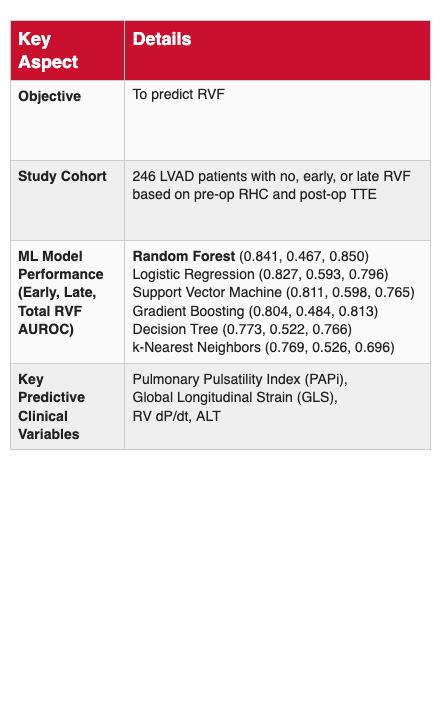
To develop and evaluate machine learning models for the prediction of RVF following LVAD implantation.

Methods:
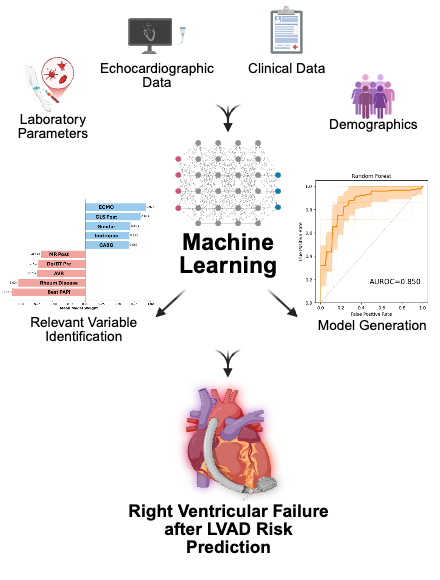
A comprehensive set of clinical, laboratory, echocardiographic, and demographic variables was utilized to train six machine learning classification models: decision tree, logistic regression, random forest, k-nearest neighbors, support vector machine, and gradient boosting. Each model was trained over 20 iterations using a 9:1 train-test split. Model performance was assessed using the area under the receiver operating characteristic curve (AUROC). Logistic regression weight analysis was employed to identify clinically relevant predictive variables for early and total RVF.

Results:
We analyzed 246 patients who underwent left ventricular assist device (LVAD) implantation at our center between January 2004 and December 2017. All patients underwent right heart catheterization (RHC) within 30 days prior to implantation and transthoracic echocardiography (TTE) within 30 days post-implantation to assess for early or late right ventricular failure (RVF). Early RVF was defined as the need for an unplanned right ventricular assist device (RVAD) within 30 days after LVAD implantation or requirement for more than 14 days of continuous inotropic support. Late RVF was defined as patients requiring medical intervention following the index hospitalization. ML models robustly predicted early RVF (AUROC: 0.769–0.841) and total RVF (0.765–0.850), with the random forest algorithm demonstrating the best performance for both. Models predicting late RVF were not as robust (0.467–0.593). Logistic regression weight analysis identified pulmonary artery pulsatility index (PAPi), global longitudinal strain (GLS), right ventricular dP/dt, and alanine aminotransferase (ALT) as clinically relevant predictors of early and total RVF.

Conclusions:
ML models reliably predicted early and total RVF following LVAD implantation. These findings support the potential utility of ML models in improving risk stratification to guide clinical decision-making in this high-risk population.
  • Guntupalli, Suman  ( Cleveland Clinic , Cleveland , Ohio , United States )
  • Popovic, Zoran  ( Cleveland Clinic , Cleveland , Ohio , United States )
  • Griffin, Brian  ( Cleveland Clinic , Cleveland , Ohio , United States )
  • Smedira, Nicholas  ( Cleveland Clinic , Cleveland , Ohio , United States )
  • Soltesz, Edward  ( Cleveland Clinic , Cleveland , Ohio , United States )
  • Tong, Michael  ( Cleveland Clinic , Cleveland , Ohio , United States )
  • Cheng, Feixiong  ( Cleveland Clinic , Cleveland , Ohio , United States )
  • Xu, Bo  ( Cleveland Clinic , Cleveland , Ohio , United States )
  • Fang, Michelle  ( Cleveland Clinic , Cleveland , Ohio , United States )
  • Zhou, Yadi  ( Cleveland Clinic , Cleveland , Ohio , United States )
  • Tonegawa-kuji, Reina  ( Cleveland Clinic , Cleveland , Ohio , United States )
  • Tang, Wai Hong  ( Cleveland Clinic , Cleveland Clinic , Ohio , United States )
  • Starling, Randall  ( Cleveland Clinic , Cleveland Clinic , Ohio , United States )
  • Estep, Jerry  ( Cleveland Clinic Florida , Weston , Florida , United States )
  • Grimm, Richard  ( Cleveland Clinic , Cleveland , Ohio , United States )
  • Author Disclosures:
    Suman Guntupalli: DO NOT have relevant financial relationships | Zoran Popovic: DO NOT have relevant financial relationships | Brian Griffin: No Answer | Nicholas Smedira: DO NOT have relevant financial relationships | Edward Soltesz: No Answer | Michael Tong: No Answer | Feixiong Cheng: No Answer | Bo Xu: DO have relevant financial relationships ; Speaker:Bristol Myers Squibb:Active (exists now) | Michelle Fang: No Answer | Yadi Zhou: DO NOT have relevant financial relationships | Reina Tonegawa-Kuji: DO NOT have relevant financial relationships | Wai Hong Tang: DO have relevant financial relationships ; Consultant:Cardiol Therapeutics:Active (exists now) ; Research Funding (PI or named investigator):National Institutes of Health:Active (exists now) ; Other (please indicate in the box next to the company name):Springer - Editor/Author:Active (exists now) ; Other (please indicate in the box next to the company name):Belvoir Media Group - Editor/Author:Active (exists now) ; Independent Contractor:American Board of Internal Medicine:Past (completed) ; Consultant:BioCardia:Active (exists now) ; Consultant:Salubris Biotherapeutics:Active (exists now) ; Consultant:Alexion Pharmaceuticals:Active (exists now) ; Consultant:Alleviant Medical:Active (exists now) ; Consultant:CardiaTec Biosciences:Active (exists now) ; Consultant:WhiteSwell:Past (completed) ; Consultant:Bristol Myers Squibb:Past (completed) ; Consultant:Boston Scientific:Past (completed) ; Consultant:Zehna Therapeutics:Past (completed) ; Consultant:Genomics plc:Past (completed) | Randall Starling: DO NOT have relevant financial relationships | Jerry Estep: No Answer | Richard Grimm: DO NOT have relevant financial relationships
Meeting Info:

Scientific Sessions 2025

2025

New Orleans, Louisiana

Session Info:

Advances in Predicting Heart Failure and Cardiomyopathy: From Risk Stratification to Early Detection

Monday, 11/10/2025 , 09:15AM - 10:30AM

Moderated Digital Poster Session

More abstracts on this topic:
Changes in high-sensitivity cardiac troponin I and associated cardiovascular risk: Analyses From the FOURIER Trial

Haller Paul, Marston Nicholas, Bellavia Andrea, Jarolim Petr, Keech Anthony, Giugliano Robert, Sabatine Marc, Morrow David

A Machine Learning Readmission Risk Prediction Model for Cardiac Disease

Bailey Angela, Wang Wei, Shannon Clarence, Huling Jared, Tignanelli Christopher

More abstracts from these authors:
Prognostic Impact of Right Ventricle-Pulmonary Artery Coupling in Patients with Severe Calcific Mitral Stenosis

Okushi Yuichiro, Unai Shinya, Pettersson Gosta, Elgharably Haytham, Gillinov A, Grimm Richard, Griffin Brian, Xu Bo

A novel deep learning framework identified associated genes and Interpretable deep learning translation of GWAS findings for drug repurposing in Atrial Fibrillation

Tonegawa-kuji Reina, Xu Jielin, Guntupalli Suman, Barnard John, Chung Mina, Cheng Feixiong

You have to be authorized to contact abstract author. Please, Login
Not Available