Elevated Body Mass Index Predicts New-Onset Heart Failure Following Catheter Ablation for Atrial Fibrillation
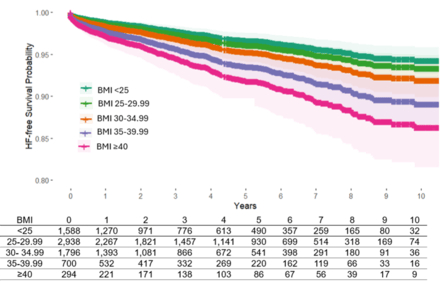
Abstract Body (Do not enter title and authors here): Introduction Atrial fibrillation (AF) is the most common sustained arrhythmia and a major contributor to heart failure (HF). Although catheter ablation (CA) reduces HF progression in AF patients, a subset remains at risk for developing HF. Body mass index (BMI) is a known cardiovascular risk factor, but its association with post-ablation HF has not been well defined. Methods This retrospective cohort study included patients who underwent first-time CA for AF between 2013 and 2024. Patients with preexisting HF or missing BMI data were excluded. The primary outcome was new-onset HF post-ablation. Multivariable Cox regression was used to identify independent predictors of HF, and Kaplan-Meier analysis assessed HF-free survival across BMI categories. Results Of 7,363 eligible patients, 550 (7.5%) developed new-onset HF during a mean follow-up of 3.62 ±2.89 years. Patients who developed HF were older (67.5±10.1 vs. 64.4±10.2 years) and more likely to be female (39.5% vs. 31.8%). HF-free survival declined progressively with increasing BMI (Figure 1). At 5 and 10 years post-ablation, HF-free survival was 96.7% and 94.2% for BMI <25; 96.1% and 93.3% for BMI 25–29.99; 95.3% and 91.9% for BMI 30–34.99; 93.4% and 89.0% for BMI 35–39.99; and 91.8% and 86.3% for BMI ≥40. In multivariable Cox regression (Figure 2), older age, particularly >75 years, strongly predicted post-ablation HF (HR [95% CI]: 2.55 [2.10–3.09], p<0.001). Additional independent predictors included female sex (HR [95% CI]: 1.41 [1.16–1.73], p<0.001), hypertension (HR [95% CI]: 1.28 [1.03–1.59], p=0.02), ischemic heart disease (HR [95% CI]: 1.44 [1.19–1.74], p<0.001), mitral regurgitation (HR [95% CI]: 2.60 [2.07-3.27], p<0.001), aortic stenosis (HR [95% CI]: 1.97 [1.38-2.80], p<0.001), pulmonary hypertension (HR [95% CI]: 3.02 [2.26-4.050], p<0.001 ), pulmonary embolism (HR [95% CI]: 1.99 [1.23-3.21], p<0.001), and eGFR <60 mL/min (HR [95% CI]: 2.51 [1.87-3.37], p<0.001). Higher BMI categories also showed a graded increase in risk compared to BMI <25. BMI 30-34.99 (HR [95% CI]: 1.35[1.04-1.79], p=0.02), BMI 35-39.99 (HR [95% CI]: 1.68 [1.23-2.28] p<0.001), BMI ≥40 (HR [95% CI]: 2.31[1.56-3.41], p<0.001) Conclusion Elevated BMI is a strong modifiable independent predictor of new-onset HF following AF ablation, with risk rising progressively across higher BMI categories. Interventions aimed at reducing BMI may play an important role in lowering HF risk and improving long-term outcomes in patients with AF.
Ramadan, Adham
(
Massachusetts General Hospital
, Boston , Massachusetts , United States )
Sanadgol, Ghazal
(
Massachusetts General Hospital
, Boston , Massachusetts , United States )
Yazdanpanah, Mohammad Hosein
(
Massachusetts General Hospital
, Cambridge , Massachusetts , United States )
Desouky, Marawan
(
Mass General Brigham- Salem Hospital
, Salem , Massachusetts , United States )
Nahlawi, Acile
(
Massachusetts General Hospital
, Boston , Massachusetts , United States )
Ptaszek, Leon
(
MASSACHUSETTS GENERAL HOSPITAL
, Boston , Massachusetts , United States )
Ruskin, Jeremy
(
Massachusetts General Hospital
, Boston , Massachusetts , United States )
Author Disclosures:
Adham Ramadan:DO NOT have relevant financial relationships
| Ghazal Sanadgol:DO NOT have relevant financial relationships
| Mohammad Hosein Yazdanpanah:DO NOT have relevant financial relationships
| Marawan Desouky:DO NOT have relevant financial relationships
| Acile Nahlawi:No Answer
| Leon Ptaszek:No Answer
| Jeremy Ruskin:DO have relevant financial relationships
;
Consultant:Acesion:Active (exists now)
; Individual Stocks/Stock Options:Amgen:Active (exists now)
; Individual Stocks/Stock Options:Celero Systems:Active (exists now)
; Individual Stocks/Stock Options:Element Science:Active (exists now)
; Individual Stocks/Stock Options:InfoBionic.ai:Active (exists now)
; Consultant:InfoBionic.ai:Active (exists now)
; Consultant:Vertex:Active (exists now)
; Consultant:Treeline Bio:Active (exists now)
; Consultant:Sanofi:Active (exists now)
; Consultant:Jazz Pharma:Active (exists now)
; Consultant:Janssen:Active (exists now)
; Consultant:InCarda:Active (exists now)
; Consultant:Foghorn Therapeutics:Active (exists now)
; Consultant:Baim Institute - Lexeo:Active (exists now)
; Consultant:Advanced Medical Education:Active (exists now)