Association of Chronic Kidney Disease with Incident Probable Dementia and Cognitive Impairment in the SPRINT trial
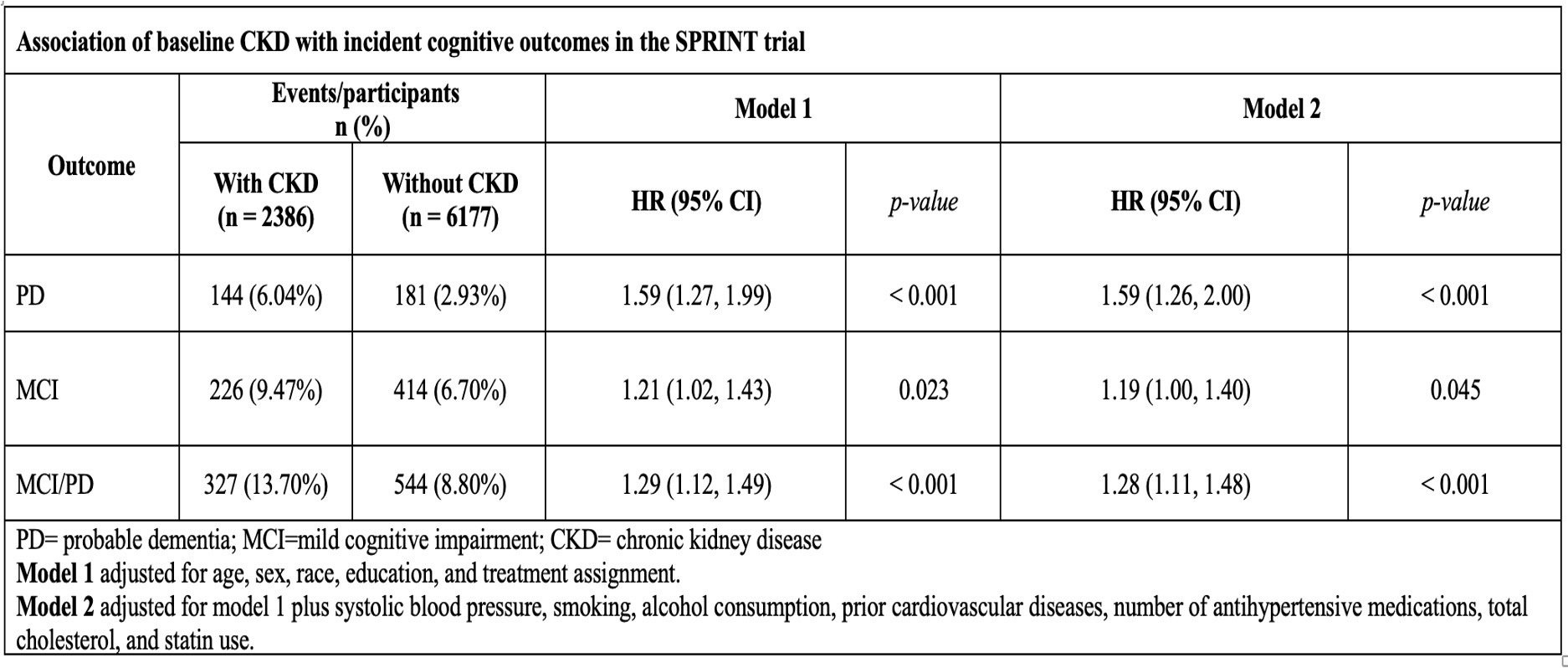
Abstract Body (Do not enter title and authors here): Background: Emerging evidence links chronic kidney disease (CKD) to an elevated risk of dementia and cognitive impairment, but the strength of this association in patients with hypertension remains uncertain. Objective: We examined the association of baseline CKD with incident probable dementia (PD), mild cognitive impairment (MCI), and a composite of both outcomes in patients with hypertension enrolled in the Systolic Blood Pressure Intervention Trial (SPRINT). Methods: SPRINT enrolled adults aged ≥50 years with hypertension but without diabetes or prior stroke. In this ad hoc analysis, participants with baseline pre-existing clinical dementia, prescribed dementia medications, or with missing eGFR or cognition data were excluded. Baseline CKD was defined as an estimated glomerular filtration rate (eGFR) <60 mL/min/1.73 m2, calculated using the MDRD equation. Incident PD and MCI were adjudicated during follow-up. Multivariable Cox proportional hazards models assessed associations between baseline CKD and cognitive outcomes, adjusting for sociodemographic factors, treatment assignment, cardiovascular risk factors, and other confounders. Results: Among 8,563 participants (mean age 67.9 years; 35.1% women; 30.8% Black), 2,386 had baseline CKD. Over a median five-year follow-up, 325 (3.8%) developed PD, 640 (7.4%) developed MCI, and 871 (10.1%) developed either outcome. Incidence rates were significantly higher in those with CKD versus without: PD (6.04% vs. 2.93%), MCI (9.47% vs. 6.70%), and the composite outcome (13.7% vs. 8.8%). In multivariable Cox regression models adjusted for sociodemographic, treatment assignment, CVD risk factors, and other potential confounders, the presence of baseline CKD was associated with a 59% increased risk of PD, a 19% of MCI, and a 28% of either outcome (Table). Conclusions: In patients with hypertension without diabetes or prior stroke, presence of CKD increases their future risk of PD and MCI. These findings underscore the importance of early CKD detection and management to mitigate cognitive decline in this high-risk population
Samimisedeh, Parham
(
WAKE FOREST SCHOOL OF MEDICINE
, Winston Salem , North Carolina , United States )
Kazibwe, Richard
(
WAKE FOREST SCHOOL OF MEDICINE
, Winston Salem , North Carolina , United States )
Schaich, Christopher
(
WAKE FOREST SCHOOL OF MEDICINE
, Winston Salem , North Carolina , United States )
Hughes, Timothy
(
WAKE FOREST SCHOOL OF MEDICINE
, Winston Salem , North Carolina , United States )
Soliman, Elsayed
(
WAKE FOREST SCHOOL OF MEDICINE
, Winston Salem , North Carolina , United States )
Author Disclosures:
Parham Samimisedeh:DO NOT have relevant financial relationships
| Richard Kazibwe:DO NOT have relevant financial relationships
| Christopher Schaich:DO NOT have relevant financial relationships
| Timothy Hughes:DO NOT have relevant financial relationships
| Elsayed Soliman:DO NOT have relevant financial relationships
Khan Muhammad Aslam, Haider Taimoor, Bhattarai Shraddha, Afzal Hafsa, Khan Bilal, Muhammad Anza, Shafique Nouman, Bhatia Hitesh, Aafreen Asna, Adil Abid Nawaz Khan, Akbar Usman, Khan Alamzaib, Haider Muhammad Adnan