Cardiovascular and Kidney Events Associated with Hypertension Screening Algorithms Among Young and Middle-Aged Adults
Abstract Body (Do not enter title and authors here): Introduction Multiple screening algorithms exist for detecting undiagnosed hypertension, but hypertension-related outcomes across algorithms are unexplored, limiting universal implementation.
Research Question What is the association between different hypertension screening algorithms and increased risks of cardiovascular and kidney events among young and middle-aged adults without a prior hypertension diagnosis?
Methods We identified young (18-39 years) and middle-aged (40-64 years) individuals without prior hypertension diagnosis from Kaiser Permanente Southern California from 2009 to 2019. We applied three hypertension screening algorithms based on outpatient blood pressure (BP) measurements from separate visits that met high BP criteria (≥140/90 mm Hg) within 2 years: (1) the average of two BPs, (2) the average of three BPs, and (3) two consecutive BPs. If individuals had multiple BP measures during the same visit, the lowest BP recorded was used in the primary analysis; a sensitivity analysis used the average BP per visit. We used a composite outcome of cardiovascular and kidney events, including myocardial infarction, stroke, heart failure, chronic kidney disease, and macroalbuminuria. Cox proportional hazard models identified associations between each hypertension screening algorithm and the composite outcome, adjusting for covariates in young and middle-aged adults.
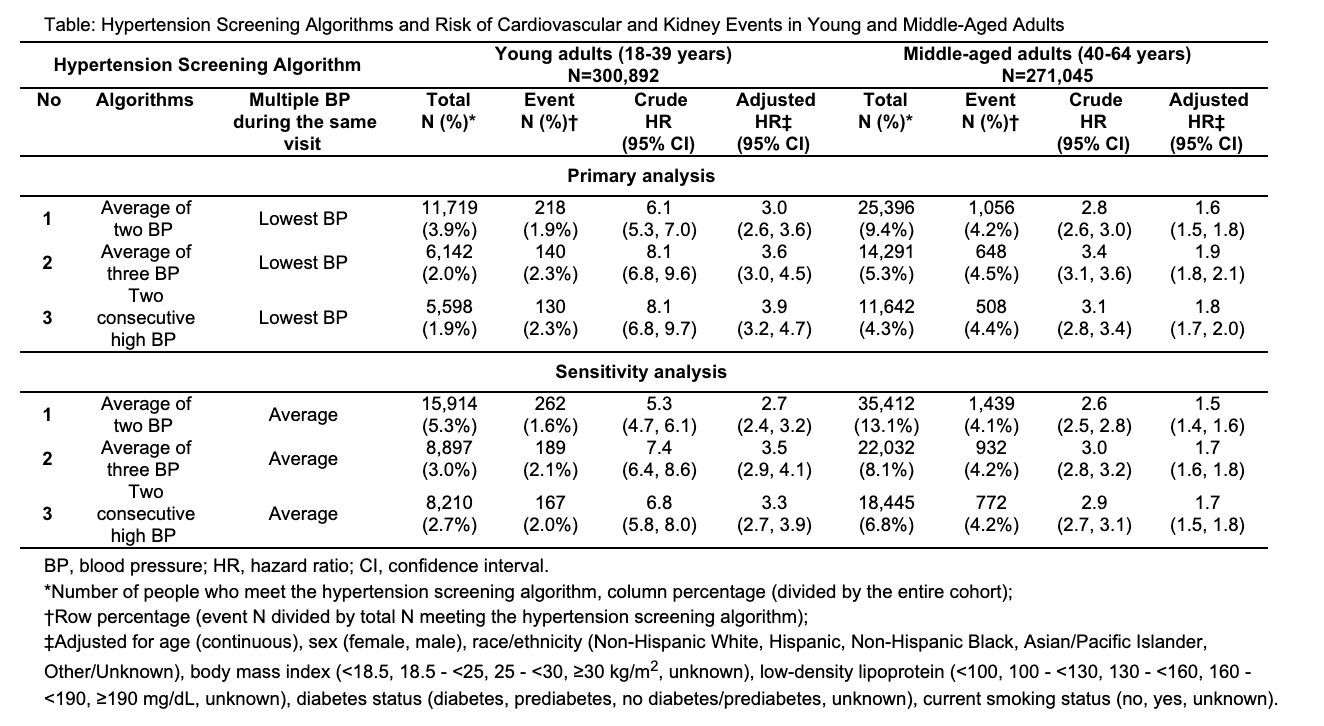
Results Of the 300,892 young adults included, 1.9-5.3% met the screening algorithm criteria, compared to 4.3-13.1% of 271,045 middle-aged adults (Table). All algorithms were associated with an increased risk of the composite outcome, with adjusted hazard ratios (aHR) ranging from 2.7 to 3.9 in young adults and 1.5 to 1.9 in middle-aged adults, though confidence intervals overlapped across algorithms. Among young adults, the algorithm using two consecutive high BPs and the lowest BP per visit was associated with the highest risk (aHR 3.9, 95% CI 3.2, 4.7), whereas among middle-aged adults, the average of three BPs using the lowest BP per visit was associated with the highest risk (aHR 1.9, 95% CI 1.8, 2.1).
Conclusion Despite identifying varying numbers of individuals with high BP, all screening algorithms were associated with an increased risk of cardiovascular and kidney events with similar magnitudes of risk in young and middle-aged adults. These findings support using these algorithms for risk monitoring and timely diagnosis of hypertension to prevent future cardiovascular and kidney events.
Bal, Kavenpreet
(
Kaiser Permanente School of Medicine
, Pasadena , California , United States )
Zhang, Yiyi
(
Columbia University
, New York , New York , United States )
Pak, Katherine
(
Kaiser Permanente
, Pasadena , California , United States )
Ni, Liang
(
Kaiser Permanente
, Pasadena , California , United States )
Fischer, Heidi
(
Kaiser Permanente School of Medicine
, Pasadena , California , United States )
Choi, Soonie
(
Kaiser Permanente
, Pasadena , California , United States )
Morrissette, Kerresa
(
Kaiser Permanente
, Pasadena , California , United States )
Xu, Stanley
(
Kaiser Permanente
, Pasadena , California , United States )
Brettler, Jeff
(
Kaiser Permanente School of Medicine
, Pasadena , California , United States )
Reynolds, Kristi
(
Kaiser Permanente
, Pasadena , California , United States )
An, Jaejin
(
Kaiser Permanente
, Pasadena , California , United States )
Author Disclosures:
Kavenpreet Bal:DO NOT have relevant financial relationships
| Kristi Reynolds:DO have relevant financial relationships
;
Research Funding (PI or named investigator):Merck:Past (completed)
| Jaejin An:DO have relevant financial relationships
;
Research Funding (PI or named investigator):Bayer:Active (exists now)
; Research Funding (PI or named investigator):Merck:Past (completed)
; Research Funding (PI or named investigator):AstraZeneca:Active (exists now)
| Yiyi Zhang:DO have relevant financial relationships
;
Research Funding (PI or named investigator):NIH/NHLBI:Active (exists now)
| Katherine Pak:DO NOT have relevant financial relationships
| Liang Ni:No Answer
| Heidi Fischer:DO NOT have relevant financial relationships
| Soonie Choi:DO have relevant financial relationships
;
Other (please indicate in the box next to the company name):Bayer AG:Active (exists now)
| Kerresa Morrissette:DO NOT have relevant financial relationships
| Stanley Xu:No Answer
| Jeff Brettler:DO NOT have relevant financial relationships