Logo

American Heart Association

  14
  0


Final ID: MP423

The metabolome is preserved in failing mouse hearts but shifts under additional stress

Abstract Body (Do not enter title and authors here): The healthy heart is omnivorous as it readily utilizes fatty acids, glucose, lactate, pyruvate, ketone bodies, and amino acids. This adaptation enables the heart to metabolize alternative fuels when the preferred fatty acids for maximal ATP production cannot be utilized due to decreased cardiac efficiency. It is well established that the failing human heart ultimately becomes metabolically insufficient as it gradually shifts to fuels such as ketone bodies and fails to generate enough ATP to compensate for the energy deficit. While mouse HF models are being utilized to elucidate underlying pathomechanisms and explore metabolic therapy targets, the metabolome of the failing mouse heart is not well characterized. Thus, using stable isotope-labeled metabolites, we sought to characterize the global metabolome and fuel utilization in failing mice myocardia.

We hypothesize the metabolome and fuel utilization of the failing mice heart will change substantially like failing human hearts.

To assess the metabolic phenotype of the failing mice heart, we induced HFrEF in mice with TAC/MI surgeries, followed by echocardiography after 4 weeks to assess systolic functions and morphometrics. Next, cocktails of isotope-labeled metabolites (glucose, lactate, β-OHB, glutamine, and valine) were infused intravenously for 2 hr while arterial blood was collected at different time points. Alternatively, isoproterenol (90 ng/kg/min) was added to the cocktail to mimic ambulatory heart rates while metabolites were being infused.

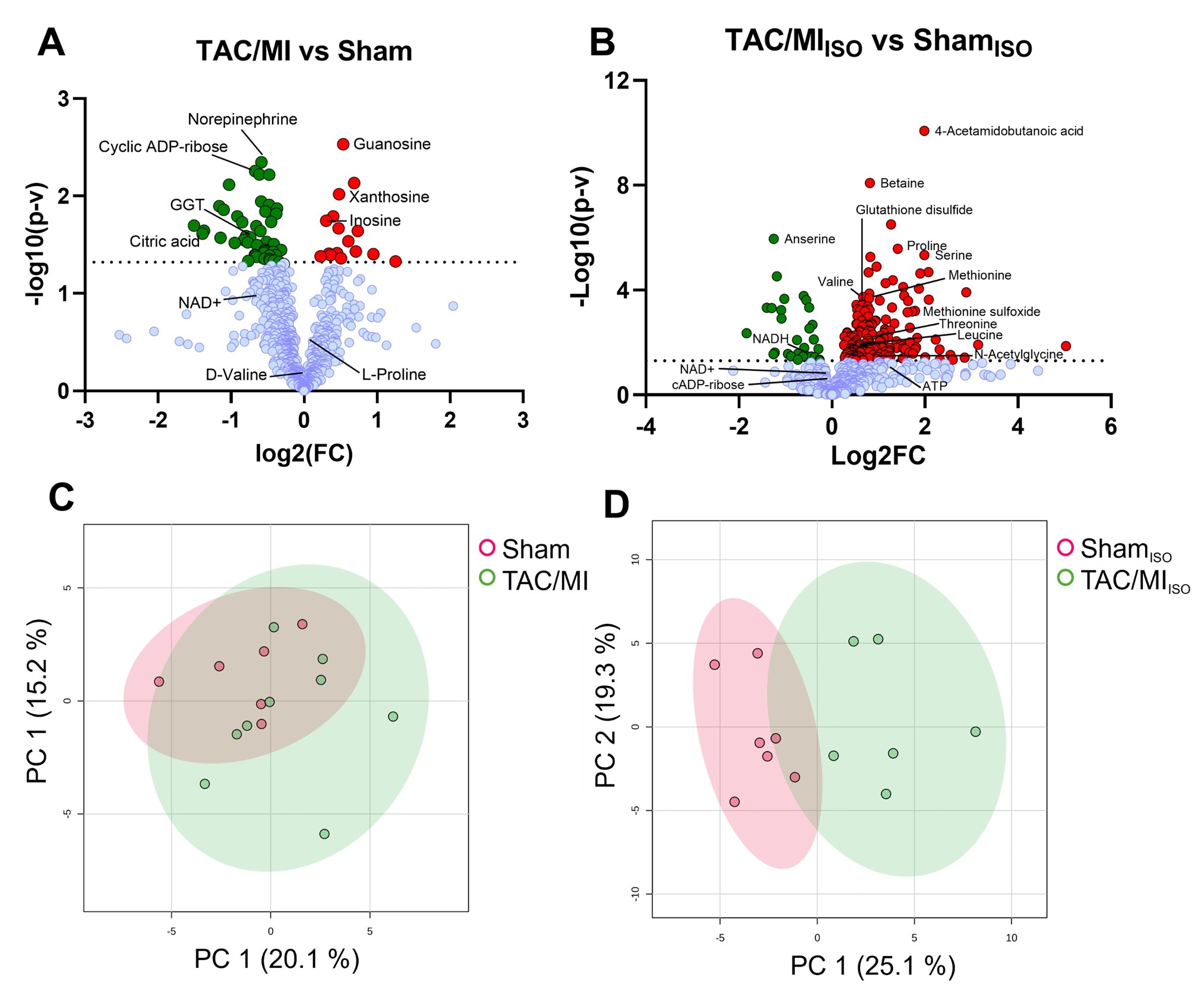
Intriguingly, the metabolome of the TAC/MI with reduced LVEF compared to the Sham showed only 7.2% of myocardial metabolite levels altered; principal component analysis (PCA) showed no overt change in the metabolome. Similarly, isotope tracing data showed no differences in metabolite enrichment and fuel utilization in the myocardia. However, TAC/MI drastically altered the response to additional stress with isoproterenol, with 34.9% of metabolites changed in myocardial metabolomics between TAC/MI and Sham. Also, PCA showed a significantly diverging metabolic profiling between the failing and normal hearts from TAC/MI and Sham mice, respectively – representing similar observations in failing human hearts.

We show for the first time that metabolome is preserved in failing mouse hearts but shifts under stress, thus warranting further investigation into the dynamics of the metabolic profile of the failing heart for insights into developing metabolic therapies for HF.
  • Adzika, Gabriel  ( University of Pennsylvania , Philadelphia , Pennsylvania , United States )
  • Arany, Zoltan  ( University of Pennylvania , Philadelphia , Pennsylvania , United States )
  • Baur, Joseph  ( University of Pennsylvania , Philadelphia , Pennsylvania , United States )
  • Davis, James  ( University of Pennsylvania , Philadelphia , Pennsylvania , United States )
  • Gaspar, Ryan  ( University of Pennsylvania , Philadelphia , Pennsylvania , United States )
  • Velazquez Aponte, Ricardo  ( University of Pennsylvania , Philadelphia , Pennsylvania , United States )
  • Mukherjee, Sarmistha  ( University of Pennsylvania , Philadelphia , Pennsylvania , United States )
  • Bye, Nicole  ( University of Pennsylvania , Philadelphia , Pennsylvania , United States )
  • Zou, Xiangyu  ( University of Pennsylvania , Philadelphia , Pennsylvania , United States )
  • Tanosaki, Sho  ( University of Pennylvania , Philadelphia , Pennsylvania , United States )
  • Lee, Won  ( Princeton University , Princeton , New Jersey , United States )
  • Author Disclosures:
    Gabriel Adzika: DO NOT have relevant financial relationships | Zoltan Arany: DO NOT have relevant financial relationships | Joseph Baur: DO have relevant financial relationships ; Research Funding (PI or named investigator):Metro Biotech:Active (exists now) ; Research Funding (PI or named investigator):Eli Lilly:Active (exists now) ; Advisor:Cytokinetics:Active (exists now) ; Other (please indicate in the box next to the company name):Elysium Health (research materials):Active (exists now) | James Davis: No Answer | Ryan Gaspar: DO NOT have relevant financial relationships | Ricardo Velazquez Aponte: DO NOT have relevant financial relationships | Sarmistha Mukherjee: No Answer | Nicole Bye: No Answer | Xiangyu Zou: DO NOT have relevant financial relationships | Sho Tanosaki: No Answer | Won Lee: No Answer
Meeting Info:

Scientific Sessions 2025

2025

New Orleans, Louisiana

Session Info:

Novel Mechanistic Pathways Underlying Cardiometabolic Risk

Saturday, 11/08/2025 , 09:15AM - 10:25AM

Moderated Digital Poster Session

More abstracts on this topic:
ATP Citrate Lyase Supports Cardiac Function and NAD+/NADH Balance And Is Depressed in Human Heart Failure

Meddeb Mariam, Paolocci Nazareno, Hahn Virginia, Sharma Kavita, Pearce Erika, Kass David, Koleini Navid, Jun Seungho, Keykhaei Mohammad, Farshidfar Farnaz, Zhao Liang, Kwon Seoyoung, Lin Brian, Keceli Gizem

ACS-Specific Gut Microbial and Metabolic Profiles Reveal Diagnostic and Recovery Markers

Xu Jing, Fu Jingyuan, Dai Die, Yang Yanan, Yang Jingang, Gao Shanshan, Wu Chongming, He Jiumin, Chen Weihua, Yang Yue-jin

More abstracts from these authors:
Nicotinamide Riboside Preserves Systolic Function in a Swine Model of Heart Failure

Adzika Gabriel, Doan Khanh, Ts'olo Thato, Xiao Teresa, Lee Won Dong, Zou Xiangyu, Frederick David, Tschabrunn Cory, Baur Joseph, Velázquez Aponte Ricardo, Gaspar Ryan, Davis James, Hillegas Lindsay, Wilson Julia, Mukherjee Sarmistha, Bye Nicole, Perry Caroline

Nicotinamide Riboside is Protective in a Mouse Model of Heart Failure with Reduced Ejection Fraction

Adzika Gabriel, Davis James, Gaspar Ryan, Velazquez Aponte Ricardo, Mukherjee Sarmistha, Bye Nicole, Zou Xiangyu, Baur Joseph

You have to be authorized to contact abstract author. Please, Login
Not Available