Myc Induces Higher Cardiomyocyte Cell Cycle Activity and Protects Cardiac Function after Myocardial Infarction in Mice
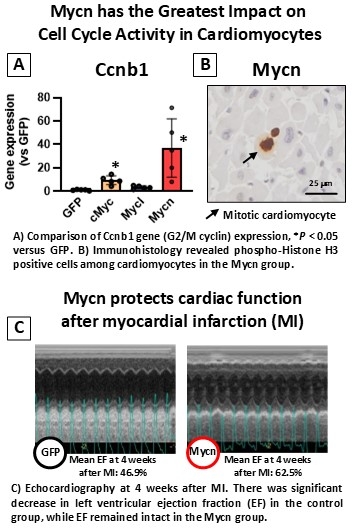
Abstract Body (Do not enter title and authors here): Background In adults, injured cardiomyocytes (CMs) rarely regenerate after myocardial infarction (MI), due to limited proliferation and cell cycle activity of CMs, impairing cardiac function. Previous studies on mature mice showed (1) endogenous cell cycle activity in 0.01% of CMs and that presence of these cells is cardioprotective after MI, and (2) expression of Myc, a proto-oncogene, in CMs activate their cell cycle activity. Hypothesis Myc expression in CMs protect cardiac function after MI in mature mice. Aims (1) Identify the Myc isoform with the greatest impact on CM cell cycle activity, and (2) investigate whether its expression in CMs exhibits cardioprotective effects. Methods (1) CM-specific adeno-associated viral vectors (AAVs) were delivered intravenously to 6-week-old mice (control group: GFP; Myc isoform groups: cMyc, Mycl, Mycn). Hearts were collected after 2 weeks for histological or gene expression analysis. Myc isoforms inducing greater cell cycle activity were selected for transduction to MI-model mice. (2) AAVs (GFP, Mycn) were injected to 6-week-old mice prior to MI procedure (left anterior descending artery ligation). Cardiac function was evaluated every 2 weeks by transthoracic echocardiography. Hearts were collected 4 weeks after MI for histological analysis. Results (1) Of the isoforms, Mycn induced the most cell cycle activity (Ccnb1 expression) in CMs (Figure A), through to mitosis (Phospho-Histone H3 positive CMs, Figure B). Histological analysis of the Mycn group showed fibroblast activation and inter-CM fiber increase, and angiogenesis in infarct regions, despite CM-specific Mycn gene delivery. (2) Left ventricular ejection fraction (EF) 4 weeks after MI decreased significantly in the GFP group (ΔEF -21.6%, P < 0.05), while no significant change was observed in the Mycn group (ΔEF -5.70%, P = 0.402) (Figure C). Conclusions In mature mice, (1) Mycn was the Myc isoform inducing the most cycle activity in CMs, and (2) CM-specific Mycn overexpression prevented cardiac function decline after MI. Although the mechanism is unclear, overexpression of Mycn in CMs enhances intercellular communication, as demonstrated by angiogenesis and activated fibroblasts, promoting tissue-level cardiac protection.
Hirofuji, Aina
(
Asahikawa Medical University
, Asahikawa , Japan )
Oyama, Kyohei
(
Asahikawa Medical University
, Asahikawa , Japan )
Ushioda, Ryohei
(
Asahikawa Medical University
, Asahikawa , Japan )
Setogawa, Yuki
(
Asahikawa Medical University
, Asahikawa , Japan )
Okubo, Ryo
(
Asahikawa Medical University
, Asahikawa , Japan )
Miyamoto, Hiroyuki
(
Asahikawa Medical University
, Asahikawa , Japan )
Takeyoshi, Daisuke
(
Asahikawa Medical University
, Asahikawa , Japan )
Kunioka, Shingo
(
Asahikawa Medical University
, Asahikawa , Japan )
Tsutsui, Masahiro
(
Asahikawa Medical University
, Asahikawa , Japan )
Tanaka, Hiroki
(
National Institutes of Biomedical Innovation, Health and Nutrition
, Ibaraki City , Japan )
Kamiya, Hiroyuki
(
Asahikawa Medical University
, Asahikawa , Japan )
Author Disclosures:
Aina Hirofuji:DO NOT have relevant financial relationships
| Hiroki Tanaka:DO NOT have relevant financial relationships
| Hiroyuki Kamiya:No Answer
| Kyohei Oyama:DO NOT have relevant financial relationships
| Ryohei Ushioda:No Answer
| Yuki Setogawa:No Answer
| Ryo Okubo:No Answer
| Hiroyuki Miyamoto:No Answer
| Daisuke Takeyoshi:No Answer
| Shingo Kunioka:DO NOT have relevant financial relationships
| MASAHIRO TSUTSUI:No Answer