Racial, Regional, Gender, and State-Level Disparities in Sudden Cardiac Death Mortality: An Analysis of Historical Trends and the rationale behind Shift in pattern in the U.S. Population Aged 44 to 85+ (1999–2020)
Abstract Body (Do not enter title and authors here): Background: Sudden Cardiac Death (SCD) may account for up to 20% of worldwide deaths. It mainly affects adults over 35, especially those with cardiac disease. Epidemiological trends, gender, and ethnic disparities in this condition are crucial because they develop exponentially with age and are much more common in men.
Methods: This study aims to investigate disparities in SCD among middle-aged and older adults in the United States (U.S.). It examines gender, race, and geographic differences over 21 years, from 1999 to 2020. The analysis is based on mortality data from the Centers for Disease Control and Prevention’s Wide-Ranging Online Data for Epidemiologic Research (CDC WONDER) database, employing a retrospective cohort design.
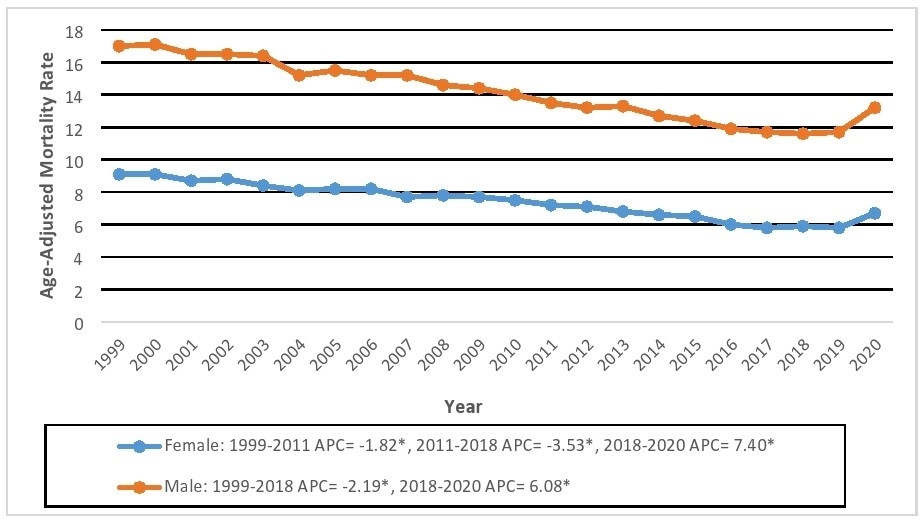
Results: From 1999 to 2020, a total of 52,491,23 adults aged 45 to 85+ years died in the U.S., with SCD as the underlying cause in 267,694 cases (156,891 men and 110,803 women), equating to 10.2 deaths per 100,000 population. Men consistently exhibited higher SCD rates than women, with both experiencing significant increases in mortality from 2018 to 2020 [male annual percent change (APC): 6.08*; female APC: 7.40*]. Black or African American individuals had the highest SCD rates, while the Asian or Pacific Islander group showed the most significant recent increase (APC: 12.53* from 2018 to 2020). Regionally, the South and West experienced significant rises in SCD rates (South APC: 5.00*; West APC: 15.36* from 2018 to 2020). Mississippi had the highest age-adjusted SCD rates, followed by Louisiana and Wyoming.
Conclusion: From 1999 to 2020, the age-adjusted mortality rate (AAMR) for SCD in middle-aged and older adults was overall declining. However, a rise in both incidence and prevalence from 2019 stresses the necessity for ongoing research to address current gaps in the healthcare system to ensure that physicians are prepared to face challenges of similar nature in future.
Kumar, Satesh
(
Howard University Hospital
, Washington , District of Columbia , United States )
Khatri, Mahima
(
Jersey city Medical Center
, Jersey City , New Jersey , United States )
Fatima, Urooj
(
Howard University Hospital
, Washington , District of Columbia , United States )
Author Disclosures:
Satesh Kumar:DO NOT have relevant financial relationshipsurooj fatima:No Answer