Resistance Training and Risk of Type 2 Diabetes and Cardiovascular Disease in Women: A Prospective Cohort Analysis from the Nurses' Health Study
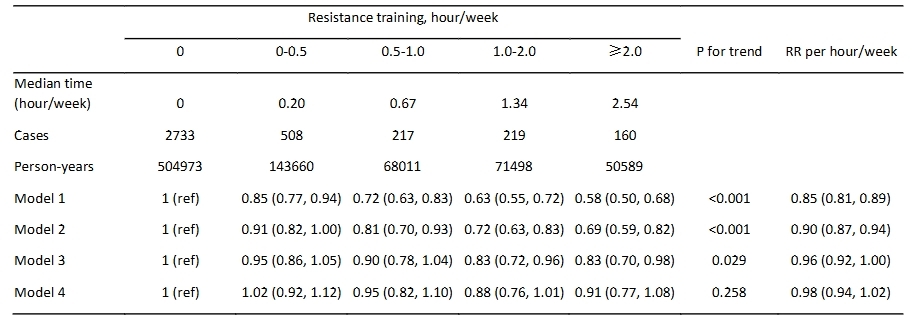
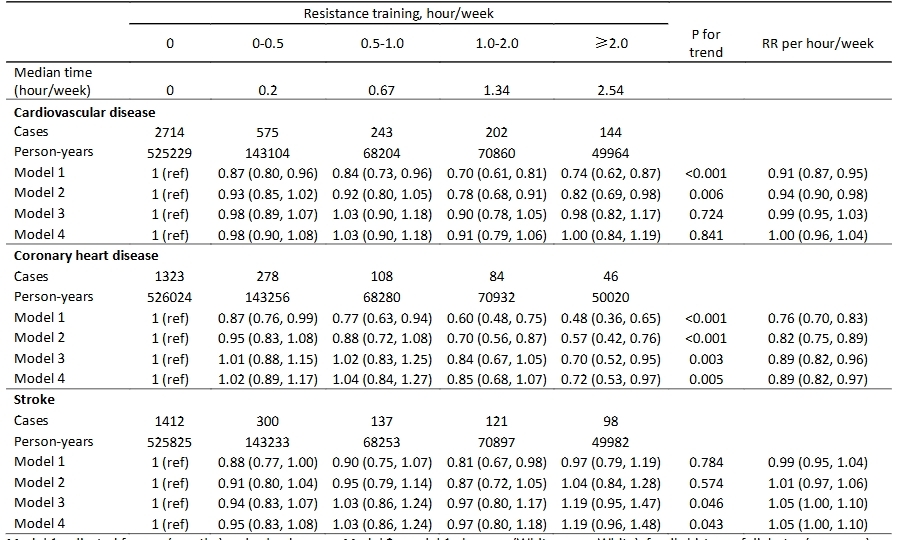
Abstract Body (Do not enter title and authors here): Background: Resistance training may help reduce the risk of chronic diseases, but evidence among women remains limited. Objective: To examine the association between resistance training and the risk of type 2 diabetes mellitus (T2DM) and cardiovascular disease (CVD) in women. Methods: We analyzed data from over 50,000 participants in the Nurses' Health Study with follow-up from 2002 to 2018. Resistance training was self-reported and categorized by weekly hours. Cox proportional hazards models were used to estimate multivariable-adjusted relative risks (RRs), controlling for age, race, smoking, alcohol intake, body mass index (BMI), and dietary factors. Results: During follow-up, 3,837 T2DM cases were documented over 838,731 person-years; 3,878 CVD cases over 857,361 person-years; including 1,819 cases of coronary heart disease (CHD) over 856,052 person-years and 1,952 stroke cases over 856,451 person-years. Compared with women reporting no resistance training, those engaging in ≥2 hours/week had a significantly lower risk of T2DM (RR = 0.69, 95% CI: 0.59–0.82; P for trend < 0.001) and CHD (RR = 0.57, 95% CI: 0.42–0.76; P for trend < 0.001). The association with total CVD was modest (RR = 0.82, 95% CI: 0.69–0.98; P for trend = 0.006), and no significant association was observed for stroke. Conclusions: Resistance training was independently associated with a lower risk of T2DM and CHD in women. These findings support incorporating resistance training into public health recommendations for chronic disease prevention.
Zhang, Tianyue
(
Harvard School of Public Health
, Boston , Massachusetts , United States )
Giovannucci, Edward
(
Harvard School of Public Health
, Boston , Massachusetts , United States )
Author Disclosures:
Tianyue Zhang:DO NOT have relevant financial relationships
| Edward Giovannucci:DO NOT have relevant financial relationships