Logo

American Heart Association

  186
  0


Final ID: HTN4

Genome-wide Maps of Human Kidney Proximal Tubules and Thick Ascending Limbs of Henle reveal an Enrichment for Human Blood Pressure Associated Polymorphisms

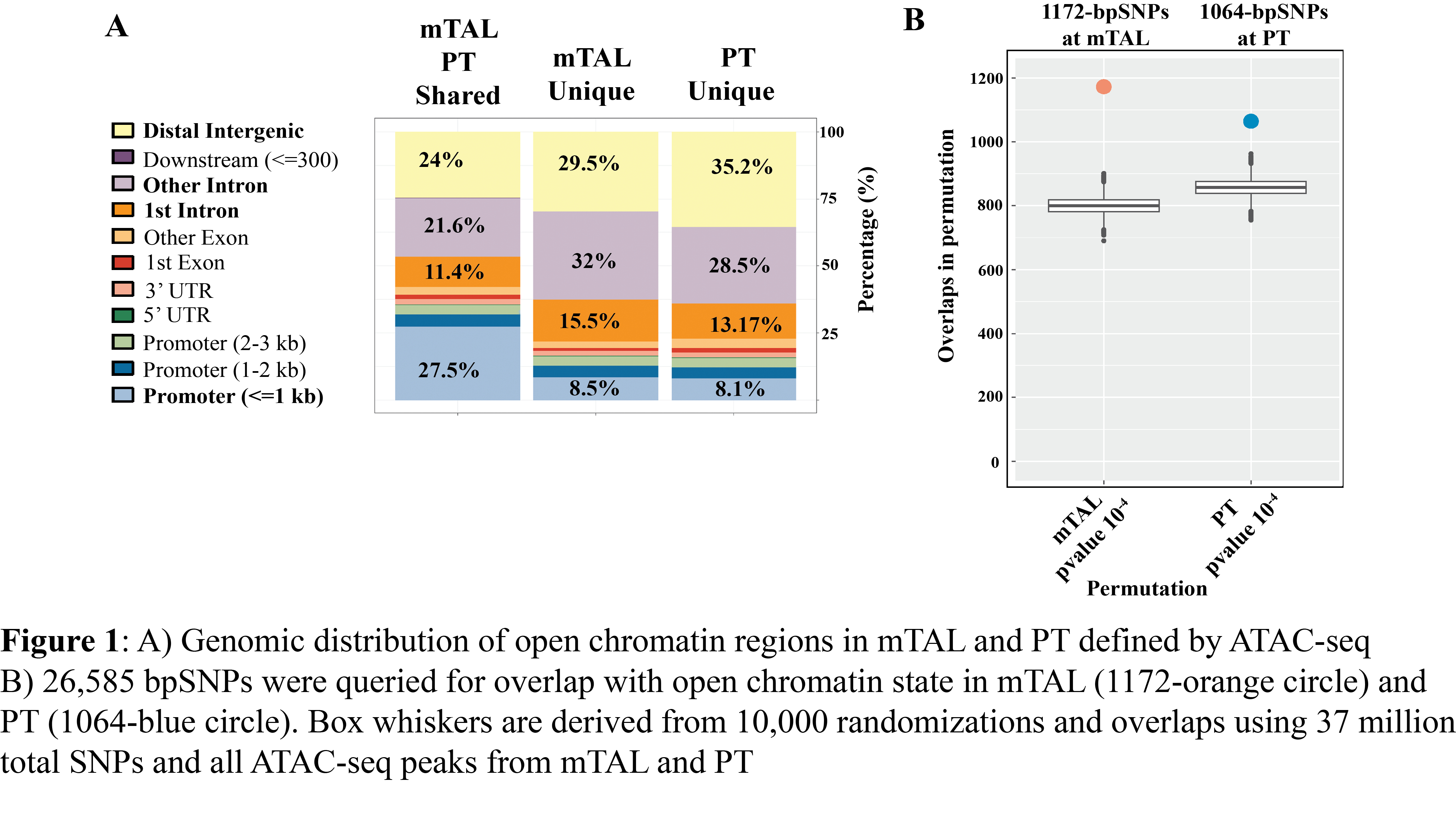
Abstract Body (Do not enter title and authors here): GWAS has identified >1,000 blood pressure (BP)-associated sentinel SNPs, most of which (>90%) are intronic and intergenic. How they regulate BP-relevant genes remains an open question. We hypothesized many SNPs would reside within cis-regulatory elements specific to nephron segments critical to sodium resorption such as proximal tubule (PT) and thick ascending limb (TAL). To address this, we developed chromatin state (ATAC-seq) and transcriptome (RNA-seq) maps from manually dissected human PT and medullary TAL (mTAL) segments. We identified 216,168 and 179,467 open regions in PT and mTAL, respectively, with the majority (70%) being unique to one tissue. Interestingly, peaks shared between the two segments resided more frequently in promoters, whereas unique peaks were more often found in distal introns or intergenic regions, suggesting they lie within enhancers (Figure 1A). Both chromatin state and transcriptomic data demonstrated a correlation between open chromatin peaks within gene promoters and mRNA levels (r=0.11; p<4.6e-16). This correlation was weaker at open regions distal to the promoter, illustrating the difficulty of mapping distal open regions to the gene(s) they regulate.
We hypothesized these open regions would be enriched for BP-relevant SNPs. We curated 26,585 bp-associated SNPs and found 1172 and 1064 in mTAL and PT, open regions respectively, many of which are near BP-relevant genes. This enrichment was significant based on 104 randomizations (pValue 10-4) (Figure 1B). We conclude that these novel tissue-specific chromatin maps can be used to identify potential mechanisms by which SNPs influence gene expression and BP. Additional studies will be needed to demonstrate both causality and molecular mechanisms.
  • Ray, Atrayee  ( Versiti Blood Research Institute , Milwaukee , Wisconsin , United States )
  • Geurts, Aron  ( Medical College of Wisconsin , Milwaukee , Wisconsin , United States )
  • Cowley, Allen  ( Medical College of Wisconsin , Milwaukee , Wisconsin , United States )
  • Liang, Mingyu  ( University of Arizona , Tuscon , Arizona , United States )
  • Greene, Andrew  ( The Jackson Laboratory , Bar Harbor , Maine , United States )
  • Rao, Sridhar  ( Versiti Blood Research Institute , Milwaukee , Wisconsin , United States )
  • Yang, Chun  ( Medical College of Wisconsin , Milwaukee , Wisconsin , United States )
  • Stelloh, Cary  ( Versiti Blood Research Institute , Milwaukee , Wisconsin , United States )
  • Tutaj, Monika  ( Medical College of Wisconsin , Milwaukee , Wisconsin , United States )
  • Liu, Pengyuan  ( University of Arizona , Tuscon , Arizona , United States )
  • Liu, Yong  ( University of Arizona , Tuscon , Arizona , United States )
  • Lin, Chien-wei  ( Medical College of Wisconsin , Milwaukee , Wisconsin , United States )
  • Widlansky, Michael  ( Medical College of Wisconsin , Milwaukee , Wisconsin , United States )
  • Kwitek, Anne  ( Medical College of Wisconsin , Milwaukee , Wisconsin , United States )
  • Author Disclosures:
    Atrayee Ray: DO NOT have relevant financial relationships | Aron Geurts: No Answer | Allen Cowley: No Answer | Mingyu Liang: No Answer | Andrew Greene: No Answer | Sridhar Rao: DO NOT have relevant financial relationships | Chun Yang: No Answer | Cary Stelloh: No Answer | Monika Tutaj: No Answer | Pengyuan Liu: DO NOT have relevant financial relationships | Yong Liu: DO NOT have relevant financial relationships | Chien-Wei Lin: DO NOT have relevant financial relationships | Michael Widlansky: DO have relevant financial relationships ; Research Funding (PI or named investigator):NHLBI:Past (completed) ; Ownership Interest:Sanacor:Active (exists now) ; Research Funding (PI or named investigator):American Heart Association:Past (completed) | Anne Kwitek: DO NOT have relevant financial relationships
Meeting Info:

Scientific Sessions 2024

2024

Chicago, Illinois

Session Info:

Best of AHA Specialty Conferences: Hypertension 2024

Sunday, 11/17/2024 , 03:15PM - 04:15PM

Best of Specialty Conferences

More abstracts on this topic:
A major uremic toxin indoxyl sulfate impairs macrophage efferocytosis and accelerates atherogenesis: a potential mechanism for cardiovascular risk in chronic kidney disease

Jha Prabhash, Kasai Taku, Vromman Amelie, Holden Rachel, Libby Peter, Tabas Ira, Singh Sasha, Aikawa Elena, Aikawa Masanori, Lupieri Adrien, Sonawane Abhijeet, Le Thanh-dat, Becker-greene Dakota, Chelvanambi Sarvesh, Turner Mandy, Nakamura Yuto, Passos Livia

Brd4-mediated 3D chromatin architecture determines old donor heart preservation quality

Gao Wenbin, Sicim Huseyin, Tang Paul, Lei Ienglam

More abstracts from these authors:
Cross-Species Epigenomic Maps of Intergenic Loci for Hypertension and Blood Pressure

Tutaj Monika, Geurts Aron, Cowley Allen, Liang Mingyu, Rao Sridhar, Kwitek Anne, Lin Chien-wei, Ray Atrayee, Yang Chun, Stelloh Cary, Liu Pengyuan, Liu Yong, Widlansky Michael, Greene Andrew

Genome-wide Maps of Human Kidney Proximal Tubules and Thick Ascending Limbs of Henle reveal an Enrichment for Human Blood Pressure associated Polymorphisms

Ray Atrayee, Geurts Aron, Cowley Allen, Liang Mingyu, Greene Andrew, Rao Sridhar, Yang Chun, Stelloh Cary, Tutaj Monika, Liu Pengyuan, Liu Yong, Lin Chien-wei, Widlansky Michael, Kwitek Anne

You have to be authorized to contact abstract author. Please, Login
Not Available