
Direct Comparison of Mechanical Circulatory Support Devices in a Porcine Model of Myocardial Infarction Complicated by Acute Mitral Regurgitation and Cardiogenic Shock
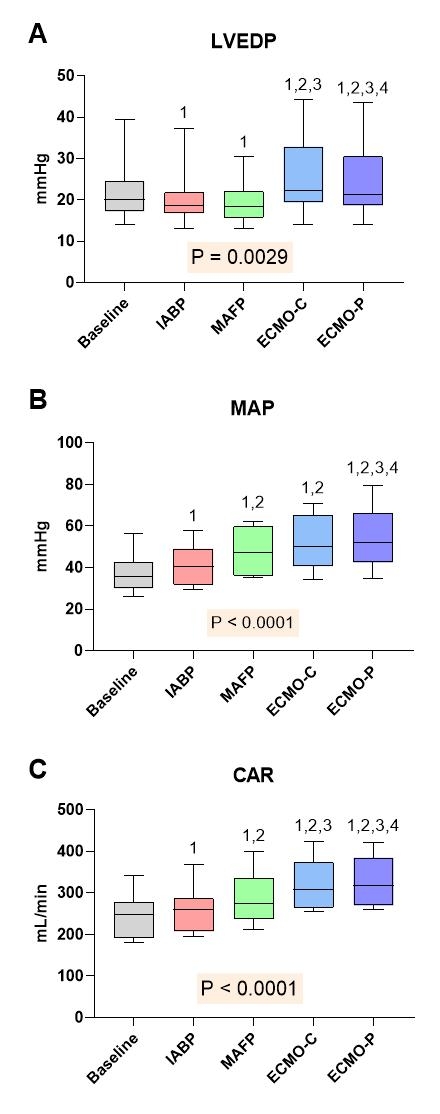
Abstract Body (Do not enter title and authors here): Introduction: Despite urgent clinical needs, an optimal strategy for mechanical circulatory support (MCS) in acute myocardial infarction (AMI) complicated by acute mitral regurgitation (MR) and cardiogenic shock (CS) has not been determined. Hypothesis: The hemodynamic effects of MCS devices vary significantly. Purpose: The aim of our study was to compare the hemodynamic effects of the intra-aortic balloon pump (IABP), microaxial flow pump (MAFP), and extracorporeal membrane oxygenation with continuous (ECMO-C) and synchronized pulsatile (ECMO-P) flow in an animal model of AMI complicated by MR and CS. Methods: Under general anesthesia and mechanical ventilation in pigs, AMI was induced by ligation of the left anterior descending artery. Severe MR was developed by the mechanical destruction of the mitral valve. The hemodynamic effects of the IABP, MAFP (2 L/min), ECMO-C (2 L/min), and ECMO-P (2 L/min) were evaluated by measuring left ventricular end-diastolic pressure (LVEDP), mean arterial pressure (MAP), and carotid flow (CAR) as a surrogate of total circulatory output. Data are presented as median (interquartile range); a P value <0.05 was considered statistically significant. Results: Ten animals were used, and all completed the study procedures. At baseline (no mechanical support) LVEDP was 20.1 (17.2-24.6) mmHg, MAP was 35.5 (30.0-56.3) mmHg, and CAR was 248.6 (191.8-341.3) mL/min. LVEDP was significantly and comparably decreased by the IABP and MAFP. On the other hand, LVEDP was increased by both ECMO modes but significantly less by ECMO-P (Figure 1A). MAP was significantly increased by all devices. MAFP and ECMO-C increased MAP comparably and significantly more than IABP. ECMO-P increased MAP significantly more than all other devices (Figure 1B). Similarly, CAR was increased by all devices. The effect of individual devices on CAR increased significantly in the ascending order of IABP, MAFP, ECMO-C, and ECMO-P (Figure 1C). Conclusions: All tested devices improved the key hemodynamic parameters of MAP and CAR, although each to a different extent. The individual devices influenced LVEDP differently. The results of this study may help in selecting the optimal therapeutic strategy in AMI complicated by MR and CS.
Ostadal, Petr
(
Motol University Hospital
, Prague , Czechia )