Logo

American Heart Association

  112
  0


Final ID: 4147678

Distinct Echocardiographic Signatures Predict Mortality in Scleroderma Pulmonary Vascular Disease

Abstract Body (Do not enter title and authors here): Background: Right ventricular (RV) contractile reserve is a main determinant of outcome in pulmonary arterial hypertension (PAH). PAH and RV maladaptation are common and portend a poor prognosis in the autoimmune disease systemic sclerosis (SSc). Clinical phenotyping of this subgroup of patients, however, remains imprecise. In the present study, we sought to identify whether unique speckle-tracking echocardiography (STE) derived phenotypic signatures predict outcomes in SSc.

Methods: In a case-complete study design, 86 SSc patients with technically adequate echocardiograms referred for evaluation of possible PAH, right heart catheterization (RHC), serum laboratories, and pulmonary function testing (PFTs) were included for analysis. RV contractility was assessed using conventional and STE-derived RV free wall strain (RVFWS). Cluster analysis was used to identify sub-groups, which were sub-stratified to adjust for differences in RV afterload as indexed by pulmonary vascular resistance (PVR). A Mann-Whitney test was used for groups comparisons, and Kaplan-Meier survival analysis and Cox regression were used to test association with mortality.

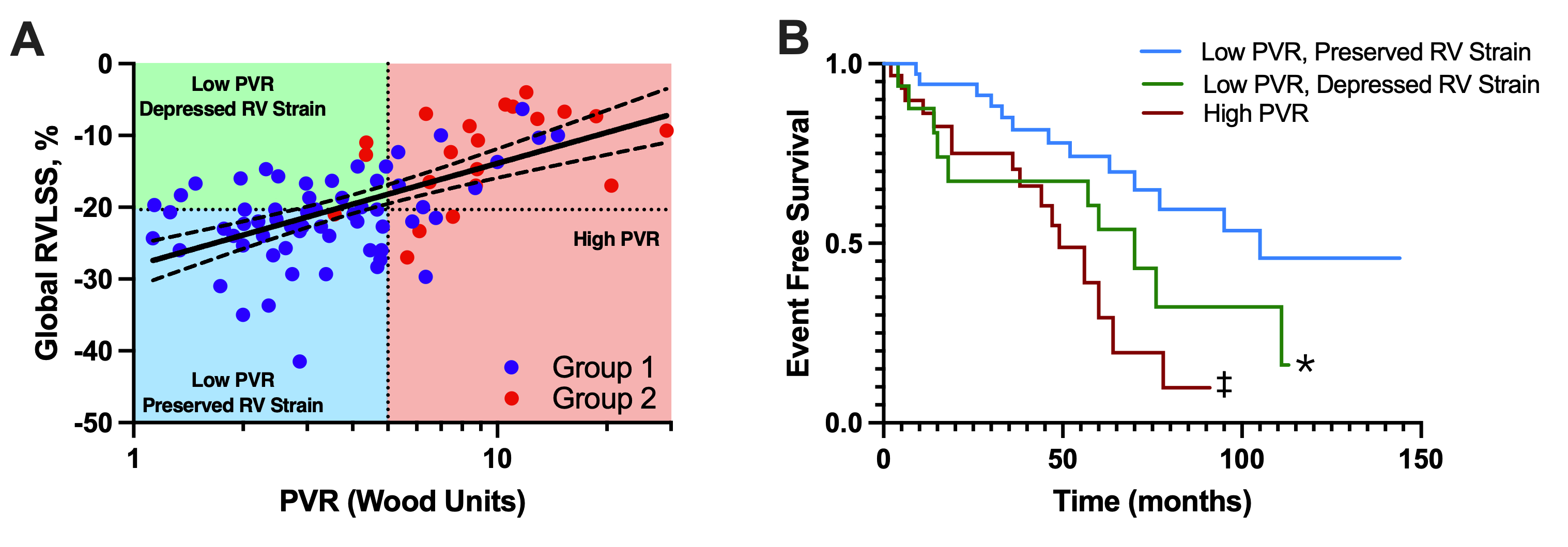
Results: Cluster analysis identified two distinct echocardiographic phenotypes in SSc, one with elevated pulmonary pressures (mean PA pressure 44±12 vs. 27±10, p<0.001), markedly elevated PVR (10±6 vs. 4±3 Wood units, p<0.001), and globally reduced RVFWS (-21±6 vs. -13±6 %, p<0.001) compared to the other. This group was associated with increased all-cause mortality (p=0.006). These differences may be driven by the increased PVR in one sub-group vs. another. To test whether RV dysfunction independent of PVR portends poor prognosis, we sub-stratified the cohort into one of three groups (Figure), one with relatively lower PVR (<5 WU) and preserved RVFWS, one with lower PVR but reduced RFWS, and one with markedly elevated PVR (>5 WU). This analysis found that patients with low PVR and reduced RVFWS had equally reduced survival (p=0.49) compared with those patients with elevated PVR.

Conclusion: Echocardiographic phenotyping utilizing STE-derived RVFWS as a marker of contractile reserve revealed clinically relevant subgroups of RV dysfunction with diminished survival even after adjustment for RV afterload. These findings highlight the utility of STE in identifying SSc patients at greatest risk for poor clinical outcomes.
  • Jani, Vivek  ( Johns Hopkins University , Baltimore , Maryland , United States )
  • Hassoun, Paul  ( Johns Hopkins University , Baltimore , Maryland , United States )
  • Mathai, Stephen  ( Johns Hopkins University , Baltimore , Maryland , United States )
  • Mukherjee, Monica  ( Johns Hopkins University , Baltimore , Maryland , United States )
  • Naranjo, Mario  ( Johns Hopkins University , Baltimore , Maryland , United States )
  • Knight, Ethan  ( Johns Hopkins University , Baltimore , Maryland , United States )
  • Mirson, Leonid  ( Johns Hopkins University , Baltimore , Maryland , United States )
  • Simpson, Catherine  ( Johns Hopkins University , Baltimore , Maryland , United States )
  • Hummers, Laura  ( Johns Hopkins University , Baltimore , Maryland , United States )
  • Wigley, Fredrick  ( Johns Hopkins University , Baltimore , Maryland , United States )
  • Shah, Ami  ( Johns Hopkins University , Baltimore , Maryland , United States )
  • Hsu, Steven  ( Johns Hopkins University , Baltimore , Maryland , United States )
  • Author Disclosures:
    Vivek Jani: DO NOT have relevant financial relationships | Paul Hassoun: No Answer | Stephen Mathai: DO have relevant financial relationships ; Consultant:Janssen:Past (completed) ; Consultant:Acceleron:Past (completed) ; Consultant:Merck:Active (exists now) ; Consultant:United Therapeutics:Past (completed) | Monica Mukherjee: No Answer | Mario Naranjo: No Answer | Ethan Knight: DO NOT have relevant financial relationships | Leonid Mirson: No Answer | Catherine Simpson: DO NOT have relevant financial relationships | Laura Hummers: DO NOT have relevant financial relationships | Fredrick Wigley: No Answer | Ami Shah: No Answer | Steven Hsu: No Answer
Meeting Info:

Scientific Sessions 2024

2024

Chicago, Illinois

Session Info:

Samuel A. Levine Early Career Clinical Investigator Award Competition

Saturday, 11/16/2024 , 01:30PM - 02:45PM

Abstract Oral Session

More abstracts on this topic:
2 Dimensional Echocardiography versus 3 Dimentional Echocardiography to Assess Right Ventricular Function in Pulmonary Hypertension: A Systematic Review

Chaudhry Waleed Razzaq, Hajj Fatima, Bathula Satyamedha, Meghji Mohammed Askari, Pasupuleti Hemalatha, Kiyani Madiha, Shah Syeda Simrah, Neelakantan Ramaswamy Sanathanan, Mirzaeidizaji Nakisa, St. Jacques Jahnoy, Khan Khalil Ullah, Veluchamy Elakkiya, Jesse Joshanna

A Novel Deep Learning Approach for Prediction of Right Heart Failure After Left Ventricular Assist Device Implantation using Pulmonary Artery Pressure Tracings

Lamicq Melissa, Buchanan Cole, Lateef Azalfa, Atteya Miriam, Houston Brian, Tedford Ryan, Wehbe Ramsey

More abstracts from these authors:
Refining Risk Prediction in Systemic Sclerosis Pulmonary Arterial Hypertension

Osgueritchian Ryan, Shah Ami, Mathai Stephen, Mukherjee Monica, Mombeini Hoda, Jani Vivek, Gami Abhishek, Hsu Steven, Hummers Laura, Wigley Fredrick, Lammi Matthew, Hassoun Paul

Refining Atherosclerotic Risk Prediction in Patients with Systemic Sclerosis: Association with Uric Acid and the Creation of a Novel Scleroderma-Atherosclerotic Cardiovascular Disease Risk (ScleroRisk) Assessment Model

Kankaria Rohan, Osgueritchian Ryan, Goldin Garrett, Hsu Steven, Hassoun Paul, Mathai Stephen, Wigley Fredrick, Shah Ami, Mukherjee Monica

You have to be authorized to contact abstract author. Please, Login
Not Available