
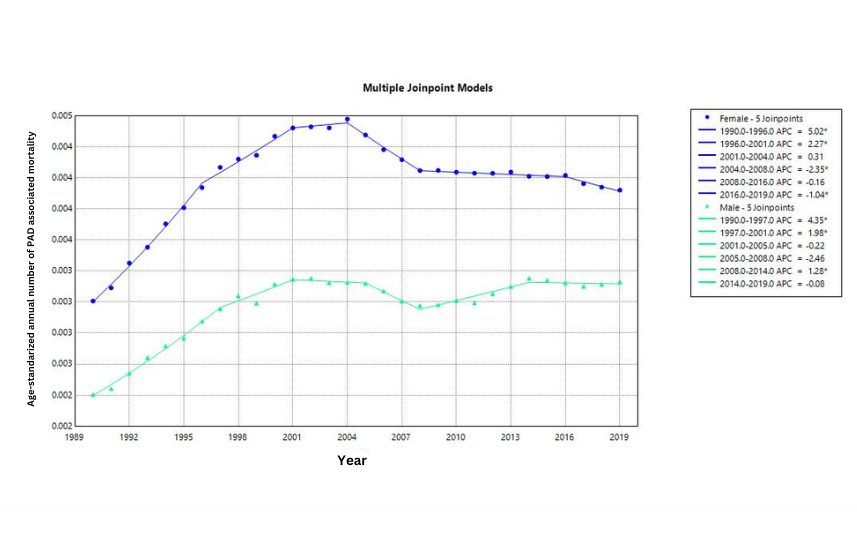
Abstract Body (Do not enter title and authors here): Introduction Peripheral arterial disease (PAD) carries a high prevalence of around 200 million individuals worldwide, and is known to significantly contribute to mortality, morbidity and healthcare expenditures in the elderly. Co-morbidities such as hyperlipidemia, diabetes, hypertension, and smoking are all risk factors associated with development of PAD. The rising prevalence of such co-morbidities has affected the mortality trends of PAD despite the significant advances in both medical and interventional therapeutic options over the past 30 years. Research Question Has there been any changes in PAD associated mortality trends in the last 30 years? Methods Mortality trends of PAD across the USA were evaluated through calculating Annual percentage change (APC) and average APC (AAPC) of mortality via JoinPoint Analysis software. The data was obtained from the Global Burden of Diseases 2019 database. Results From 1990 to 2019, there have been 268,129 PAD associated deaths in the US. Mortality trends over different age groups revealed an overall statistically significant decrement in those older than 75 (AAPC –0.3953, 95% CI –0.4590 to –0.3336; p<0.001). While a statistically significant increment was observed in those between the age of 15-49 (AAPC 1.1774; 95% CI 1.0923 to 1.2710; p <0.001) and those who were 55-75 years old (AAPC 0.2986; 95% CI 0.1968 to 0.4379; p=0.002). Furthermore, stratification by gender yielded a statistically significant increment in males with an AAPC of 1.2657 (95% CI 1.1641 to 1.3511, P<0.001) while a non-significant increment was noted in females (AAPC 0.9563; 95% CI 0.9078 to 1.0010; P<0.001). The highest decrement in mortality for females was observed between 2004 to 2008, during which an AAPC of -2.3519 (95% CI -2.9828 to -1.8419; p=0.02) was observed. On the other hand, male gender noted its highest decrement in mortality between 2002-2009 (AAPC-1.3020; 95% CI -2.2156 to -0.7734; p=0.03) (Figure 1). Conclusion Our findings identify variable trends in PAD mortality among age groups. Additionally, male gender appeared to influence mortality trends. Our findings suggest a need for further investigations to define age and gender based therapeutic regimens for PAD.
Abdulelah, Hussein
( University of Jordan
, Amman
, Jordan
)
Abdulelah, Zaid
( Royal Papworth Hospital, Cambridge
, Cambridge
, United Kingdom
)
Abdulelah, Mohammad
( University of Massachusetts Chan Medical School - Baystate Campus
, Springfield
, Massachusetts
, United States
)
Abdulelah, Ahmed
( Abdali Hospital
, Amman
, Jordan
)
Alayyat, Ahmad
( Hamilton Medical Center
, Dalton
, Georgia
, United States
)
Damlakhy, Ahmad
( Detroit medical center/Wayne state university, Michigan, USA
, Detroit
, Michigan
, United States
)
Rahman, Mansoor
( Hamilton Medical Center
, Dalton
, Georgia
, United States
)
Al-dqour, Mohammad
( East Tennesse State University
, Johnson City
, Tennessee
, United States
)
Al Balbissi, Kais
( University of Jordan
, Amman
, Jordan
)
Author Disclosures:
Hussein abdulelah:DO NOT have relevant financial relationships
| Zaid Abdulelah:DO NOT have relevant financial relationships
| Mohammad Abdulelah:DO NOT have relevant financial relationships
| Ahmed Abdulelah:DO NOT have relevant financial relationships
| Ahmad Alayyat:DO NOT have relevant financial relationships
| Ahmad damlakhy:DO NOT have relevant financial relationships
| Mansoor Rahman:DO NOT have relevant financial relationships
| Mohammad Al-Dqour:No Answer
| Kais Al Balbissi:No Answer